
A social media investigation is the structured collection, verification and documentation of information from social platforms to answer a specific question: who is behind an account, what someone did and when, and whether a post can be relied on as evidence. Done properly, it is not scrolling through a profile. It is a process that ends with material you can hand to a lawyer, an HR panel or a court. Done badly, it produces screenshots that fall apart the moment someone challenges them.
This guide explains what investigators actually do, which cases use the method, where the legal limits sit, and how evidence is preserved. It also covers a related service we provide: corporate bug sweeps for government and private clients.
TL;DR
- A social media investigation collects public online information, verifies it and records it so it can be explained and defended later.
- It is used in infidelity, family law, personal injury, employment, fraud and child-safety matters.
- A lawful investigator works with public information and proper process. Hacking accounts, reading private messages or using false pretenses is off the table.
- Evidence is only as good as its provenance: source, date, location and an unbroken record of how it was captured.
- We also provide corporate bug sweeps for government and private clients, which protect the offline side of confidential information.
Table of Contents
- What a social media investigation is
- What investigators actually look at
- Verification: where most DIY efforts fail
- Cases where it matters
- What is lawful, and what is not
- Preserving evidence so it holds up
- Our view
- Bug sweeps: protecting information offline
- Working with us
- FAQ
- Sources
What a social media investigation is
A U.S. Bureau of Justice Assistance guide describes the law-enforcement version as a process in which personnel gather publicly available social-media information for analysis to develop criminal intelligence, support an investigation, or identify public-safety risks. Private investigators use the same core logic for civil, family, corporate and insurance work.
The same guide lists what the method can help identify: suspects, relevant evidence, possible witnesses, a person’s historical and recent online activity, additional incidents in a pattern, and possible associates. Translate that to private matters and the questions become familiar:
- Is this person who they say they are?
- Does this activity contradict what was said in a claim, a statement or a court filing?
- Who is the second account, and is it the same person as the first?
- Where was this photo taken, and when?
- Is this threatening or defamatory content traceable to a real individual?
What investigators actually look at
Public profiles hold more structure than most people realize. An academic text on the subject, Introduction to Social Media Investigation, breaks the useful data into demographic details; friends, family and associates; activities, preferences and favorites; places and how often they are visited; time-stamped posts; and the content of the posts themselves.
Each category answers a different question. Time stamps establish sequence. Locations and visit frequency show patterns. Associates show who else may hold relevant information. None of them proves anything alone, which is why the next step matters more than the search itself.
Pivot points across platforms
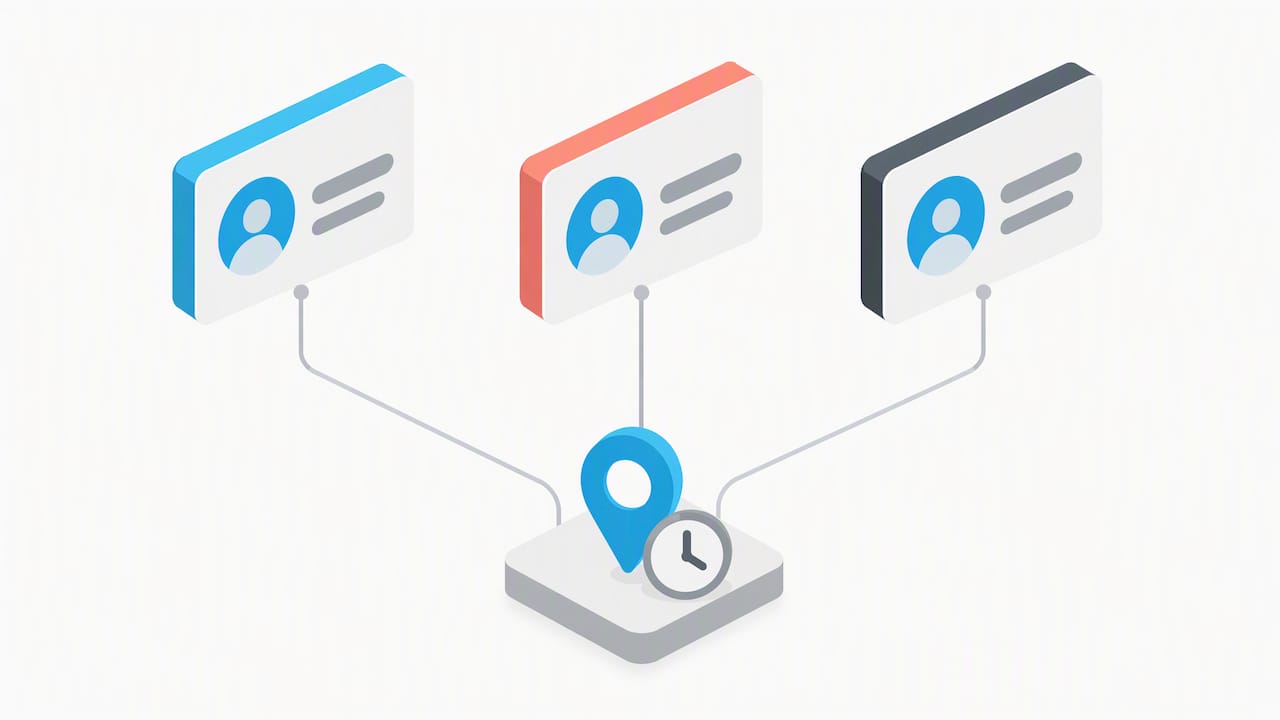
People reuse details. Investigators use usernames, email addresses, phone numbers, profile pictures and bio text as pivot points to find and corroborate accounts across platforms. A handle that appears on a forum, a dating app and a photo-sharing site, with the same profile picture, is a stronger lead than any one of them. A shared handle is still only a lead until it is corroborated by something independent.
Non-attributable research
Investigators should not leave traces that alert the subject or expose the client. Professional UK guidance on online research says non-attributable work must use equipment that cannot be attributed to the investigating organization or identifiable individuals. In practice that means dedicated devices and accounts, kept separate from anything personal.
Verification: where most DIY efforts fail
Anyone can screenshot a post. The hard part is showing it is real, current and attributable. Official U.S. guidance says social-media information should be evaluated for source reliability and content validity, and that an investigator should be able to explain what information was used, why, how, and for what period it stayed relevant.
Practitioners use several checks:
- Find the original source. Content is often re-uploaded or scraped by aggregators, so identifying where it first appeared is critical.
- Confirm provenance. Because online content is easy to fabricate, including tweets, the same guide stresses checking who uploaded it, its date and its location.
- Geolocate and date it. Open-source verification can involve geolocation by matching visible clues to satellite imagery, chronolocation to work out when media was taken where feasible, and triangulation against other sources.
- Corroborate offline. A post that says someone was at a venue is far stronger when physical surveillance or a second record agrees.
That last point is where a traditional investigation firm adds value. Online findings tell you where to look. Field work confirms what is true. Our surveillance services are built to do exactly that: turn an online lead into photos and video that stand on their own.
Academic work on social media intelligence by Carl Miller, David Omand and Jamie Bartlett argues that disciplined collection, evidence, verification, understanding and application must go together, along with management of the ethical risks. We agree with the order: you cannot understand what you have not verified.
Cases where it matters
Social media evidence may be particularly relevant to product-liability and personal-injury cases, divorce and custody disputes, employment investigations, libel and criminal cases, and potentially any matter where it bears on the facts.
Family and relationship matters
An Australian judicial guide from the Judicial Commission of New South Wales notes that social media information may be relevant in family-law proceedings, including questions about infidelity, misconduct and children’s best interests. Courts differ by country and state, so treat that as an example of how seriously courts take the material, not a universal rule.
In a suspected affair, online activity rarely settles the matter by itself. It shapes where physical evidence is gathered. If you are weighing what you are seeing, our guide to signs of infidelity separates real indicators from false alarms.
Injury and insurance claims
The same NSW guidance says social media can help test personal-injury claims by showing activities inconsistent with alleged incapacity, loss of enjoyment or emotional distress. That is why online checks often sit at the start of an insurance fraud investigation or a workers’ compensation review. For Victorian claims, see our WorkCover investigations.
Employers and misconduct
Posts that reveal moonlighting, leaked information or harassment can start an inquiry, but the inquiry must be fair. Our guide to workplace misconduct investigations covers terms of reference, and our overview of corporate investigations shows where an online review fits alongside interviews and records.
Fraud, assets and scams
Lifestyle posts can contradict declared finances, and scam operators leave trails of reused handles and images. An online profile of a person is often the first step in an asset search, because it points to businesses, associates and property worth checking in official records.
Missing persons and child safety
When a child or adult has gone missing, a person’s last online activity, contacts and locations can narrow the search quickly. If a child is in immediate danger, contact police first. Specialized channels exist for law enforcement to obtain information from internet providers rapidly in cases of imminent danger, according to guidance from Argentina’s Supreme Court, and private firms cannot use those channels. Argentine guidance also stresses that formal requests rely on an account’s unique ID rather than its visible display name, so capture IDs and profile links early. Our child recovery service works alongside that process, not in place of it.
What is lawful, and what is not
This is the question that separates a professional from a risk. In short: public information, collected with a defined purpose and documented process, is the lawful core. Breaking into accounts, reading private messages, buying stolen credentials or deceiving a platform or person to obtain records is not, and it can contaminate the whole matter.
Several official and professional sources set the standard investigators should hold themselves to:
- The U.S. ROSA guide recommends limiting collection to information reasonably related to the search purpose and distinguishing investigative relevance from constitutionally protected expression.
- UK guidance says public information can still carry an expectation of privacy, and that covert monitoring can interfere with private life. Police work must be necessary, proportionate and lawful.
- The UN’s Berkeley Protocol says open-source investigators should adapt their methods to their legal environment while evaluating source credibility and protecting human rights.
Employers face tighter rules
Checking an employee’s profiles is not automatically allowed. Spain’s data protection authority says employers may not investigate worker profiles unless the information is strictly necessary and pertinent for professional purposes, and the worker has a right to be informed. South Africa’s courts, in a POPIA case, have accepted that processing health-related information may be permitted when necessary to establish, exercise or defend a legal right. These are examples from specific countries. Before an employer commissions a review, it should confirm the rules where the employee works.
Can you hire a private investigator for social media?
Yes, for lawful work. The better question is what you should expect them to refuse. A credible investigator will decline to hack accounts or retrieve private messages, will ask what you are trying to prove, and will tell you when the right route is a lawyer’s subpoena or a police report rather than a private inquiry. Even prosecutors in England and Wales are expected to consider open-source checks before more intrusive methods where appropriate. The same sequencing makes sense for private clients.
Preserving evidence so it holds up
A screenshot is weak evidence. A preserved capture with metadata, a record of who took it and when, and a documented handling trail is much stronger.
International guidance on electronic evidence says it should be stored to preserve readability, accessibility, integrity, authenticity and reliability, with standardized metadata where possible, and that court submission should follow a clear chain of custody. Our own explainer on chain of custody shows how that works for any evidence we collect.
Authentication in court
The standard differs by jurisdiction, but the logic is consistent. In Maryland, the state’s top court held that social networking evidence is authenticated when there is proof from which a reasonable juror could find it is what its proponent claims. A legal paper on digital evidence adds that proof often comes through IP addresses, testimony or distinctive content features, and that when a post is challenged the proponent must show it accurately represents the profile or post at the relevant time.
A practical checklist for preserving a post:
- Capture the full page with the URL, account ID and date visible.
- Record who captured it, on what device, at what time.
- Save the original file and a working copy separately.
- Note how the account was linked to the person in question, and what independent evidence supports the link.
- Do it before the post is deleted. Do not message the subject first.
Your lawyer decides what is admissible where you are. Our job is to give them material that is easy to defend.
Our view
We have been running investigations since 2006, and our team includes former police, ex-military and polygraph specialists. The pattern we see is consistent: clients arrive with a folder of screenshots and a conviction. The screenshots show something real, but not what the client thinks it proves, or not in a form anyone can use.
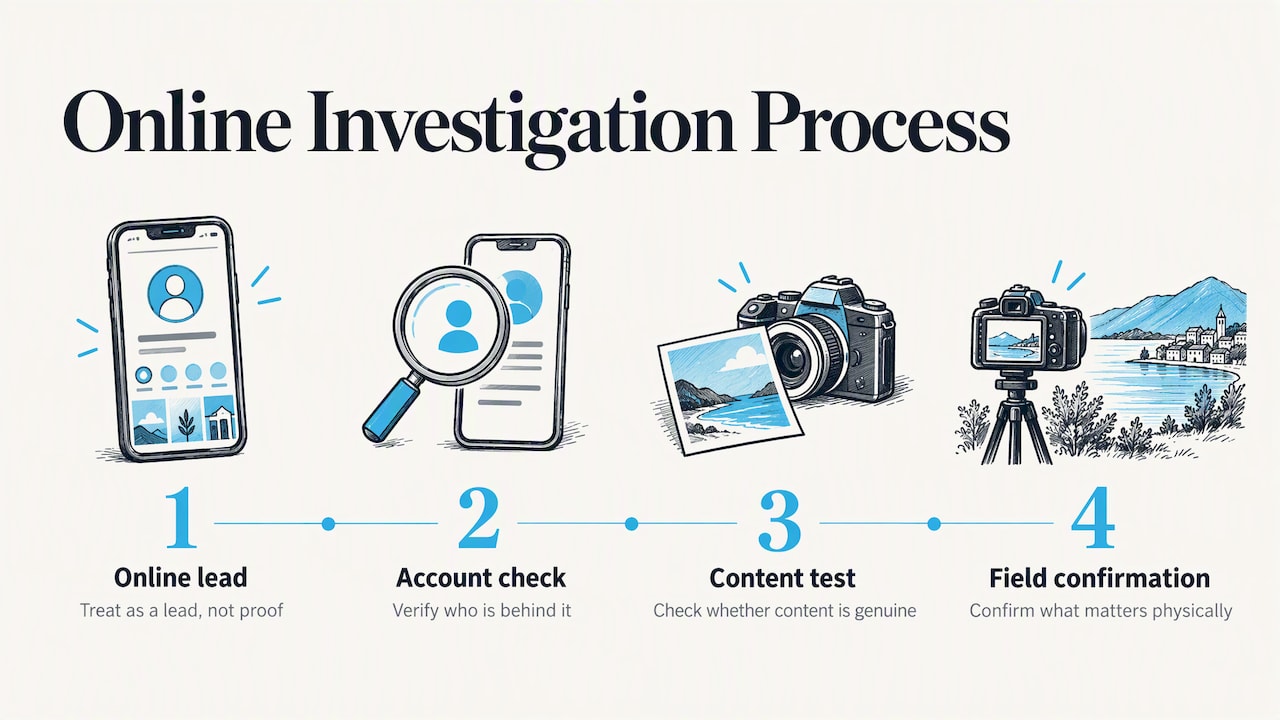
Our approach is to treat the online material as a lead, not a conclusion. We verify who is behind an account, test whether the content is genuine, and then confirm what matters in the physical world, with court-ready photos and video where the matter calls for it. We would rather tell you that a post proves nothing than let you build a case on it.
We also keep the process boring on purpose: a defined question, a documented method, a record of every capture. That is what lets a lawyer, a tribunal or an insurer rely on the result.
— Global
Bug sweeps: protecting information offline
Social media investigation looks at what has been published. Corporate bug sweeps address the opposite risk: information leaking from places that should be private. We provide corporate bug sweeps for government and private clients, checking meeting rooms, offices and other sensitive spaces for hidden listening devices.
The two services often connect. A company that finds confidential details surfacing online, or in a competitor’s hands, may have a leak that starts in a boardroom rather than on a platform. An online review can show where information appears. A sweep can help rule out, or find, a physical source. If you are dealing with suspected leaks, start with our corporate investigations page and tell us about the setting you want checked. Pricing for sweeps is not published, so we scope it with you.
Working with us
We tailor each engagement to the client’s situation, whether that is a verified online profile for a family law matter, a social media review within a corporate inquiry, or physical surveillance to confirm what the posts suggest. Surveillance is published at $1,000 to $1,450 one-off, and our cost guide explains what drives the figure. Other services are priced after we understand the matter.
To see how an engagement runs, read how a private investigator works on a job, then contact us through our full list of investigation services to discuss your situation in confidence.
FAQ
Can a private investigator look at someone’s private social media?
No, not lawfully. A licensed investigator works with publicly visible information and proper legal process. Requests to bypass privacy settings, guess passwords or read private messages should be refused, because they expose both the investigator and the client to legal risk and can ruin the evidence.
Can social media posts be used as evidence in court?
Often, yes, if they can be authenticated. Courts generally want proof that the post is what you say it is, such as the account owner, the date and the content at that time. Rules vary by country and state, so ask your lawyer what your court requires before you collect anything.
Can police search social media?
Police can review publicly available social media as part of an investigation, and U.S. guidance describes policies that set authorization levels, limit collection to relevant information and require documentation. Accessing private content generally requires legal process. A private investigator has no such powers.
What should I do before hiring someone for a social media investigation?
Write down the specific question you need answered, and keep the posts as they are without contacting the account holder. Do not delete anything on your own accounts either. If a child is at risk, call the police first and then contact us.
Sources
- Real-Time and Open Source Analysis (ROSA) Resource Guide
- Developing a Policy on the Use of Social Media
- Introduction to Social Media Investigation: A Hands-on Approach
- Centre for Information Resilience methodology
- Verification of online data
- Online Research and Investigation Guidance v1.2
- Everything About Social Media Intelligence (SOCMINT)
- Introducing social media intelligence (SOCMINT)
- Social Media Data in Ediscovery
- Tweeters, posters and grammers beware
- Investigar para proteger
- La protección de datos en las relaciones laborales
- Employment law: privacy, surveillance and legal rights
- Berkeley Protocol
- Social Media: Reasonable Lines of Enquiry
- Guidelines on the Treatment of Electronic Evidence
- Sublet v. State of Maryland
- Digital Evidence: authenticating social media