
Proof of cheating is a set of facts that would lead a reasonable person to conclude an affair happened, and not just a feeling, a changed routine or a suspicious text. In practice that means evidence of two things: a romantic or sexual interest, and the time and privacy to act on it. It also has to be gathered legally, or it can hurt you more than it helps.
This guide covers what counts, what doesn’t, how courts in the U.S. weigh it, and where people go wrong while trying to find it.
TL;DR
- Suspicion is not proof. Secrecy, distance or a new password can justify a conversation, but they don’t establish an affair.
- Courts usually accept circumstantial proof: evidence of interest plus opportunity, such as overnight stays, hotel records, travel and messages.
- Hacking accounts, spyware and secret recordings can be crimes and can make your evidence unusable. Recording laws differ by state.
- Investigator surveillance, documented with dated photos and video and written logs, is one of the cleaner ways to build a record.
- Talk to a family lawyer in your state before you act on anything you find.
Table of Contents
- Proof versus suspicion
- What courts treat as proof of adultery
- Types of evidence, from weakest to strongest
- How hard is it to prove?
- Gathering evidence without wrecking your case
- Surveillance: how investigators document an affair
- Hiring ex-military or former FBI investigators for advice
- When the other person is overseas or hard to find
- Our perspective
- Work with a team that documents it properly
- What to do if you already have evidence
- FAQ
- Sources
Proof versus suspicion
Most people who search this are not in a courtroom yet. They are at the kitchen table at 1 a.m., certain something is wrong and unable to say what.
That certainty is real, but it is not evidence. Behavior changes such as more privacy, shifted routines or a phone kept face down do not prove cheating, though they may be a reason to talk. Relationship specialists advise raising concerns gently rather than accusing a spouse before you know the truth. We cover the difference in more detail in our guide to the signs of infidelity that are real and the ones that aren’t.
A useful rule: suspicion tells you where to look. Proof is what you can show another person, such as a lawyer, a mediator or a judge, who has no reason to take your word for it.
What courts treat as proof of adultery
Few people admit to an affair, and nobody films it. So courts work with inference.
New York’s courts describe adultery as voluntary sexual conduct with someone other than a spouse after marriage, and say it may be proved circumstantially through desire, opportunity and action on that desire. The same decision, Agulnick v Agulnick, makes a point that matters for anyone gathering evidence: being near another person is not enough on its own. Proximity plus something more can support a reasonable inference. Examples the court gave include a hotel receipt for two, unusual joint travel, incriminating writings, repeated private meetings, flirtatious conduct or a suspicious conversation.
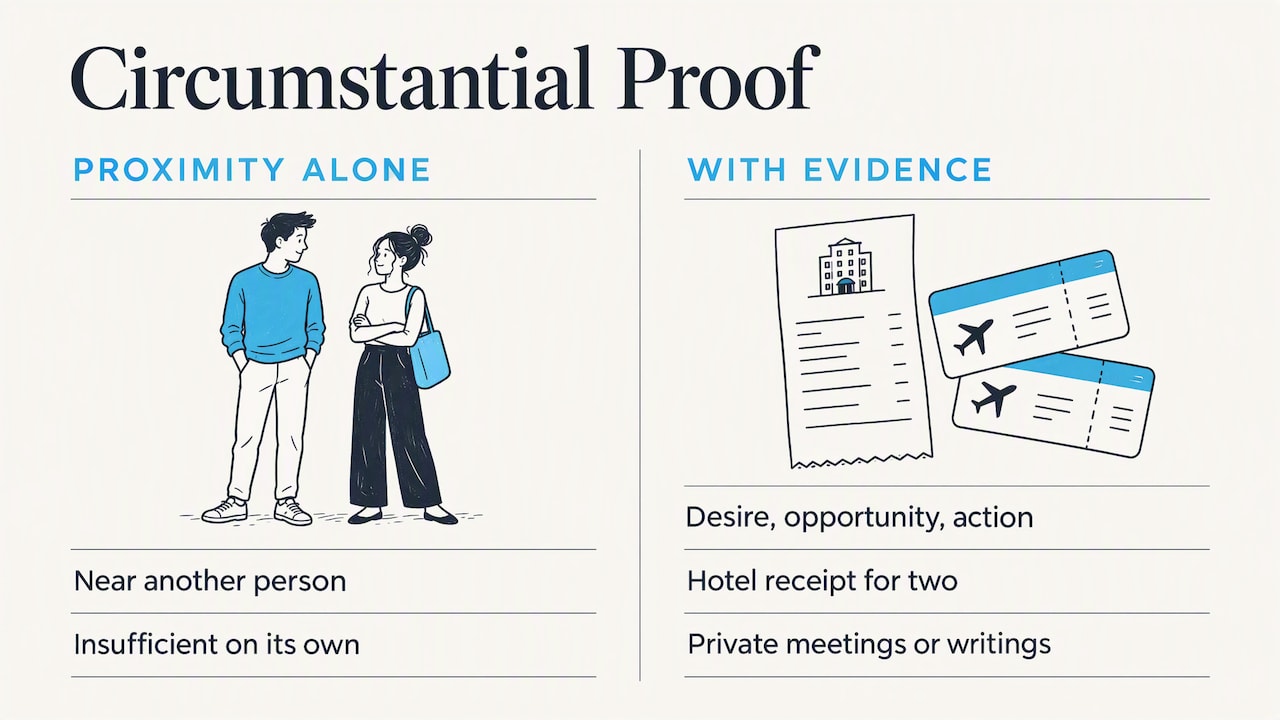
That is a New York decision, so treat it as an illustration of how courts reason, not a universal rule.
The two ingredients: inclination and opportunity
Think of every piece of evidence as answering one of two questions.
- Inclination: is there a romantic or sexual interest? Messages, gifts, photographs together, affectionate behavior in public.
- Opportunity: did they have the time and privacy to act on it? Overnight stays, a car parked outside a residence for hours, a shared hotel room, trips that don’t match the stated reason.
One alone is thin. A coffee together shows opportunity at most. A flirty message shows inclination at most. Both, repeated and dated, begin to form a pattern.
Patterns beat single items
A single odd credit card charge usually has an innocent explanation. A repeated financial pattern that lines up with messages, travel records or witness observations can carry far more weight, according to one South Carolina family law firm. That is why a timeline, with dates and sources for every entry, is more persuasive than a pile of screenshots.
Types of evidence, from weakest to strongest
| Evidence | What it shows | How much it carries |
|---|---|---|
| Gut feeling, changed habits | Something is different | Nothing alone, a reason to talk |
| One unusual receipt or charge | A purchase | Low, easily explained |
| Repeated charges that match travel or messages | A pattern | Moderate |
| Messages that clearly imply a sexual relationship | Inclination | Moderate to strong, if lawfully obtained and authentic |
| Hotel records, travel records, overnight stays | Opportunity | Strong when combined with inclination |
| Dated photos and video of the two entering a residence or hotel and staying | Opportunity, plus conduct | Strong, especially with a witness who can testify |
| Admission by the spouse | Everything | Strongest, but rare and sometimes later disputed |
Witnesses matter as much as documents. A Louisiana appeals court in Arnoult v. Arnoult said investigator testimony should ordinarily be corroborated, though it can sometimes be enough alone, and that the court looks at the totality of the evidence and the credibility of the witnesses. In plain terms: an investigator’s observations are most convincing when something else backs them up.
How hard is it to prove?
In most U.S. divorces, the question is not “beyond a reasonable doubt.” That is the criminal standard. Civil matters generally ask whether something is more likely than not. Some states set the language higher: South Carolina decisions, for example, require proof of adultery to be “clear and positive”, established by a clear preponderance of the evidence.
Whether proof of an affair matters at all depends on where you live and what you are asking for. Fault can bear on some issues in some states and be irrelevant in others. A family lawyer in your state can tell you whether the affair affects property, support or custody before you spend money proving it.
Gathering evidence without wrecking your case
This is where well-meaning people do damage. The urge to check the phone, log into the email account or hide a recorder in the car is strong. It is also risky.
An American Bar Association article on illegally obtained evidence in family cases notes that hacking email, covert recording, spyware or intercepting communications can violate criminal laws and create civil liability, and that some laws bar such evidence outright. The same article notes that recording rules vary by jurisdiction: recording a conversation without the consent of at least one party is a crime under federal law and most states, and about ten states require all parties to consent.
California is a concrete case. The Bar Association of San Francisco explains that Penal Code section 632 generally makes recording a confidential communication without consent illegal, and such a recording may be barred from evidence, subject to limited exceptions.
Admissibility is not uniform. Many jurisdictions follow a rule that relevant evidence stays admissible even when a private person obtained it illegally, while some states have statutes, such as New York’s CPLR 4506, that prohibit evidence from unlawful wiretapping or electronic interception. Even where a court lets it in, you can still face criminal charges or a civil claim for how you got it.
What is generally safer
- Things you already have lawful access to. Shared bank statements, joint credit card bills and your own phone records.
- Public information. Publicly posted photos, or shared cloud albums you jointly own and are authorized to access, can support a timeline, while breaking into private accounts can be illegal and make evidence unusable, as one family firm puts it.
- Messages sent to you. Keep original emails and full chains, store copies securely and keep a separate note of what each one contains. Tech Safety Canada’s guidance on preserving digital evidence describes that approach for harassment cases, and it applies equally to any record you may need later.
- Your own written log. Dates, times, what you saw and how you know it. Write it the same day.
- Lawful surveillance by a licensed professional. More on that below.
What to avoid
- Logging into your spouse’s email, social media or messaging apps.
- Installing spyware or tracking software on their phone.
- Recording phone calls or private conversations you are not part of, until a lawyer has told you what your state allows.
- Confronting them first. It tips them off and they delete things.
Surveillance: how investigators document an affair
Surveillance is the part of an investigation most people picture, and the one most often done badly by amateurs. A tailing car that gets noticed ends the opportunity. A blurry photo from 100 meters proves nothing.
Professional surveillance has a different goal. It is to produce a record that a lawyer can use: who, where, when, for how long, and what was observed, with the investigator available to explain it. In practice that looks like:
- Scoping. You tell the investigator what you know: routines, vehicles, days when your partner is “working late.” Good surveillance targets the windows when something is likely to happen, not every hour.
- Observation in public places. Following, photographing and filming what can be seen lawfully from public spaces.
- Time-stamped records. Photos and video with dates and times, plus a written log of movements.
- A report. A clear account that separates what was observed from what is assumed.
An investigator’s value is also in what they won’t do. A reputable one stays within the law, because evidence collected unlawfully can collapse in court. Our own guidance on surveillance done the right way explains how we approach that.
What surveillance costs
Our published surveillance pricing is $1,000 to $1,450, one-off, as listed on our page about what a private investigator costs in Melbourne. The final scope depends on your situation, so ask for a clear quote before you start.
Hiring ex-military or former FBI investigators for advice
Our owner’s brief is that readers often ask about this, so here is a straight answer.
Former FBI staff. Federal investigators spend careers on interviewing, building case files and presenting evidence that has to survive cross-examination. That discipline carries over to infidelity and family cases: knowing what is relevant, documenting it cleanly and not overstating it. Our team includes former FBI and military agents, and you can read more on our former FBI agent page. An advice session with someone like that is useful for judging what you actually have and what your next lawful step should be. It does not replace a lawyer for legal advice.
Former SAS or other special forces soldiers. People sometimes ask for an ex-SAS operator because they imagine more aggressive tactics. For evidence of an affair, that is the wrong instinct. What serves you is patience, field craft and restraint: staying unseen, noting detail and not crossing legal lines. Military backgrounds can bring real strengths in surveillance, but the title matters less than whether the person works within the law and can write a report a court will take seriously. Be wary of anyone who sells menace instead of method.
Ex-military hires in general. Our investigators include ex-military personnel alongside former police and polygraph specialists. If you want to understand how that works, our page on ex-military security is the place to start. For affairs and divorce, we keep the work to lawful investigation and evidence.
Whoever you hire, ask four questions: what is your background, what will you do and not do, how will you record what you see, and will you be able to explain it if asked?
When the other person is overseas or hard to find
Some affairs involve a partner who travels, a lover in another country, or a spouse who has left and can’t be found. Locating people across borders is a different skill from watching a front door. It needs record research, contacts abroad and an understanding of how each country treats personal information.
We work on finding people internationally, and we have published an example of a missing person located in the UK. Our Australian investigator overview explains where we operate from. If your case crosses borders, say so in your first conversation, because the legal limits differ from country to country. Evidence rules are not the same abroad either: courts in India, for instance, have balanced privacy against the right to a fair trial, allowing requests only when they are specific and narrowly tailored, while a Madhya Pradesh High Court ruling allowed improperly obtained messages to be produced but said admission is not proof of the fact itself. Rules that look permissive in one country can be criminal in another.
Our perspective
We have worked on infidelity cases since 2006, and the pattern is consistent. People come to us after weeks of checking, and the checking has often done harm: a deleted thread, a tipped-off partner, a log-in they should not have made.
We tell clients that the goal is not to feel certain. It is to know what can be shown. Sometimes the answer is that the suspicion is unfounded, and that is a real result worth paying for. When it isn’t, we want the evidence to be dated, lawfully gathered and clearly written, because that is what lawyers can use. Our investigators come from police, military and polygraph backgrounds, and we tailor each engagement to the person in front of us instead of running a template.
— P.i Melbourne
Work with a team that documents it properly
If you want evidence that holds up, our cheating partner surveillance and other investigation services are built for exactly this: discreet surveillance, time-stamped photos and video, and written reports a lawyer can use.

We will tell you in the first conversation whether surveillance makes sense for your situation, and what we would and would not do. If your matter involves custody or separation, our family law support covers that side too.
What to do if you already have evidence
Say you’ve found messages, photos or receipts. The next steps matter.
- Stop collecting by risky means. Don’t keep digging into accounts you are not authorized to use.
- Preserve what you have. Keep originals, make secure copies and write down when and how each item came to you.
- Build a timeline. Date, source, what it shows. Leave out guesses.
- Talk to a family lawyer early. The ABA article advises counsel to ask where evidence came from and to guide clients early about admissibility and the consequences of using it. A lawyer can tell you whether your method creates exposure.
- Mind spousal privilege. In New York, for example, confidential communications induced by the marital relationship are protected, so one spouse can’t be forced to disclose them without the other’s consent. Other states have their own rules.
- Consider what you want. Divorce, negotiation, custody or simply the truth. The evidence you need depends on the goal.
FAQ
How do I prove my spouse is cheating?
Show both interest and opportunity with dated, lawfully obtained facts: messages, financial records, travel records, and observed overnight stays or visits. Patterns carry more weight than single items. A licensed investigator’s surveillance record is a common way to document the opportunity side. Have a family lawyer review what you have.
Are text messages enough proof of cheating?
Sometimes, but rarely alone. Messages that clearly imply a sexual relationship show inclination, and courts often look for corroboration such as travel or overnight records. How the messages were obtained matters as much as what they say, because accessing private accounts without permission can be unlawful.
Can I record my spouse to get proof?
It depends on your state. Recording without the consent of at least one party is a crime under federal law and most state laws, and roughly ten states require everyone’s consent. Illegal recordings can be barred from court and expose you to charges. Ask a lawyer before you press record.
Does proof of adultery matter in court?
That depends on your state and what you are asking for. Where fault is relevant, courts commonly accept circumstantial proof under a civil standard, though some states use stricter wording. In other places it has little effect on the outcome. A local family lawyer can tell you whether it is worth pursuing.
Should I confront my partner first?
Usually not, if you plan to gather proof. Confrontation gives them time to delete messages and change behavior. Experts also recommend raising worries calmly rather than accusing, so decide first whether you want evidence or a conversation.
Sources
- Agulnick v Agulnick, 2020 NY Slip Op 07335
- Arnoult v. Arnoult (1997), FindLaw
- The Admissibility of Illegally Obtained Evidence in Family Law Cases, American Bar Association
- The Evidence Code in Family Court, Bar Association of San Francisco
- Spousal privilege, New York Courts
- Signs of Infidelity: What May Raise Questions and What Does Not Prove Cheating
- How Are Most Affairs Discovered?, Marriage Helper
- What Evidence Is Required to Prove Adultery in South Carolina, Max Hyde Law Firm
- What to Do Legally If Your Husband Is Cheating on You, Gastelum Attorneys
- Preserving Digital Evidence, Tech Safety Canada
- Delhi High Court on call records and hotel records as evidence, Verdictum
- Madhya Pradesh High Court on WhatsApp chats as evidence, LiveLaw