
The evidence that carries a restraining order case is usually ordinary: messages, photos, call logs, police and medical records, and witnesses who saw or heard what happened. What decides weight is whether each item is dated, attributable to the other person, preserved intact and organized so a judge can follow it in minutes. This guide covers what to collect, how to preserve it, how much proof courts generally ask for, and where a professional investigator fits in when you cannot gather proof safely yourself.
Rules differ by state and country, so treat this as a framework and confirm details with your own court’s self-help center or a family law attorney.
TL;DR
- Start a dated incident log today, and save every message, voicemail, photo and record that shows the behavior.
- Preserve digital evidence with sender, date and time visible, and keep originals as well as copies.
- Bring witnesses and documents that corroborate your account. A police report helps even without criminal charges.
- The standard of proof and the court’s rules vary by jurisdiction, so check your local court’s instructions before the hearing.
- If the other person hides, denies or escalates and you cannot safely document it yourself, a licensed investigator can collect court-ready evidence. Never put yourself at risk to get it.
Table of Contents
- What counts as evidence in a restraining order case
- Build an incident log first
- Preserving digital evidence so it holds up
- Witnesses: who to bring and how to prepare them
- How much proof does a court require?
- Rules that change by place
- Where a licensed investigator fits
- Our perspective
- Working with Pi Melbourne
- A checklist before your hearing
- FAQ
- Sources
What counts as evidence in a restraining order case
Courts want proof of the specific acts you describe: threats, stalking, harassment, violence, or contact after you asked for it to stop. The categories below appear in nearly every court’s guidance.
- Communications. Texts, emails, voicemails, social media messages and posts. California’s court self-help site tells petitioners to gather pictures, text messages and emails before the court date.
- Photos and video. Injuries, damaged property, the other person at your home or workplace, or a vehicle that keeps appearing.
- Official records. A police report documents violence and can be used as evidence in court even if no criminal charges are filed. Medical records serve the same purpose for injuries.
- Other proof of the act. Singapore’s judiciary lists emails, blogs, websites, photographs, CCTV footage, police reports and medical reports as examples of material that can support a harassment application.
- Witness testimony. Neighbors, coworkers, friends or relatives who saw incidents or saw you immediately afterward.
- Your own testimony. Your account is evidence too. The rest of the file exists to make it credible and specific.
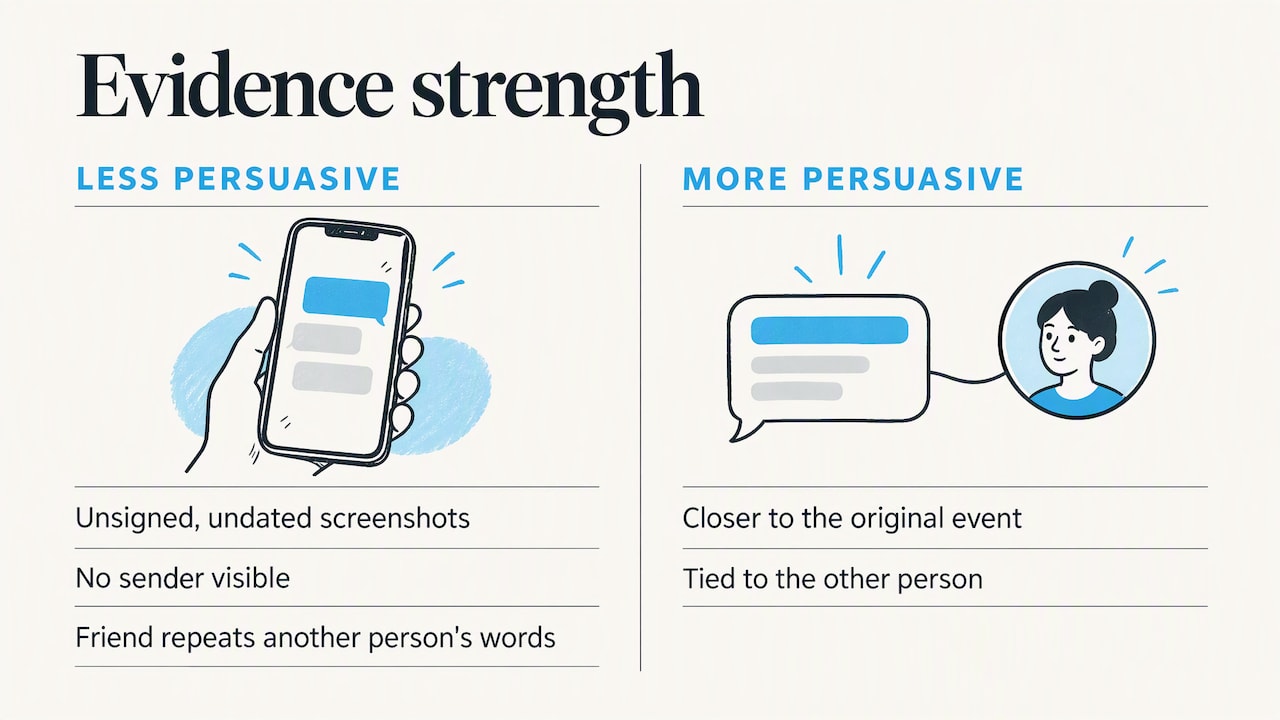
Weak evidence
Weak does not mean useless, but some items persuade less. Unsigned, undated screenshots with no sender visible are easy to challenge. Hearsay, such as a friend repeating what someone else told them, often carries little weight. One reported guide notes that material admitted only because the rules are relaxed in protection order cases won’t be as persuasive as more reliable kinds of evidence. We do not rely on that point here. The practical lesson is simpler: the closer an item is to the original event and the easier it is to tie to the other person, the more a judge can use it.
Build an incident log first
A log is the cheapest, most useful piece of evidence you can create, and it ties everything else together. WomensLaw.org advises recording each incident’s date and time, what was said or done, actions taken, and any witnesses or evidence. The same page says to save related voicemails, emails, texts and screenshots of social media posts.
A workable entry looks like this:
| Field | Example |
|---|---|
| Date and time | March 4, 9:40 p.m. |
| Where | Outside my apartment building, parking lot |
| What happened | He waited by my car and said he would “make sure I lost my job” |
| Who saw it | Neighbor in unit 3B; building camera covers the lot |
| What I did | Went back inside, called the police, report number noted |
| Evidence saved | Photo of him taken from window; text sent at 10:05 p.m. |
Write entries the same day, in plain facts, without guessing at motives. A log kept consistently over weeks lets a judge see a pattern rather than a single argument. Keep a backup copy somewhere the other person cannot reach, such as a new email account they do not know about.
Preserving digital evidence so it holds up
Most restraining order evidence today is on a phone. Courts look for who sent it and when. Pennsylvania’s court guidance on technology abuse says digital evidence such as screenshots or videos of messages and social media should include identifying information like the sender’s identity and timestamps, and, for emails, headers and IP addresses.
Practical steps:
- Capture the whole screen. Include the contact name or number, the date and time, and enough of the thread to show context. Cropped fragments invite doubt.
- Do not delete the originals. Keep the messages on the phone and copy them elsewhere.
- Save voicemails as files and note the date, number and length in your log.
- Export call logs or photograph the call history showing repeated calls.
- Avoid alerting the sender. If an app notifies the other person when you screenshot, photographing the screen with a separate camera keeps the text and images clear and readable.
- Check the format before the hearing. Ask the clerk whether the court can play audio or video and which file types it accepts. The Pennsylvania guidance says to convert files if needed.
A word on recording: laws on recording calls and conversations differ by state and country, and in some places recording without consent is itself an offense. Ask an attorney or legal aid office before you record anything.
Witnesses: who to bring and how to prepare them
A witness who saw one incident can be worth more than a dozen of your own screenshots, because the witness is independent. The California court self-help guidance says to bring witnesses who support your case and to make sure they know when and where to appear.
Good witnesses are people who:
- saw or heard the behavior directly,
- saw your injuries or distress soon afterward,
- received messages or calls from the other person about you, or
- can confirm dates, such as a coworker who watched the person show up at your workplace.
Write down what each person saw and when, and add it to your log. Do not coach anyone on what to say. A witness who tells the truth plainly is more believable than one who sounds rehearsed.
How much proof does a court require?
There is no single national standard. It depends on the state, the type of order (emergency or temporary, versus a full hearing) and the kind of relationship involved. Two examples show the range:
- In Baltimore County, Maryland, a judge can enter a protective order if the abuser consents or if clear and convincing evidence shows that abuse occurred.
- Arizona’s protective order rules say that all relevant evidence is generally admissible unless its probative value is outweighed by considerations such as unfair prejudice.
So the question “how much evidence do I need” has a local answer. Look up your state’s court self-help page for the standard, the forms and the evidence deadlines. Judges also look at whether there is a pattern. A single rude message rarely meets the bar for harassment, while repeated contact after a clear request to stop, documented across weeks, often does.
Rules that change by place
Evidence procedure is local, and the differences can be surprising.
- Format. Singapore’s Protection from Harassment Court requires that physical documents be consecutively numbered, that evidence sets be identical, and that documents in another language include an English translation by a certified translator.
- Compelling records. In New South Wales, Australia, a subpoena to produce can compel a person or organization to hand over specific documents needed as evidence. Many US courts have similar tools, but the procedure differs.
- Cross-border contact. In 2018 the Colorado Supreme Court held that out-of-state harassment, threats or coercion aimed at someone known to be in Colorado can support personal jurisdiction for a protection order. If the person contacting you lives elsewhere, keep evidence of where you were and where they were when contact happened.
Before your hearing, call the clerk’s office and ask three questions: what is the deadline for submitting evidence, how many copies are needed, and can the court handle audio or video.
Where a licensed investigator fits
Most people can build a basic case from their own phone, a log and a police report. An investigator becomes useful in narrower situations:
- The behavior happens where you cannot safely watch, such as someone following you, loitering near your home or turning up at work.
- The other person denies everything and uses fake accounts, other numbers or third parties to make contact.
- You need to show a pattern over weeks, and photographs or video with a verifiable record of who captured them and when.
- You are in a family law matter where the restraining order sits alongside custody or property disputes.
The value is not volume. It is evidence prepared by someone who knows how it will be tested. Our guide on chain of custody explains why a clear record of who collected an item, when, and how it was stored decides whether a court will accept it. Our article on surveillance done the right way covers what lawful, discreet observation involves.
Two cautions belong here. First, an investigator cannot issue or enforce an order, and cannot replace an attorney or a domestic violence advocate. Second, if you are in immediate danger, call your local emergency number first. Evidence can wait. Your safety cannot.
Our perspective
We have worked on investigations since 2006, and the pattern we see most is the same: people arrive with plenty of anger and not enough record. They have a story, a few unlabeled screenshots and no dates. The court sees a dispute between two people, and the person with the tidier file often looks more credible.
Our investigators come from police, military and polygraph backgrounds, and we build each engagement around the client’s situation instead of a fixed package. If you want an investigator with a military background for a matter involving stalking or harassment, tell us when you enquire and we will discuss who is suited to the work. We do not promise outcomes. A court decides. What we do is make sure that anything we collect is lawful, discreet, dated and documented so it can be put in front of a judge.
We also say no. If the best step is a police report, a conversation with an attorney or a safety plan with an advocate, we will tell you that before we talk about surveillance.
— Global
Working with Pi Melbourne
We handle family law support, evidence collection for court and related services for clients who need documentation they can hand to their lawyer. Surveillance engagements are published at $1,000 to $1,450 one-off, with the details on our private investigator cost page. Other services are scoped to the matter, so the quickest route is to describe your situation through our investigation services page and we will tell you what is realistic, and what is not.
A checklist before your hearing
- Incident log up to date, in date order, with each entry tied to an exhibit.
- Messages and call logs captured with names, numbers, dates and times visible.
- Photos and video labeled with date, place and who took them.
- Police report numbers and medical records gathered.
- Witnesses confirmed, told the date and place, and their accounts written down.
- Copies made for the court and the other side, in the format the clerk requires.
- A one-page timeline you can follow when you speak.
Stay on facts. Judges respond to specific dates, quotes and consequences, not labels.
FAQ
What evidence do you need for a restraining order?
There is no universal list, but courts commonly look at messages, photos, police and medical records, and witnesses. Your own dated account matters too. Check your state’s court self-help page for the local requirements and forms.
How do you prove harassment in court?
Show a pattern with specifics. Present a dated incident log, the saved messages or call records that match each entry, and any independent witnesses. Contact that continued after you clearly asked it to stop is especially persuasive.
Can I get a restraining order without a police report?
Often yes, because a police report is helpful but not usually the only route. A police report is useful as it documents violence and can be used in court even without charges. Ask your court clerk whether your state requires one.
Is a screenshot enough evidence?
It can be, if it shows who sent it, the date and the time, and you keep the original on your device. Court guidance recommends including identifying details such as the sender and timestamps. Keep the thread intact rather than saving only a single message.
Can a private investigator gather evidence for a restraining order?
A licensed investigator can lawfully document behavior such as following or loitering and keep a clear record of how it was collected. They cannot replace legal advice, so work alongside your attorney. Licensing and the rules on surveillance vary by place.
Sources
- Prepare for your restraining order court date, California Courts Self-Help
- Getting a restraining order, Office on Women’s Health
- Preparing your evidence and documents for a protection from harassment case, Singapore Judiciary
- Starting the Court Case: Gathering evidence, WomensLaw.org
- Evidence for Court, Pennsylvania Courts
- How to use evidence from your phone, Ohio Legal Help
- Apply for a Restraining Order, Baltimore County Government
- Arizona Rules of Protective Order Procedure
- Getting your evidence, Legal Aid NSW
- Parocha v. Parocha, Colorado Supreme Court, 2018