
Choose the investigator whose track record matches your exact type of case, who can show you the licensing that applies where the work happens, and who puts scope, fees and reporting in writing before anything starts. Everything else, from the price to the former-FBI or ex-military résumé, matters only after those three tests are passed. Pi Melbourne has run private investigations since 2006, using former police, ex-military and polygraph specialists, and this guide sets out the checks we would want a friend to make before handing over a retainer.
TL;DR
- Match the investigator to your case type: infidelity, family law, corporate fraud, a missing person and a WorkCover claim all need different skills.
- Confirm licensing in the place where the work will happen, and ask who will actually do the work.
- Get a written agreement covering scope, fees, expenses, reporting and confidentiality before work begins.
- Former FBI, police or military backgrounds are worth having when they match the job. Lawful method matters more than a dramatic résumé.
- If a child is in immediate danger or has been abducted, call 911 first. An investigator supports the response, it does not replace it.
Table of Contents
- Start with your case, not the investigator
- Check licensing where the work will happen
- Who actually does the work
- Hiring former FBI staff for advice
- Hiring ex-military and former special forces investigators
- Surveillance: what good looks like
- Finding people anywhere in the world
- Questions to ask before you sign
- Put the agreement in writing
- Match the investigator to your kind of case
- Red flags that should end the call
- Our approach to investigations that hold up
- Our perspective
- FAQ
- Sources
Start with your case, not the investigator
Most people begin by comparing firms. Begin instead by writing down, in two or three sentences, what you need to know and what you will do with the answer. Will it go to a lawyer, to an HR panel, to an insurer, or only to you? The answer decides almost everything that follows.
The Maryland People’s Law Library, a state-run legal information service, advises hiring someone with experience in your specific kind of case and warns that a specialist in a different field can be a poor match. A strong fraud accountant is not automatically a strong surveillance operator, and the reverse is also true.
Here is how the common situations map to skills:
| Your situation | What the investigator needs | Where to read more |
|---|---|---|
| You suspect a partner is cheating | Discreet mobile surveillance, clear photo and video, a log of times and places | Proof of cheating: what counts |
| Custody or family court dispute | Evidence that is dated, documented and usable in proceedings | Family law investigations |
| Staff theft or misconduct | Fair process, clear terms of reference, lawful monitoring | Workplace misconduct investigations |
| Suspected insurance or WorkCover fraud | Surveillance plus careful reporting for a claims decision | Insurance fraud investigation |
| Hidden assets in a dispute | Records research and a defensible paper trail | Asset search investigation |
| A missing relative or lost contact | Tracing skills, often across borders | Locating a missing person |
If your situation spans two rows, say so on the first call. A good investigator will tell you how the pieces fit together rather than quoting for one and hoping for the best.
Check licensing where the work will happen
Private investigation is regulated by region, not by a single global rule. In the United States it is mostly a state matter, and the differences are real.
- Maryland requires private investigators and agencies to hold a Maryland State Police license, and the state library suggests asking for the license number and checking status and complaints with the licensing division.
- California licenses expire two years after issue unless renewed, according to the state’s Business and Professions Code.
- Utah is moving licensing administration to its Division of Professional Licensing from 1 September 2026, with separate categories for agencies, agents, registrants and apprentices.
- Alabama requires individuals to hold a valid private-investigator license.
The practical lesson: licensing is checked against the rules of the place where the investigation happens, which may not be where you live or where the firm is based. Ask the firm which rules apply to your job and how it handles them. The Maryland library also notes that most investigators face no formal education requirement, while licensing there asks for three to five years of full-time investigation experience. So experience, not a certificate on the wall, is usually the real filter.
Who actually does the work
A firm’s website describes the firm. Your case is handled by individuals. A professional client alert on hiring investigators recommends confirming exactly who will carry out the work, and checking specialization, experience, data-protection training, insurance, references and willingness to testify.
At Pi Melbourne, investigations are conducted by experienced former police, ex-military and polygraph specialists, and the firm also draws on former FBI and military agents. That mix matters because different cases call for different strengths: one person’s patience on a long surveillance, another’s interview technique, another’s knowledge of how evidence is tested. Whoever you hire, ask to speak to the person who will lead your file, not only to the person who sells the job.
Hiring former FBI staff for advice
People search for “FBI for hire” for a good reason: they want someone who has run serious cases and knows what a prosecutor or court needs. Former federal investigators bring training in structuring a case, interviewing, documenting a chain of events and separating fact from assumption.
There are two things to get right.
- Keep expectations lawful. A former agent has no special powers once out of service. They gather information the way any investigator can, through open-source research, lawful records, interviews and surveillance. Anyone who promises access to confidential databases is describing conduct that can bring trouble. A legal primer on private investigators warns that unlawful access to confidential records can breach laws including the Fair Credit Reporting Act, the Driver’s Privacy Protection Acts and the Gramm-Leach-Bliley Act, with possible civil or criminal consequences.
- Use the experience as advice first. A short consultation with a former federal investigator can tell you whether your situation is an investigation at all, what evidence is realistic, and in what order to act. For serious matters such as child abduction or a cross-border disappearance, that early framing often saves the most time. Our former-FBI agent page explains how we handle missing persons and child kidnapping matters.
Hiring ex-military and former special forces investigators
“Ex-military hire” and even “mercenaries for hire” appear in searches, and the intent behind them is usually protection or recovery. Be clear on the line. An investigation firm finds information and documents it. It does not use force, and a reputable one will never offer to. What military experience genuinely adds is a set of working habits:
- Patience and discipline. Long static or mobile surveillance is dull, and attention drifts. Trained operators keep detailed, time-stamped notes through hours of nothing.
- Awareness. Knowing how to blend into a location, read a street and avoid being noticed is a learned skill.
- Planning. Routes, backups, and what to do when a subject changes plans mid-day.
- Composure. Calm judgment in tense family or workplace situations.
A special-forces background, such as the British SAS, signals a high standard of selection and field craft, and can be a real asset when advice is what you want: how to assess a risk, how to plan a safe recovery of a child through proper channels, how to protect yourself while you gather information. But the same test applies as with any résumé. Ask how that background applies to your type of case, and what the investigator will actually do for you. The title is the opening of the conversation, not the answer.
Pi Melbourne’s investigators include ex-military professionals, and we use them where field discipline counts most, which is surveillance and recovery work.
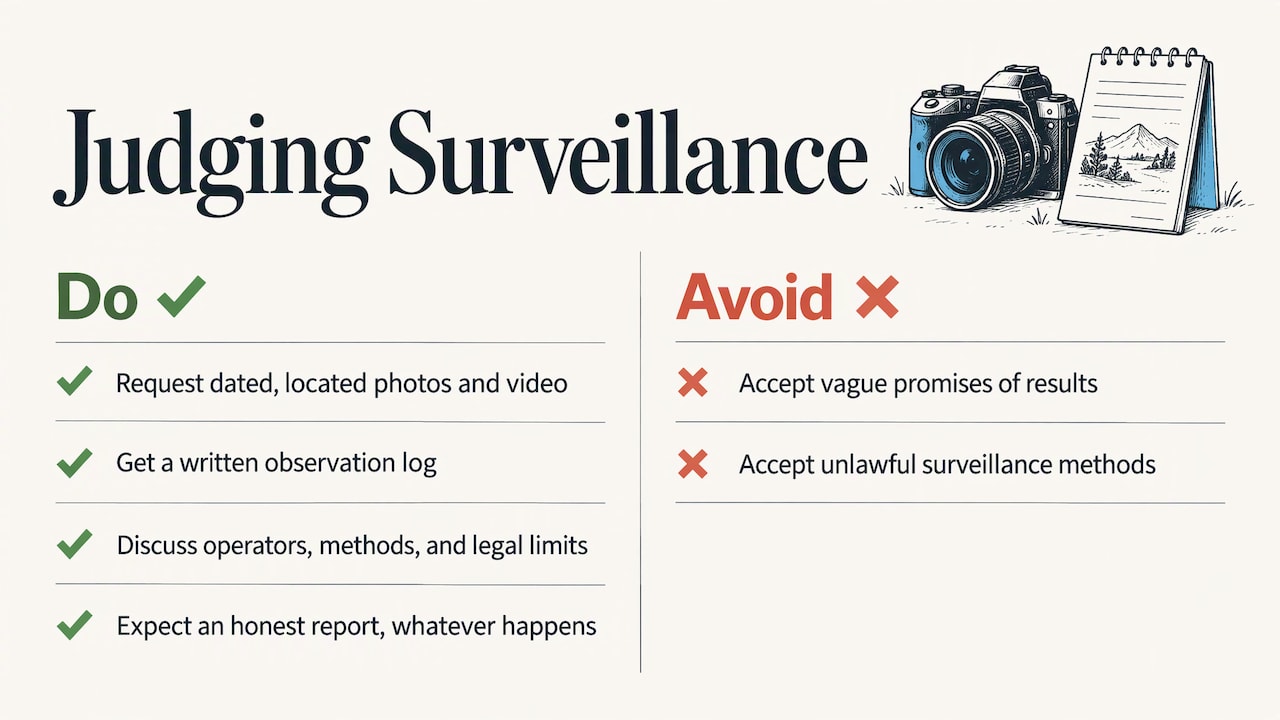
Surveillance: what good looks like
Surveillance is the backbone of infidelity, family law, staff and claims cases, so it is worth knowing how to judge it before you pay for it.
What you should receive. Court-ready photos and video, each with date, time and location, and a written log of what the investigator observed. Evidence you cannot date or place is evidence a lawyer cannot rely on.
What to ask about method. How many operators will be on the job, and in vehicles or on foot? What happens if the subject spots them? Are there places the team will not go, such as private property? The legal primer cited above tells lawyers to raise surveillance, privacy, trespass, witness contact and payment issues with the investigator up front, because unlawful conduct can create liability and lead to evidence being excluded. If you are an employer, read what employers can legally monitor before you start.
What it costs. Our surveillance service is published at $1,000–$1,450 one-off, and our cost page explains what moves a quote. Hours, number of operators, travel and complexity all do. We also explain the approach on our surveillance services page.
What you should not accept. Vague promises of a result. Surveillance records what happens, and an honest firm will say so. If the subject does nothing, the honest report says nothing happened, and that is useful information too.
Finding people anywhere in the world
Tracing a person who has moved interstate or overseas is one of the most common reasons families and lawyers hire an investigator, and it is also where choosing badly costs the most.
For a cross-border trace, check these points:
- Reach. Can the firm work lawfully in the country where the person is likely to be, or does it have people on the ground there? We have worked cases abroad, including locating a missing person in the UK.
- Method. Tracing normally rests on public records, open-source research, interviews with people who knew the person, and, where needed, field enquiries. Ask which of these the firm will use for your case.
- Local law. Privacy and data rules differ from country to country. A firm that ignores them risks your evidence as well as its own position.
- Realistic first steps. We lay out what to gather before the first call in our guide on how to locate a missing person: last known addresses, phone numbers, employers, social accounts, vehicle details, friends and relatives.
We serve clients worldwide, and our pages on private investigators in Australia and how an investigation works day to day show the process from first call to final report.
When it is an emergency, call first
If a child or adult may be in danger, do not wait for an investigator. USA.gov says to dial 911 in an emergency, and for a kidnapping inside the U.S. to call 911 or the National Center for Missing and Exploited Children at 1-800-843-5678. For international child abduction it directs families to local law enforcement and the State Department’s Office of Children’s Issues.
If you suspect trafficking, the Department of Homeland Security’s Blue Campaign says never to confront a suspected trafficker and to contact local law enforcement, the HSI tip line at 1-866-347-2423 or the National Human Trafficking Hotline at 1-888-373-7888. Once the authorities are engaged, a private investigator can support the search with tracing, surveillance and documentation, and our team can do that alongside them.
Questions to ask before you sign
A first call should feel like a professional assessment, not a sales pitch. Bring these questions:
- Have you handled cases like mine, and what did that work involve? The Maryland library suggests asking exactly that, along with how they would handle your investigation and whether they have ever been sued over one.
- Who will work on my file, and what is their background?
- What methods do you propose, and what methods will you refuse to use? The legal primer advises making your ethical limits explicit.
- How will you report: how often, in what form, and who owns the photos and video?
- Could this evidence be used in court, and would the investigator be willing to testify?
- How do you protect my confidentiality, including how my details are stored?
- What will it cost in total, and what could make it cost more?
- What happens if the investigation finds nothing, or if I want to stop early?
Watch how the answers are given. Clear, specific replies that mention your facts are a good sign. A pitch that could be pasted into any case is not.
Put the agreement in writing
A written agreement protects both sides, and in some places it is the law. California’s licensing authority confirms that all services by a licensed investigator must be covered by a written agreement, with the scope including all labor, services and materials and a breakdown of how fees are assessed. The California Association of Licensed Investigators summarizes the section as requiring, among other things, the investigator’s name and license number, approximate start and completion dates, whether a written report will be provided and how, and a signed copy to the client before work begins, with the written report due within 30 days of completion.
Even where no such law applies, use that list as your template. The agreement should name:
- the scope of work and the questions you want answered
- fees and how they are calculated, plus how expenses are billed
- the reporting schedule and format
- how evidence is delivered and stored
- confidentiality terms
- how either side can end the engagement, and what happens to any unspent retainer
On price, be wary of choosing by the lowest number. Cost depends on the type of work, the experience involved, location, and whether the job needs surveillance, travel or extended hours. The cheapest quote often leaves out the hours that produce usable evidence. Compare what each quote includes, then compare totals. Our investigation timeline shows how long each phase usually takes, which helps you judge whether a quote is realistic.
Match the investigator to your kind of case
A few notes for the readers we hear from most.
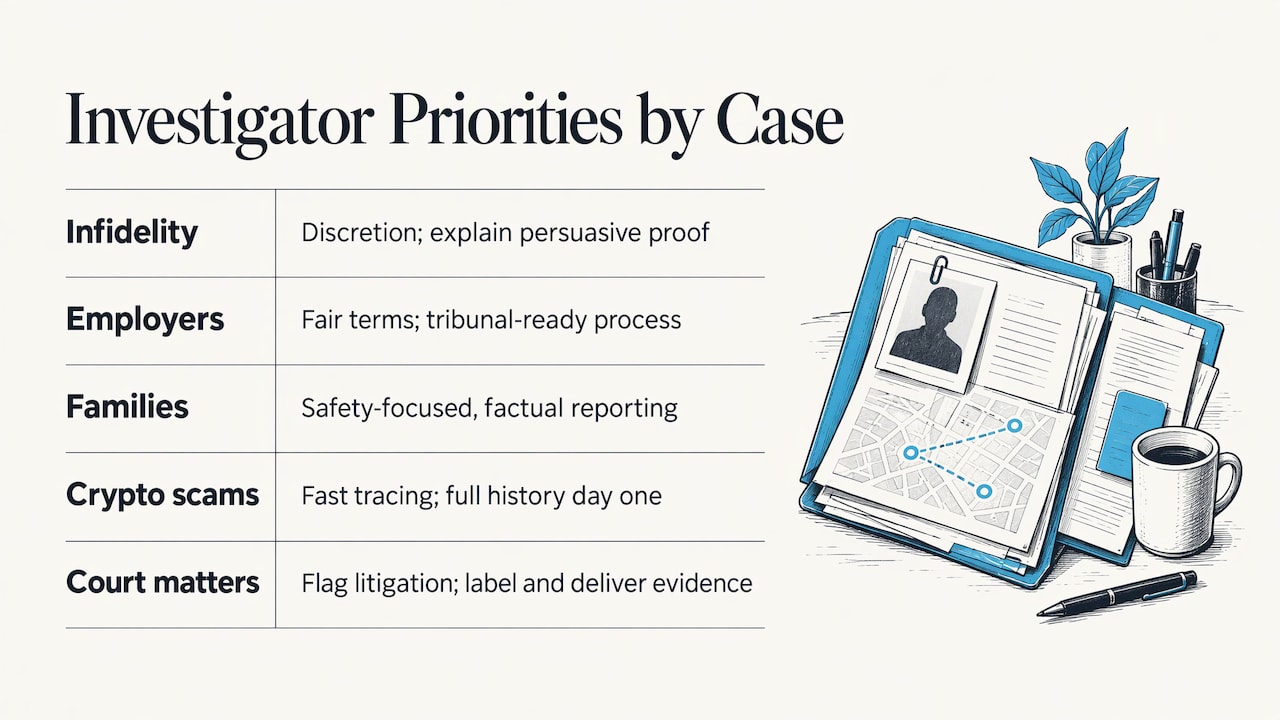
Suspected infidelity. Look for discretion first. The investigator should be able to explain what proof is persuasive and what is not. Our guide to signs of infidelity helps you decide whether surveillance is warranted at all.
Employers. Staff monitoring and misconduct work has to be fair as well as effective. The investigator should help you set terms of reference and follow a process that stands up if the matter reaches a tribunal. See our guides on internal fraud investigations, employee theft and corporate investigations.
Families. For teenagers at risk, the aim is safety, not punishment. Choose someone who understands family dynamics and can report factually. Our teenage monitoring service is built around that.
Crypto and online scams. Tracing money and identifying who is behind a scheme is investigative work, and speed matters because funds move quickly. Report to the police or relevant regulator as well, and give your investigator the full transaction history on the first day.
Court matters. Tell the investigator at the start that the work is for litigation. That changes how evidence is collected, labeled and delivered.
Red flags that should end the call
- A guarantee of a particular outcome.
- Offers to obtain phone records, bank details or other confidential data. The primer above lists the laws that can be broken, and you could share the exposure.
- No written agreement, or reluctance to put fees in writing.
- Pressure to pay large sums immediately without a defined scope.
- Vagueness about who will do the work.
- Claims of special powers because of a past career.
Our approach to investigations that hold up
Pi Melbourne offers surveillance, cheating partner investigations, corporate and staff investigations, fraud and WorkCover investigations, asset searches, family law support, teenage monitoring, missing persons, child recovery and evidence collection for court. Each engagement is tailored to the client’s situation and run by experienced former police, ex-military and polygraph specialists using advanced technology to produce court-ready photos and video.
If you are ready to talk, see our full list of private investigation services or start at pimelbourne.com.au and tell us what you need to find out.
For workers’ compensation matters in Victoria, see our WorkCover investigations page.
Our perspective
Clients rarely come to us wanting an investigation. They want an answer, and they want it to be right. That is why we start every job by asking what the answer will be used for, and then we build the work around it.
We believe the best investigators combine two things: the discipline of people trained in policing and the military, and the patience to document facts without bending them. That is the reason we use former police, ex-military and polygraph specialists, and why our evidence is gathered to be court-ready from the first day.
Customized work beats a standard package. A custody case, a staff theft and a missing relative abroad have almost nothing in common except that all of them need discretion. So we shape each investigation to the person in front of us.
If you take one thing from this guide, make it this: choose the team that asks the most thoughtful questions about your case before it quotes you.
P.i Melbourne
FAQ
How do I pick a good private investigator?
Pick the one whose experience matches your type of case, who can explain licensing where the work will happen, and who agrees to a written scope, fee and reporting schedule. Speak to the person who will lead your file, and judge the quality of the answers to your questions.
What does a private investigator usually cost?
It depends on the work, the investigator’s experience, the location and whether surveillance or travel is needed. Our surveillance service is published at $1,000–$1,450 one-off. Other services are priced to the case, so ask for a written breakdown of fees and expenses.
Is it worth hiring a private investigator?
It is worth it when you need facts you cannot lawfully or safely gather yourself, or evidence that a lawyer, employer or insurer can rely on. Define what you need to learn and what you will do with it, and the value becomes easier to judge.
Should I hire a former FBI agent or ex-military investigator?
Those backgrounds bring training in case-building, surveillance and composure, and they are valuable when they match your job. Judge the investigator on relevant experience and lawful method. Former service gives no special legal powers, and a good investigator will say so.
What should I do if a child has been abducted?
Call 911 immediately, or the National Center for Missing and Exploited Children at 1-800-843-5678 for a kidnapping in the U.S. For international abduction, contact local law enforcement and the State Department’s Office of Children’s Issues. Investigators can then support the search alongside the authorities.
Sources
- Using a Private Investigation Service, Maryland People’s Law Library
- Client Alert on private investigators, Milbank
- A Primer on Private Investigators, Law.com
- New Requirements for Private Investigators FAQ, California BSIS
- Sample Service Agreements, California Association of Licensed Investigators
- California Business and Professions Code, Legislature
- Utah private investigator rule, Division of Professional Licensing
- Alabama private investigator legislation, Alabama Private Investigation Board
- How to Identify and Report Human Trafficking, Homeland Security
- Report a crime, USAGov