
In most US courts, polygraph results are not admitted as evidence unless both sides agree to it in advance, and a few jurisdictions allow it on narrower terms. The rule depends on the state, the federal circuit and whether the case is criminal or civil. If you are planning a legal matter around a polygraph, the practical lesson is to build the case on evidence a judge will accept, such as documented surveillance, records and witness statements, and to use a polygraph where it helps you: in an investigation, a negotiation or a settlement conversation.
This guide explains the rule in plain terms for people who suspect infidelity, business owners dealing with staff misconduct, families in custody disputes and anyone gathering evidence for a legal matter.
TL;DR
- There is no single US rule. Neither federal statute nor the Federal Rules of Evidence has a specific provision on polygraph results, so each state and circuit decides.
- Where results are admitted, it is usually because every party stipulated (agreed in writing) to the test before it was taken.
- Some states, such as California, bar polygraph results in criminal cases unless all parties stipulate. New Mexico allows them under a defined test.
- A polygraph exam can still shape an investigation, even where the result never reaches a jury.
- Courts routinely accept well-documented surveillance, photographs, video and records, so evidence gathering should be planned for court from day one.
Table of Contents
- The short answer for US courts
- How different jurisdictions treat the evidence
- Stipulation: the main route into a courtroom
- Results versus what was said during the exam
- What courts do accept: evidence built for the record
- Using a polygraph where it helps, even if it never reaches court
- Outside the US: the answer changes again
- Hiring former FBI, SAS-style and military expertise for advice
- Newer developments: courts are still debating the rule
- Work with a team that plans for court
- FAQ
- Sources
The short answer for US courts
Search results for this topic repeat one line: polygraphs are not admissible. That is a fair summary of the default, but it hides the detail that matters to you. The better description is that admissibility is a matter of local law, and the default can be changed by agreement.
The federal system is a good example. Neither the United States Code nor the Federal Rules of Evidence contains a specific provision on the admissibility of polygraph results, so federal judges apply the general rules on expert evidence. Federal circuits have reached different positions, and state courts have reached their own. A result that is excluded in one courthouse can be considered in another.
For a reader deciding what to do, three questions settle most cases:
- Is the matter criminal, civil or family law?
- Which state or federal circuit will hear it?
- Will every party agree in advance to the test and its terms?
Your attorney answers the first two for your specific case. The third is a negotiation, and it is where a polygraph most often enters a courtroom.
How different jurisdictions treat the evidence
The examples below come from the courts themselves and show how far apart the positions are.
| Jurisdiction | Position | Source |
|---|---|---|
| California | Results, the examiner’s opinion and any reference to offering, refusing or taking a polygraph are not admitted in criminal proceedings unless all parties stipulate | Evidence Code section 351.1 |
| Oregon | Unstipulated polygraph evidence is inadmissible under any provision of the state’s Evidence Code | State v. Brown (1984) |
| New Mexico | Results can be admitted if the examiner is qualified and the exam follows the state’s rule on polygraph examinations | Lee v. Martinez (2004) |
| Eleventh Circuit (federal) | Results may be admitted on advance stipulation, and in some situations to impeach or corroborate a witness | United States v. Piccinonna (1989) |
| North Carolina | Testimony about the administration or results of a polygraph is inadmissible at trial | NC PRO, UNC School of Government |
Two patterns stand out. First, the word “stipulate” appears again and again. Second, even the most open jurisdictions attach conditions: a qualified examiner, a set procedure, notice to the other side and the judge’s discretion.
Stipulation: the main route into a courtroom
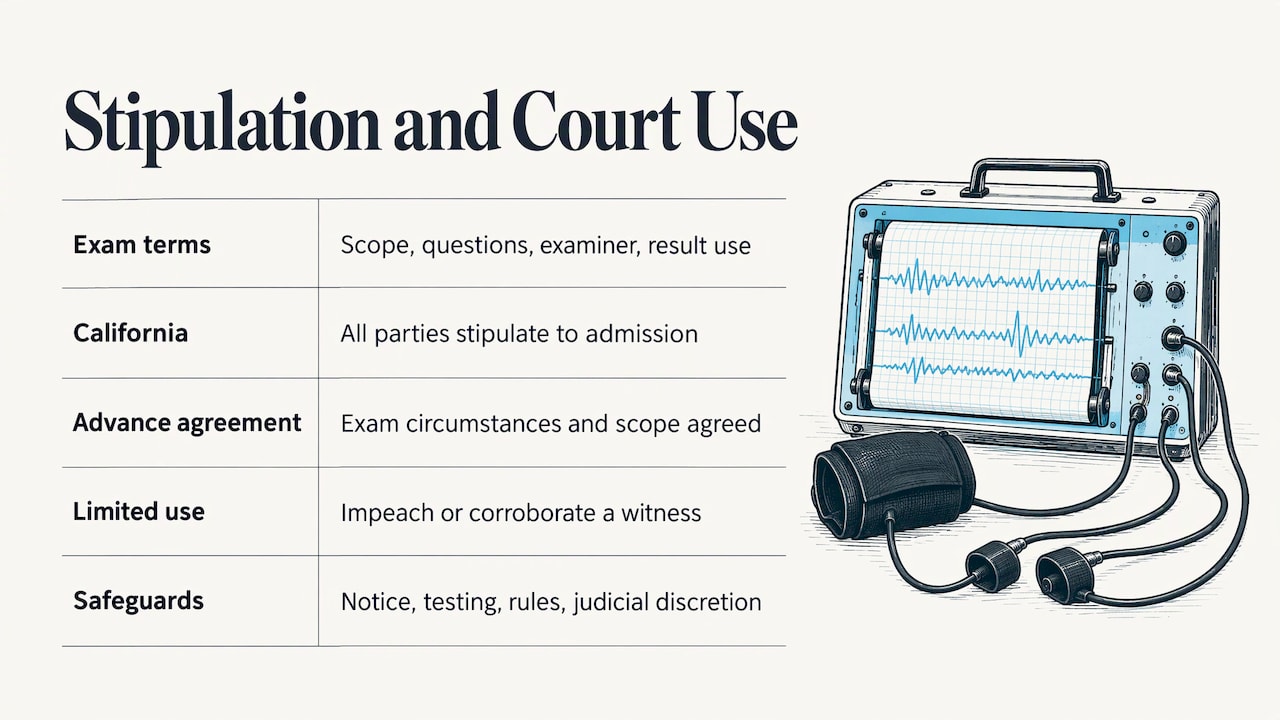
A stipulation is a formal agreement between the parties. For a polygraph, it usually fixes the scope of the exam, the questions, who the examiner is and what the parties accept about the use of the result. California’s statute, for example, lets results in as long as all parties stipulate to their admission.
In practice, stipulation is a strategic decision, not a formality. The other side agrees only when it expects the result to help it or when the agreement is part of a larger deal. If you are the party offering, you should treat the test as one step of a negotiation and work out with your attorney what happens if the result goes against you.
The Eleventh Circuit’s decision in Piccinonna shows the approach courts take. It allows results where the parties agree in advance to the circumstances and scope of the exam. It also allows limited use to impeach (challenge) or corroborate (support) a witness, subject to notice, a chance for the other side to test the evidence, the rules of evidence and the judge’s discretion. Each of those conditions is a place where the process can fail if it is not managed carefully from the start.
Results versus what was said during the exam
Readers often assume that anything connected to a polygraph is barred. That is not always true. North Carolina’s guidance explains that testimony about the administration or results of a polygraph is inadmissible at trial, but statements a person makes during or after testing are not excluded merely because they happened in connection with a polygraph, provided the test and results are not put before the jury.
This distinction matters for investigations. An examination can lead a person to explain, correct or add to their account. That account can then be dealt with under the ordinary rules, separate from the test itself. The same guidance notes that polygraphs remain useful in practice for prosecutors and officers deciding, for example, whether a person of interest is really a witness.
One point of caution: do not record or use statements without checking your state’s consent rules for recording. A lawyer in your state is the right person to ask before you rely on any statement.
What courts do accept: evidence built for the record
Because a polygraph result is so often kept out, the evidence that carries a case is the evidence that always has a way in. That means:
- Dated, time-stamped photographs and video showing who was where and when.
- Written surveillance logs prepared by the person who watched, who can later testify to what they saw.
- Financial and business records, such as bank statements, invoices and access logs.
- Witness statements taken properly and kept in their original form.
The difference between useful and useless surveillance usually comes down to method. Footage with no chain of custody, notes written weeks later, or a investigator who cannot testify clearly are the common ways a good case turns weak. Our own surveillance work is designed around this problem: our investigators use advanced technology to produce court-ready photos and video, and they are experienced former law enforcement and military people used to documenting what they see.
If you are a business owner, the same applies to staff problems. Evidence in a theft or misconduct matter has to be gathered fairly to support a fair decision. Our guides on employee theft investigations and workplace misconduct terms of reference walk through how to set the scope before anyone is watched or interviewed.
Using a polygraph where it helps, even if it never reaches court
Not being admissible is different from having no value. People use polygraph examinations in several ways outside the witness box:
- Directing an investigation. A result can show where to look first and which accounts to check.
- Settlement and negotiation. Parties sometimes agree to a test as part of resolving a dispute, with terms set out in advance.
- Workplace and personal matters. Where the person being tested agrees, an examination can help clear a person or focus an inquiry.
We have a polygraph specialist on our team. You can read about Steve van Aperen, polygraph examiner, and our page on polygraph test accuracy and what the research shows explains how examinations are conducted and what to expect from one.
A polygraph should always be voluntary and agreed. Before you ask anyone to take one, particularly an employee or a family member, speak with an attorney about the laws that apply to you. Employment law in many places limits when an employer may ask for a test, and the rules differ by state and by country.
Outside the US: the answer changes again
Our clients are not only in the United States, and the legal picture shifts at each border. A test that is routine in one country can be restricted in another, and in some places the law limits who may be asked to take one and why. If your matter has an international element, such as a spouse who has moved abroad, a business partner overseas or a family dispute across borders, local counsel in that country decides what can be used. Our role is the factual groundwork: establishing where a person is, what they are doing and what can be documented.
Finding people across borders
A court case cannot move until the other party is located. Locating a person is often the first investigative job, whether it is a debtor, a witness, a relative or a former partner who has left. Our missing persons work extends across borders, and our case page on finding a missing person in the UK shows what an overseas search looks like. Where assets are involved, an asset search can show what a person owns before a settlement is agreed, and our guide to asset searches in divorce explains how hidden assets are found.
Hiring former FBI, SAS-style and military expertise for advice
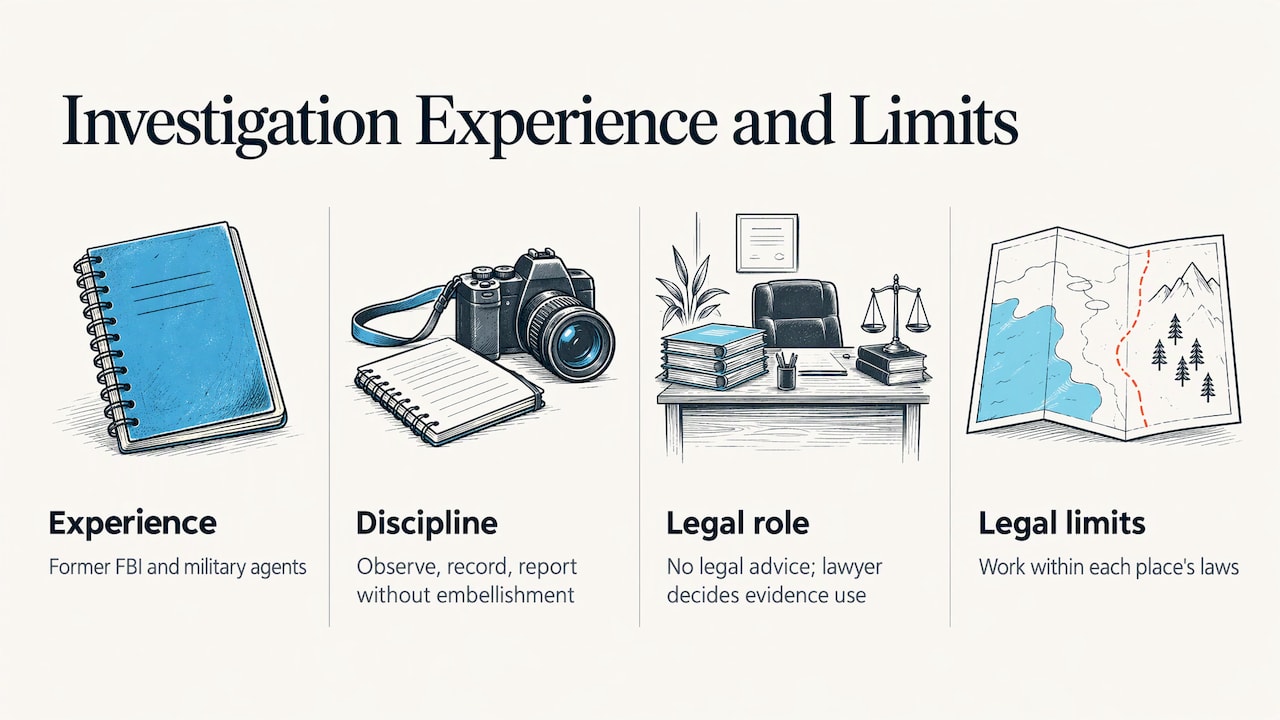
Some readers come to this topic wanting more than a legal answer. They want to talk to someone who has questioned suspects, run surveillance or recovered a child. Experience of that kind is valuable for advice on how to plan an investigation, what to document and how to avoid mistakes that cost a case.
Our team includes former FBI and military agents, former police and polygraph specialists. You can see how this experience is applied on our page about a former FBI agent working on missing persons and child kidnapping. If you want to hire ex-military personnel, the useful framing is not force but discipline: trained people are used to observing patiently, recording accurately and reporting without embellishment. Those habits produce the notes and footage that survive cross-examination.
Two boundaries are worth stating clearly. We are private investigators, not a law firm, and we do not offer legal advice, so the lawyer handling your matter remains the person who decides whether evidence will be used. We also work within the law of each place where we operate. Our page on what a private investigator can do covers powers and limits in detail. Anyone offering to act outside those limits, including advertising themselves as mercenaries for hire, puts your case and your own legal position at risk.
Newer developments: courts are still debating the rule
The default of exclusion has been stable for a long time, but it is not frozen. Courts continue to hear arguments about when a result might be considered, and individual judges have written separately to say that blanket rules deserve a second look. For a reader, the sensible approach is to treat the rule as it stands in your court today, confirm it with your attorney, and avoid assuming that a trend in one state applies in yours.
What we tell clients about polygraph evidence
Clients often ask us whether a polygraph will win their case. We answer by asking what the judge will let in. Polygraph results are handled differently from state to state, so we plan every matter around evidence that has a clear route into the record: documented surveillance, accurate logs, records and properly taken statements.
Our investigators are experienced former police, former military and polygraph specialists. That mix means one team can watch a subject, document it in a form a court can use, and, where all sides agree, carry out an examination that helps direct the inquiry or resolve a dispute.
Each investigation is tailored to the client’s situation, whether that is a suspected cheating partner, a staff fraud problem, a family law matter or a search for a missing person. We start by asking what you need to prove and to whom, then plan the work backward from that.
P.i Melbourne
Work with a team that plans for court
If your matter may end up in front of a judge, the time to think about admissibility is before any evidence is gathered. We offer surveillance at a published price of $1,000 to $1,450 one-off, and we also handle cheating partner surveillance, fraud investigations, family law support, child recovery, staff monitoring and collecting evidence for court. Each engagement is tailored to the client. To discuss yours, see our private investigation services or visit Pi Melbourne.

FAQ
Are polygraph results admissible in court?
Usually not, unless the parties agree in advance. California, for instance, bars results in criminal proceedings unless all parties stipulate, and Oregon’s Supreme Court has held unstipulated results inadmissible. New Mexico allows results under a defined procedure. Your attorney can tell you how your own court treats them.
Can I use a polygraph in a divorce or custody case?
Rules differ by state, and family courts have their own practices. A result is unlikely to be treated as proof by itself, but parties sometimes agree to an exam as part of a negotiation. Speak with your family law attorney first, and rely on documented evidence such as surveillance and records for the core of the case.
Can I be forced to take a polygraph?
In general, a polygraph is something a person agrees to take. Employment and criminal rules differ by state and country, so ask an employment or criminal defense attorney before you request or refuse an exam.
If a polygraph is excluded, can anything said during the exam be used?
Possibly. North Carolina’s guidance, for example, says statements made during or after testing are not inadmissible only because they were connected to a polygraph, as long as the test and results are not presented to the jury. A lawyer in your state should confirm how the rule applies to you.
What evidence should I gather instead?
Focus on material a court can always consider: dated photos and video, written surveillance logs, financial and business records and properly taken witness statements. Planning the collection with an investigator before you start helps keep it usable.
Sources
- California Evidence Code section 351.1, Codes Display Text
- State v. Brown, Oregon Supreme Court (1984)
- Lee v. Martinez, New Mexico Supreme Court (2004)
- United States v. Piccinonna, Eleventh Circuit (1989)
- Polygraphs, Plethysmography, and Witness Credibility, NC PRO, UNC School of Government