
Courts do not decide parental alienation on a feeling or on a child’s rejection alone. They look for a documented pattern of one parent’s behavior, and they must rule out other reasons the child is pulling away. The strongest evidence is dated, specific and observed: messages, records of missed handovers, witness accounts and, where words are not enough, independent surveillance that shows what actually happens at exchanges and in daily routines. If you are in this position, build that record early, keep it factual, and have a family law attorney in your state guide how it is presented.
TL;DR
- Parental alienation is not proven by a child saying “I don’t want to go.” Courts look for a child’s unjustified rejection plus a pattern of the other parent’s behavior that caused it.
- Rejection that has a reasonable basis, such as abuse or neglect, is treated as estrangement, not alienation, so your evidence must address that question directly.
- Good evidence is contemporaneous and factual: a dated log, saved messages and emails, missed-contact records, and witnesses who saw events firsthand.
- Several US states have recently tightened rules on custody experts and on assuming alienation, so the record matters more than labels.
- Where the other parent’s conduct happens out of your sight, a professional investigator can document it in a form a court can use. A family law attorney decides how it is filed.
Table of Contents
- What courts mean by parental alienation
- Signs of alienation are not the same as proof
- What counts as evidence
- How to document without damaging your case
- How US courts are changing what they accept
- Where a private investigator fits
- Working with your attorney
- Perspective
- Talk to us about your case
- FAQ
- Sources
What courts mean by parental alienation
An American Bar Association chapter on the subject describes parental alienation as a condition in which a child in a high-conflict separation allies strongly with one parent and rejects the other without legitimate justification. The same chapter quotes a case, McClain v. McClain, for the dividing line: rejection with a reasonable, objective basis is estrangement, and rejection without one is alienation.
The Oregon courts’ guide for judges says much the same thing in plainer terms. It describes alienation as unjustified actions by a parent that cause the child to reject the other parent, where the child previously had a reasonably good relationship with that parent. It separates this from affinity, where a child simply prefers one parent.
That definition tells you what the evidence has to do. It must show three things:
- The child is resisting or refusing contact.
- The reason is not the rejected parent’s own conduct, and not an ordinary preference.
- The other parent has behaved in ways that plausibly caused it.
An England and Wales guidance document from the Family Justice Council, issued in December 2024, uses the same three-part structure. It is not US law, but it shows how seriously courts now treat the second element.
Signs of alienation are not the same as proof
Many people search for lists of signs. A list is a useful prompt for what to watch and record. It is not evidence by itself.
Psychiatrist William Bernet’s Five-Factor Model lists 17 common alienating behaviors, including bad-mouthing the other parent, limiting contact, interfering with communications and asking the child to spy or keep secrets. It also lists signs in the child, such as a campaign of denigration, weak rationalizations, no ambivalence and an absence of guilt. The model is explicit that alienating behaviors must be observed in the favored parent’s actions and should not be assumed from the child’s behavior alone.
The same model names other causes that have to be ruled out first:
- A understandable preference for one parent
- A loyalty conflict, where the child avoids taking sides
- Separation anxiety or depression
- Oppositional behavior
- Estrangement from earlier maltreatment
So the practical reading is this. Your child’s words and moods tell you something is wrong. Only documented conduct by the other parent, with dates and sources, can tell a court why.
What counts as evidence
The ABA’s book on litigating parental alienation treats the work as three tasks: evaluating the case, handling it in court and presenting expert evidence. Behind all three sits ordinary factual proof. These are the categories that carry weight.
Written communications
Texts, emails and co-parenting app messages are the backbone of most cases. They show refusals of contact, last-minute cancellations, hostile language about you in front of the child and the other parent’s own explanations. Keep the full thread, not selected screenshots, so the context cannot be challenged.
A contemporaneous log
A log kept at the time, with date, time, place, what happened and who was present, is more persuasive than recollection assembled months later. Record facts only: “Handover at 5:00 pm, child told me her mother said I did not want her” is useful. “She is poisoning him against me” is a conclusion, and it undercuts the rest.
Contact records
A calendar of scheduled and missed parenting time, with the reason given each time, shows the pattern a court needs to see. One missed visit is a dispute. Twelve in a row, each with a different explanation, is a pattern.
Witnesses
Teachers, coaches, relatives, neighbors and counselors who saw or heard something firsthand can speak to it. Hearsay is a complication: what a child told you about the other parent’s statements may not be admitted the way a direct message from that parent would be. Ask your attorney how your state treats it.
Social media and digital material
Public posts, comments and messages can show disparagement or interference. Capture them with the date, account and URL visible before they are deleted. Our guide to social media evidence and how to preserve it covers what courts tend to accept.
Independent observation
Some conduct leaves no written trail: who actually brings the child to a handover, whether a parent is present when they claim to be away, whether the child is being coached at the curb, or whether a household is what the other parent says it is. This is where first-person evidence from you may be doubted as self-interested, and where independent documentation helps.
How to document without damaging your case
The way you collect evidence can help or hurt as much as what you collect.
- Start now and keep going. Courts value patterns over time. A log that begins the week before a hearing looks tactical.
- Stay neutral in writing. Messages to the other parent should be short, civil and about the child. Assume a judge will read every one. Do not bait the other parent into a hostile reply.
- Never record or question the child as a witness. Do not ask a child to report on the other parent, and do not coach them. Asking a child to spy is itself on the list of alienating behaviors.
- Back up everything. Export full message threads, keep originals, and store copies somewhere the other parent cannot reach.
- Check your state’s recording laws. Rules on recording calls and conversations differ across states. Ask your attorney before you record anything.
- Include evidence that cuts against you. A court will see the full picture. Know what the other side will say about your own conduct and the child’s reasons, so your account stands up.
If your concern includes a safety issue, such as threats or abuse, the evidence is of a different kind and is usually handled in a separate process. Our page on restraining order evidence sets out what to gather for that.
How US courts are changing what they accept
The legal ground has moved in the last few years, and it affects how evidence is weighed.
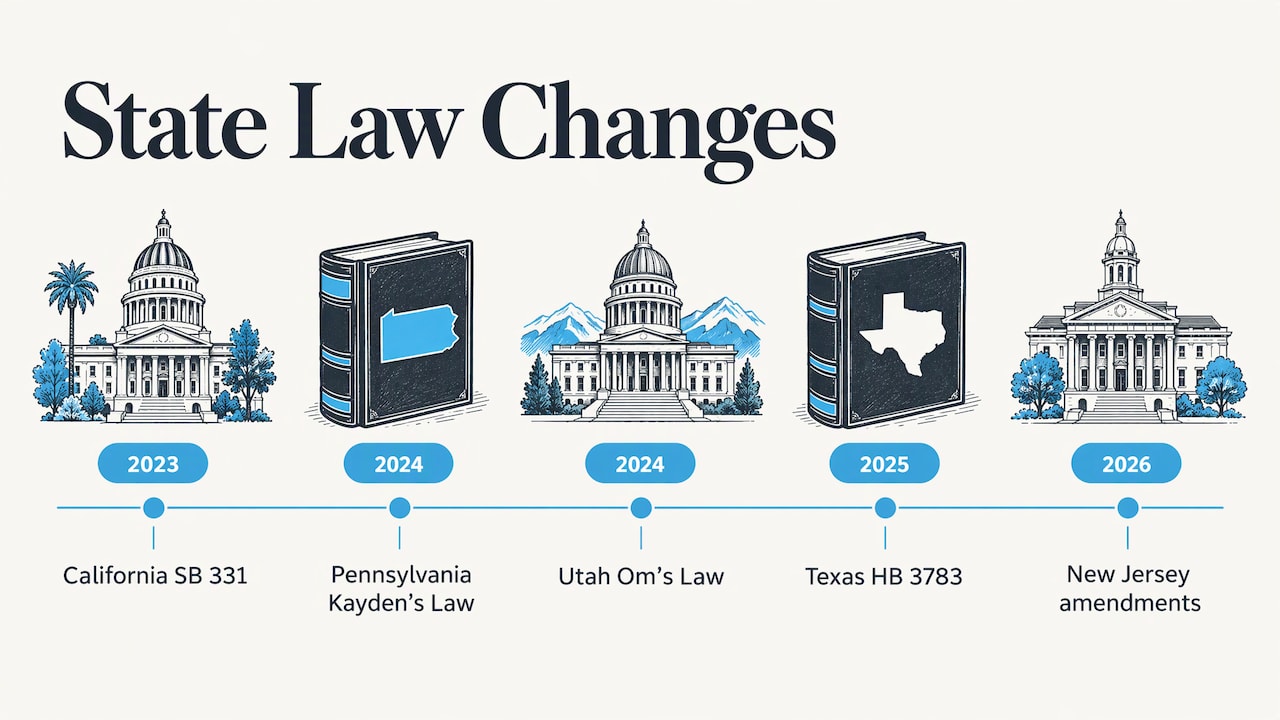
A March 2026 legal analysis reports that no US state has banned parental alienation evidence outright. It lists recent changes including Pennsylvania’s Kayden’s Law (2024), California SB 331 (2023), Colorado HB 24-1350, Utah’s Om’s Law (2024), Texas HB 3783 (2025) and New Jersey’s 2026 amendments, which bar assuming alienation without investigating why the child is resisting.
Pennsylvania’s version is a good example. The statute now says that a party’s reasonable concerns for a child’s health and welfare and reasonable efforts to protect the child are not to be treated as attempts to turn the child against the other party. The Superior Court of Pennsylvania applied this in a 2025 decision.
On the expert side, a Federal Bar Association course notes that several states now set qualification requirements for custody experts in domestic violence and child abuse cases, and that others restrict court-ordered reunification therapy. Utah’s Om’s Law, for instance, requires judges to consider risks to a child’s safety first and requires expert witnesses to be qualified, credentialed and experienced with abuse victims.
What this means for you: a bare claim that “the other parent is alienating” is weaker than it used to be. A factual record of specific conduct, dated and sourced, is stronger, because it works under any state’s rules. In England and Wales, a BBC report on the 2024 guidance says courts should weigh domestic abuse allegations before alienation claims, and that whether alienation occurred is a judicial finding of fact rather than an expert’s opinion. US readers should treat that as a sign of the direction of travel, not as US law, and ask their attorney how their own state handles it.
Where a private investigator fits
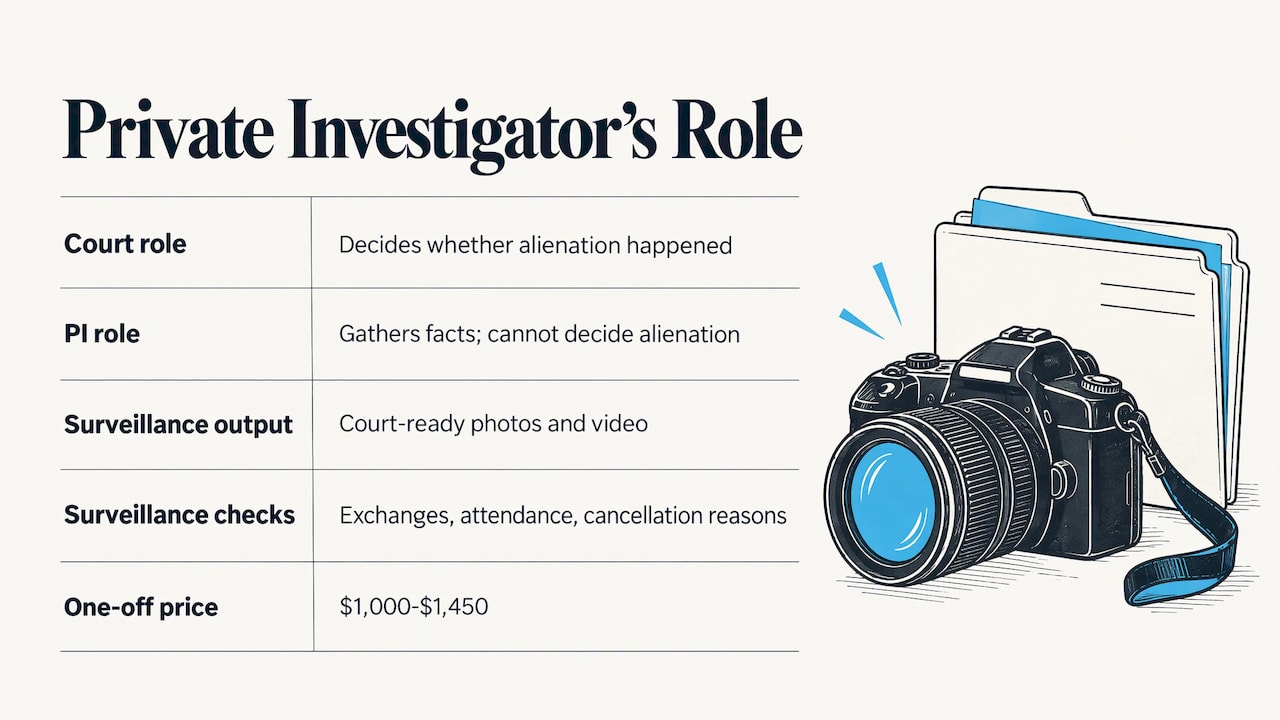
A private investigator does not decide whether alienation has happened. That is for the court. What an investigator can do is gather facts you cannot gather yourself without risk, and present them in a form that can be filed.
Our investigators are experienced former police, military and polygraph specialists, and our work for family law matters is built around evidence for legal proceedings. Our surveillance produces court-ready photos and video, which is useful when the question is what actually happened at an exchange, who was present, or whether a stated reason for canceling contact holds up. Investigations are tailored to each client’s circumstances, and discretion is part of the job, which matters when a child is in the middle.
Surveillance on our site is published at $1,000 to $1,450 as a one-off price, and the surveillance cost page explains what drives it. Other family matters are scoped to the case.
When the other parent has moved or cannot be found
Some alienation cases involve a parent who relocates with the child, sometimes abroad, and stops communicating. Finding people across borders is part of what we do. Our team includes former FBI and military agents, and our page on a former FBI agent for missing persons and child abduction explains how that experience is used. Our guide to locating a missing person sets out the first steps, and a UK case is described in a private investigator finding a missing person in the UK. If you are weighing an investigator with a law enforcement or military background, ask what they can document and how it will be handed to your attorney. A child recovery matter involving a risk to the child’s safety should also go to the police or an attorney at once.
Other facts that bear on custody
Custody disputes often turn on circumstances beyond contact records. A new partner living in the home can be shown through cohabitation investigation, and where finances are part of the case, asset search work can trace what has been hidden. Our family law services bring these strands together.
Working with your attorney
Evidence only helps if it is filed correctly. A family law attorney in your state will tell you what is admissible, whether to ask the court for an evaluation or a guardian ad litem, and how to respond if the other side claims your concerns are the real problem. Bring them your log, your saved messages and a one-page timeline. If you have hired an investigator, ask for the report to be addressed so your attorney can use it directly.
Be prepared for the court to examine the child’s reasons carefully. If there is any history of abuse or neglect, a court will want that explored first, and your attorney needs to know about it from the start.
Perspective
Most parents who come to us with this problem arrive with a feeling and a folder of screenshots. The feeling is real. The folder is rarely enough.
What changes outcomes is independent, factual documentation: who was where, when, and what was said and done in front of the child. We run investigations around the client’s actual circumstances, and our investigators come from police, military and polygraph backgrounds, which means they are used to recording facts and leaving conclusions to the court.
Our advice is the same whatever the case: keep your own record calm and dated, do not involve the child, and where the other parent’s conduct is out of your sight, get it documented properly rather than guessing. A court-ready photo or video of a handover will say more than any argument about it.
P.i Melbourne
Talk to us about your case
If the other parent’s conduct is happening where you cannot see it, or you need to find a parent or child who has moved, our team can scope an investigation around your situation and your attorney’s needs. See our family law investigation services or get in touch through Pi Melbourne.

FAQ
How hard is it to prove parental alienation?
It is difficult, by design. The court must find that the child’s rejection is unjustified, that it is not ordinary preference or a response to your own behavior, and that the other parent’s conduct caused it. The 2024 England and Wales guidance says such behaviors are relatively rare and that a child’s reluctance can have many causes. A dated, factual record is the best foundation in any state.
What are the main signs of parental alienation?
In the parent, common signs include bad-mouthing the other parent, limiting contact, interfering with calls and messages, and asking the child to keep secrets or report back. In the child, they include harsh criticism with weak reasons and no guilt. Signs prompt you to document. They do not prove anything alone.
How do I document parental alienation?
Keep a dated log of facts, save full message threads, record every scheduled and missed visit, and note who witnessed what. Capture social media posts with the date and account visible. Do not question or record the child, and ask your attorney about your state’s recording rules before taping any call.
What evidence helps in a child custody case more broadly?
Courts weigh the child’s safety first, then each parent’s conduct and the child’s relationship with each. Written communications, contact records, witness accounts and independent documentation of events all help. Your attorney will tell you what your state’s court expects.
Sources
- ABA chapter on parental alienation
- Oregon courts, Resist/Refuse guide for judges
- Family Justice Council guidance, December 2024
- Bernet, The Five-Factor Model for the Diagnosis of Parental Alienation
- ABA, Litigating Parental Alienation
- Have American jurisdictions passed legislation on parental alienation
- Superior Court of Pennsylvania opinion J-A04007-25
- Federal Bar Association, Custody Experts After Kayden’s Law
- Youth Today, new Utah law on child safety in custody courts
- BBC News, new guidance on parental alienation