
Surveillance costs depend on which kind you need. A camera system for your property averages $1,288 installed in the US, with monthly fees on top. Surveillance carried out by people, an investigator following a subject and documenting what they do, is priced by the day. Our surveillance service is listed at $1,000–$1,450 one-off, and the rest of this guide shows what drives that number up or down.
TL;DR
- Fixed cameras: most US homeowners pay $590–$2,040 to have them installed, and labor is 50%–70% of that bill.
- Monitoring and storage are the recurring costs, often more than the hardware over three to five years.
- Investigator surveillance is a different product: it follows a person, not a doorway. Our surveillance service is listed at $1,000–$1,450 one-off.
- Hourly investigator rates in the US average about $132, so a full day of covert work is a four-figure decision.
- A defined goal, a known routine and court-ready footage keep the cost down and the result useful.
Table of Contents
- Two things people mean by “surveillance cost”
- What fixed surveillance costs in the US
- What investigator surveillance costs
- Who does the work matters
- Worked example: a spouse and two evenings
- How to keep surveillance cost under control
- Perspective
- Start with your situation
- FAQ
- Sources
Two things people mean by “surveillance cost”
The search brings up two very different purchases.
Fixed surveillance is equipment: cameras, a recorder, cabling and perhaps a monitoring contract. It watches a place, around the clock, and it is yours to keep.
Investigative surveillance is a service. A trained investigator watches a person or a location for a set period, usually discreetly, and produces dated photos, video and a written log. It follows someone through traffic, to a workplace, to an address, and it is what people hire when they suspect infidelity, staff misconduct, a false injury claim or a custody problem.
The first is a purchase you make once and run for years. The second is a short, targeted engagement. We cover both below so you can see which budget you are actually working with. If you are a person or business with a question about someone’s behavior, the second is almost always the one you need, because a camera on a wall cannot follow anyone.
What fixed surveillance costs in the US
Installation
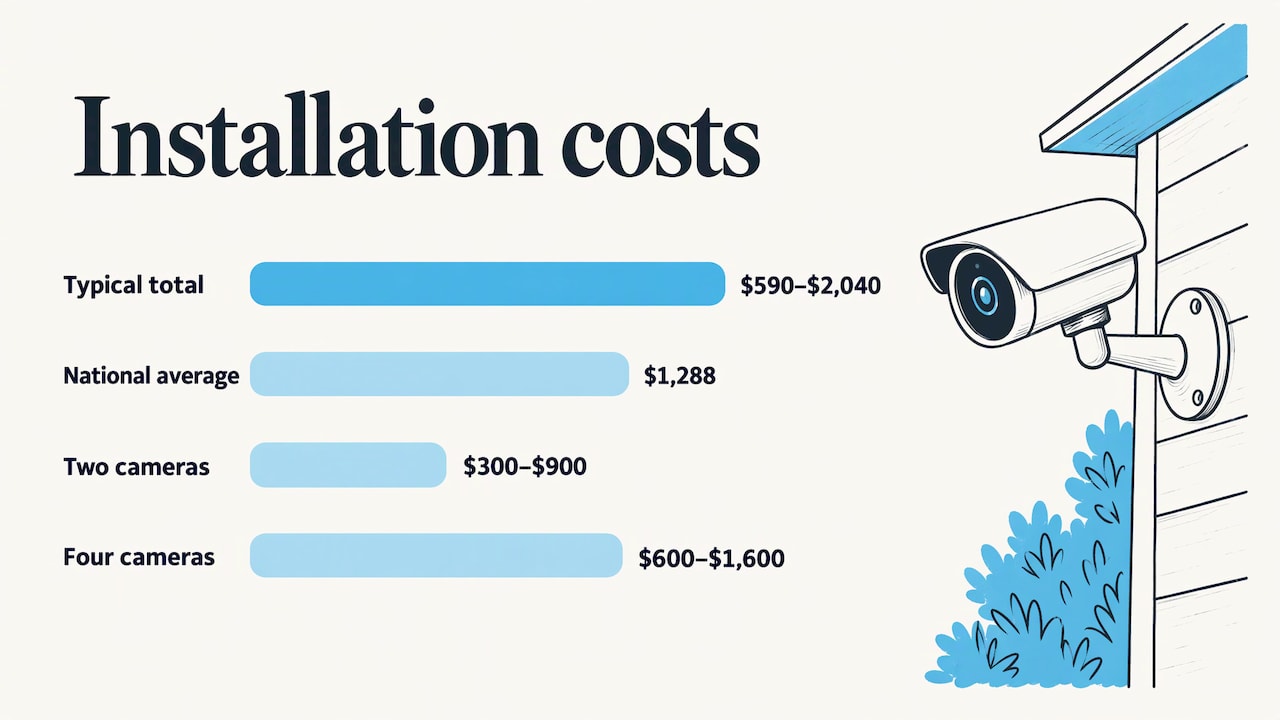
Angi’s 2026 guide, built on 4,027 verified projects, puts the national average for security camera installation at $1,288, with most homeowners paying $590–$2,040. It suggests budgeting another $150–$200 for add-ons such as a monitor and extra storage.
HomeAdvisor’s 2026 figures break the project down: cameras at $25–$500 each, labor at $80–$200 per camera, and labor making up 50%–70% of the total. That is why two quotes for “four cameras” can differ so much. A wireless set on one wall is a different job from wired cameras with cable runs through masonry.
For small setups, Airtasker’s US guide (updated 17 November 2025) lists two cameras at $300–$900 and four cameras at $600–$1,600, with outdoor installs adding roughly $150–$450 per camera for weatherproofing and mounting.
Monthly and hidden costs
The sticker price is rarely the full bill. Typical recurring items in 2026:
| Item | Typical cost | Source |
|---|---|---|
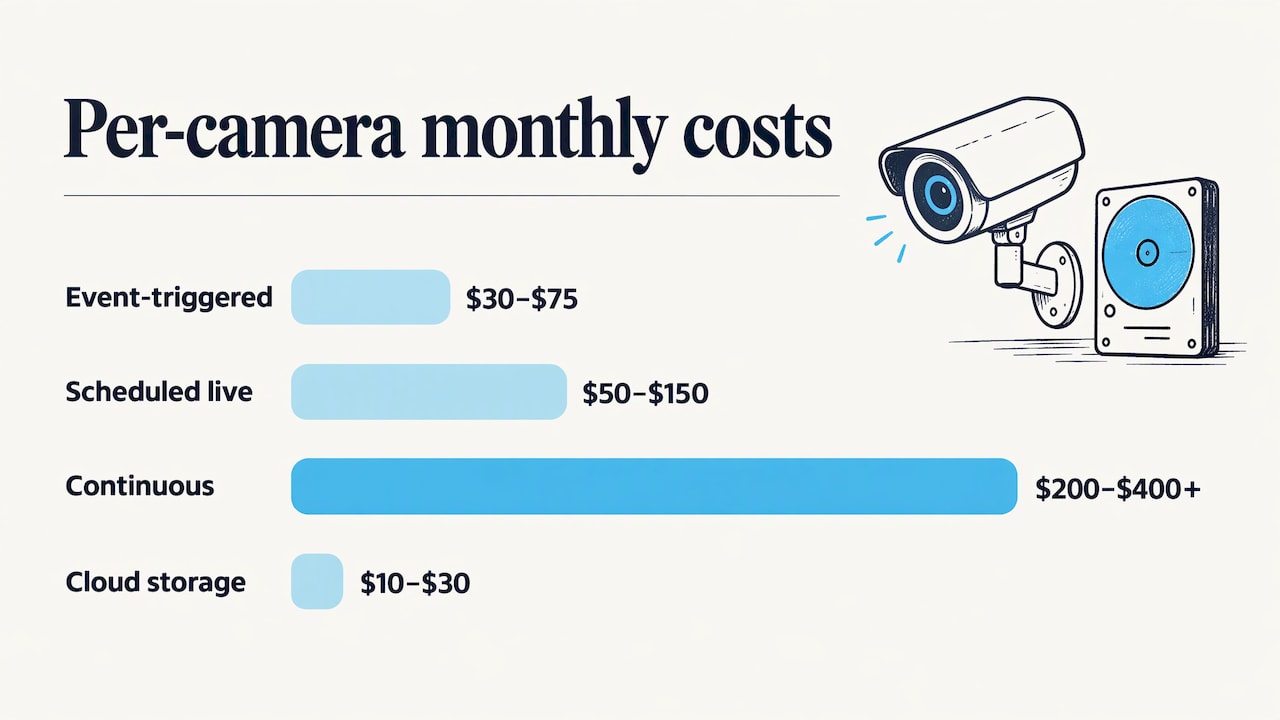
| Event-triggered monitoring | $30–$75 per camera per month | Commercial Security Quotes |
| Scheduled live monitoring | $50–$150 per camera per month | Commercial Security Quotes |
| Continuous monitoring | $200–$400+ per camera per month | Commercial Security Quotes |
| Cloud storage and video software | About $10–$30 per camera per month for 30-day retention | Surveillant |
| Home professional monitoring | $20–$80 per month | Monitoreal |
Contracts matter as much as rates. Most monitoring agreements run 12–36 months, and early-termination exposure is typically 50%–100% of the remaining contract value, so a cheap per-camera price on a 60-month term can cost you more than a higher price on 12 months, as Commercial Security Quotes explains.
Surveillance hard drives typically last 3–5 years, and a ten-camera network can run $100–$300 a month in storage. Over three to five years, subscriptions often cost more than the original hardware, according to Monitoreal’s 2025 pricing overview, which notes the figures may have risen since.
Homes versus businesses
Home systems often cost $300–$3,000 up front. Business systems typically start around $5,000 and can pass $100,000 across multiple sites, depending on camera count, infrastructure and cloud subscriptions, per the same Monitoreal comparison.
If you are an employer, the money is only half the question. What you may record, where and with what notice is set by law. Our guide to workplace surveillance laws explains what employers can legally monitor, and it is worth reading before you buy a single camera. HireSecurityNow also stresses getting audio-recording and employee-notice rules right before you record.
What investigator surveillance costs
Here the price is not equipment but people, time and skill. Our surveillance service is listed at $1,000–$1,450 one-off. That is the published range for a surveillance engagement, and the exact figure within it depends on the case.
For context, a 2026 survey of 32 US investigation firms found an average hourly rate of $132, with rates ranging from $25 to $250. Because covert work is hours of waiting, following and documenting, hourly billing turns into a day rate quickly. A fixed published range for a surveillance engagement lets you plan the spend before work starts.
What moves the price
- How much time you need covered. A single early-morning departure is cheap. A week of evenings is not.
- How well the routine is known. If you can tell the investigator where the subject lives, what car they drive and when they usually leave, hours are used on observation instead of searching.
- How many investigators the job needs. One person can follow a predictable subject on foot. A subject who drives fast through dense traffic, or an address with several exits, usually needs more than one person.
- What the footage is for. Material meant for a family law matter or a court needs careful dating, continuity and a clear log. Our evidence is gathered with legal proceedings in mind, using technology designed to produce court-ready photos and video.
- Travel. Following a subject between cities, or across borders, adds time and logistics.
Why a camera cannot do the same job
A fixed camera records everything in front of it and nothing beyond. It cannot show where your partner went after leaving work, who an employee met at lunch, or whether someone claiming an injury is lifting heavy loads at a second job. Investigators move with the subject, and the written log ties the images to times and places. That is what makes surveillance evidence usable when a lawyer, insurer or employer needs to act.
If the question you are trying to answer is about a person, the cost that matters is the cost of getting a clear answer once, not the cost of running equipment for years.
Who does the work matters
You are paying for judgment. Knowing when to hold back so a subject does not notice, how to document a scene so it stands up later, and when to stop are skills, not features.
Our investigators are experienced former police and military personnel and polygraph specialists, and the firm has operated since 2006. Our approach is to tailor each investigation to the client’s situation instead of running the same script on every case.
Hiring ex-military investigators
People often ask about hiring ex-military talent directly. Discipline, patience and field awareness carry over well into surveillance, where the job is to stay unnoticed for hours and record accurately. Our team includes ex-military investigators, and you can read more on our ex-military security page. When you ask about former special-forces experience, such as SAS-type backgrounds, the practical question is the same: what is the task, what is legal, and what evidence do you need at the end? Describe the problem and we will tell you how an investigation would be run.
Advice from former FBI staff
Some clients, especially those with cross-border cases, want the view of a former FBI agent before they decide anything. Our team draws on former FBI experience, particularly for missing persons and child abduction matters. Our former FBI agent page explains how that experience applies. An early conversation usually settles whether you need surveillance, a locate, or a legal step first, which can save you from paying for the wrong thing.
Finding people anywhere in the world
Surveillance often starts with a simple problem: you do not know where the person is. Locating someone, whether a relative who has stopped answering, a debtor or a parent who has taken a child abroad, is a separate piece of work that comes before any watching. Our guide to locating a missing person lays out the first steps, and we have handled cases overseas, such as finding a missing person in the UK. Once an address is confirmed, surveillance can document the daily pattern there.
Worked example: a spouse and two evenings
This example is illustrative, not a client case.
Suppose you believe your spouse visits someone on Tuesday and Thursday evenings after work. You tell the investigator the workplace address, the car and the usual finish time. Surveillance is set for those two evenings. The investigator picks up the car at the exit, follows it, and records arrival and departure times and any contact, with a dated log. Because the pattern was narrow and the window short, the engagement stays at the lower end of the range. If you had said only “sometime this month”, the same answer would take many more hours.
The same logic applies to employers watching a staff member suspected of theft, or to a family worried about a teenager. For the family case, see our pages on teenage monitoring and employee theft investigation.
How to keep surveillance cost under control
- Define one question. “Does he go to this address on Thursdays?” is cheaper to answer than “what is she up to?”
- Share what you know. Addresses, vehicles, schedules and photos save hours.
- Pick the days with the highest chance. Your own knowledge of the routine is the most valuable input.
- Plan the evidence use first. If the footage may go to a lawyer, tell us at the start, so continuity and documentation are built in. Read how footage is treated in video evidence in court and why chain of custody matters.
- Decide when you will stop. Agree a number of sessions in advance, then review.
Perspective
We get asked about cost before anything else, and the honest answer starts with what the money is meant to prove. Equipment is cheap compared with an unclear question. A person who needs to know where someone goes, and who needs it in a form a lawyer, employer or insurer can use, is buying an answer, not footage.
Our investigators are former police, ex-military and polygraph specialists, and since 2006 we have built each engagement around the client’s situation instead of a fixed package. That is why we publish a surveillance range of $1,000–$1,450 one-off: you can see the scale of the decision before you call.
The best value comes from a narrow question, a known routine and evidence collected correctly the first time.
P.i Melbourne
Start with your situation
If your question is about a person, talk to us before you spend on equipment. We run surveillance for suspected infidelity, corporate misconduct, family law matters, insurance and WorkCover claims, and child welfare concerns, with former law-enforcement and ex-military investigators and court-ready photos and video. Our surveillance page shows the published range, and our private investigation services cover the rest.
Tell us what you know, what you need to prove and by when, and we will tell you how an investigation would be planned.
FAQ
How much does surveillance cost?
It depends on the type. Installing cameras at a US home averages about $1,288, with most projects between $590 and $2,040. Investigator surveillance of a person is a service: ours is listed at $1,000–$1,450 one-off.
Is monthly monitoring included in the camera price?
Usually not. Monitoring runs about $20–$80 a month for a home, and business monitoring is quoted per camera. Storage and software are billed separately in many cases, so ask for the full monthly total and the contract length.
Can surveillance footage be used in court?
It can, but admissibility depends on how it was gathered, stored and presented, and on the laws of the place where it was recorded. For a legal matter, discuss the plan with your lawyer and with us from the start. Our guide on video evidence in court explains the main points.
Can you find someone who lives in another country?
Often yes. Locating comes first, then surveillance if you need the person’s activity documented. Our experience includes overseas missing-person cases, and the outcome depends on what information you already have.
Sources
- Angi: security camera installation cost, 2026
- HomeAdvisor: cost to install a surveillance camera
- Airtasker US: CCTV installation cost guide
- Commercial Security Quotes: video surveillance monitoring costs
- Surveillant: commercial security camera system cost
- Monitoreal: surveillance pricing for homes and businesses
- iFactory: total cost of ownership for CCTV
- HireSecurityNow: video surveillance and CCTV guide
- Zealous Advocate: private investigator cost, 2026