
An asset search in a divorce combines legal disclosure, record analysis and, where needed, licensed investigation to find money and property a spouse has not reported. It starts with the paperwork you can compel through your lawyer. It then moves to forensic accounting and field investigation when the numbers do not add up. The sections below explain each stage, what is lawful, and where a private investigator fits.
TL;DR
- Start with formal disclosure and discovery through your attorney: tax returns, bank statements, business records and sworn financial statements.
- Warning signs such as unusual transfers, missing statements or spending that does not match reported income justify a closer look, but they do not prove concealment.
- Forensic accountants trace money through commingled accounts; investigators add public-record work, surveillance and locating people or property, including overseas.
- Hacking, pretexting and unauthorized access to accounts or devices are not investigative methods. They can damage your case and expose you to criminal liability.
- Hire an investigator early, once you have a lawyer and a specific question to answer.
Table of Contents
- What an asset search in a divorce involves
- Warning signs a spouse may be hiding assets
- Records that reveal undisclosed assets
- Lawful ways to obtain financial records
- How forensic accountants and investigators trace assets
- Surveillance in an asset case
- Finding people and assets around the world
- Hiring former FBI staff and former military investigators for advice
- What hidden-asset evidence can change
- Working with a private investigator on an asset search
- Talk to us about your case
- FAQ
- Sources
What an asset search in a divorce involves
Asset tracing follows the money. In family-law disputes it can reveal hidden or undervalued assets and undisclosed income. It can also show where an asset came from, how it was used, and whether it was acquired before, during or after the relationship, or received as a gift or inheritance, according to Grant Thornton Australia.
In the United States, tracing can cover cash and bank accounts, securities, real property, corporate interests and digital assets. Courts generally permit tracing through mixed funds, including by using the Lowest Intermediate Balance Rule, as a 2026 Baker & Hostetler chapter on U.S. asset tracing explains.
The hard part is usually commingling. When separate and shared money sit in the same account, ownership and value become difficult to identify. Tracing then has to follow both the source and the later use of the funds so that marital property can be separated from separate or third-party interests.
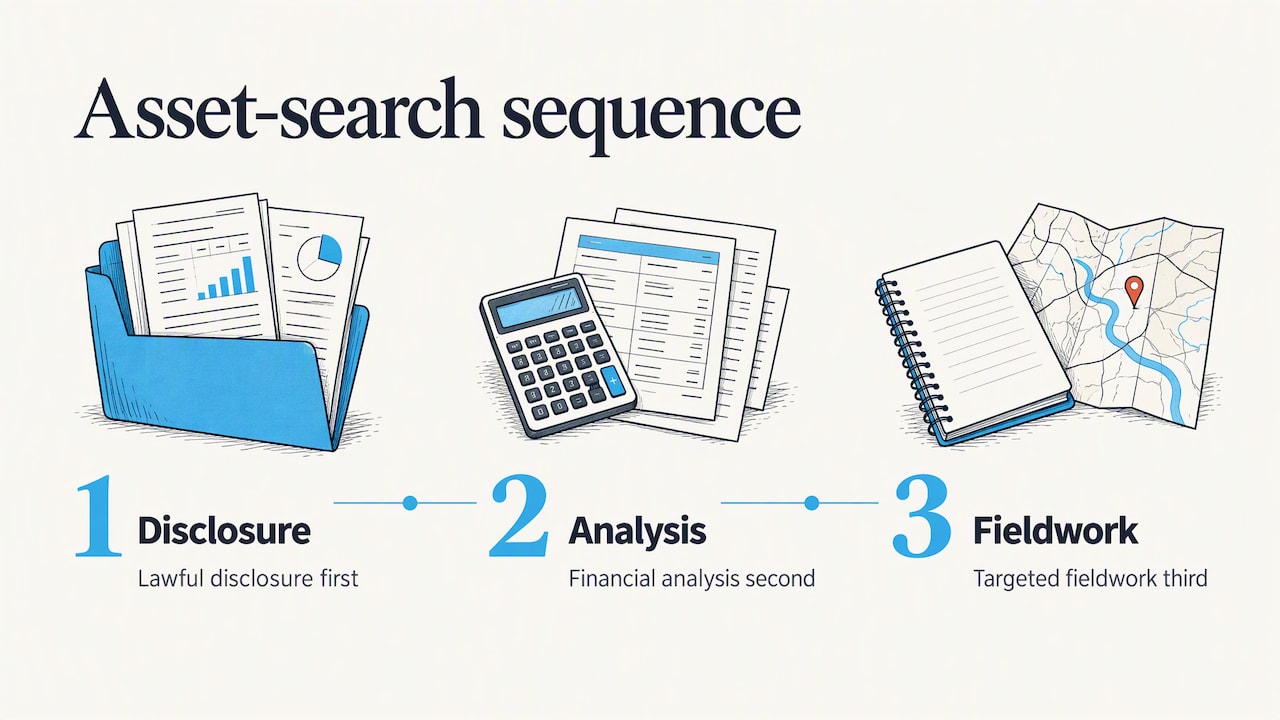
That is why a good asset search is rarely one task. It is a sequence: lawful disclosure first, analysis second, targeted fieldwork third.
Warning signs a spouse may be hiding assets
No single clue proves anything. Patterns matter more than one odd transaction. Nolo’s guide to hidden assets lists signs that deserve attention:
- unusual withdrawals or transfers
- missing statements or changed account passwords
- discrepancies in financial documents
- large gifts or sham loans to friends or family
- sudden claims of business or income losses
- spending that does not fit reported income
- pressure to sign a settlement quickly
- reluctance to share financial information
Other concealment techniques described by U.S. family-law practitioners include delayed invoicing in a business, unreported cash income, fabricated vendors or expenses, deposits into undisclosed accounts, and transfers to custodial or app-based accounts, as Coover Law’s 2022 article outlines.
Write down what you notice, with dates, and give it to your attorney. Do not confront your spouse or move money yourself in response. Both can tip off the other side and complicate your own position.
Records that reveal undisclosed assets
The American Bar Association’s guide names the documents that most often matter: bank statements, credit reports, tax returns and schedules, business ledgers, appointment books, business assets, mortgage-closing documents, financial affidavits and social-media information.
Two of these deserve a closer look.
Credit reports. The ABA explains that a report can show open and closed cards for at least the preceding seven years. That can expose loans you never knew about, or valuable purchases.
Tax returns and business records. A lifestyle analysis compares what a household spends with what it reports earning. Discrepancies between expenses and known income are red flags, and bank statements, returns and ledgers help identify funds that were never disclosed.
What to look for in each record
| Record | What it can show |
|---|---|
| Tax returns and schedules | Income sources, interest and dividends that point to accounts you do not know about |
| Bank and brokerage statements | Transfers out, new accounts, cash withdrawals, payments to relatives |
| Credit reports | Loans, credit lines, recent applications listing assets |
| Loan and mortgage applications | Asset and income figures the applicant stated to a lender |
| Business ledgers and invoices | Delayed billing, invented expenses, retained profits |
| Property records | Real estate held personally, jointly or through an entity |
Loan applications are worth singling out. People often state their assets generously to a lender and modestly in a divorce. Your attorney can request them.
Lawful ways to obtain financial records
The core tools sit inside the court process. They are cheaper than most people expect and they produce evidence a judge will accept.
In Connecticut, for example, the judicial branch’s family discovery guide describes mandatory disclosure plus discovery. Discovery can obtain relevant, nonprivileged documents and electronically stored information within the other party’s knowledge, possession or power. Rules differ by state, so your attorney will apply your own state’s procedure.
Common discovery steps in U.S. family cases include:
- Requiring your spouse to produce tax returns, pay stubs, bank statements and similar documents within the deadline the rules set.
- Subpoenaing an employer for pay and bonus records.
- Subpoenaing banks where you suspect an account exists.
- Deposing your spouse about where assets might be.
A Michigan or New Jersey firm will describe the same list with local timing. The principle is the same everywhere: ask formally, under oath, and let the court enforce the answer.
What is not lawful matters just as much. An Australian family-law guide from Pearce & Lock Family Lawyers notes that unauthorized access to accounts, devices, communications or business records may breach criminal, surveillance, interception, privacy or computer-access laws. U.S. readers face the same kind of exposure under federal and state law. Reading your spouse’s email, installing spyware or logging into their bank account can turn you from the injured party into the defendant.
How forensic accountants and investigators trace assets
Two professions usually work alongside your attorney.
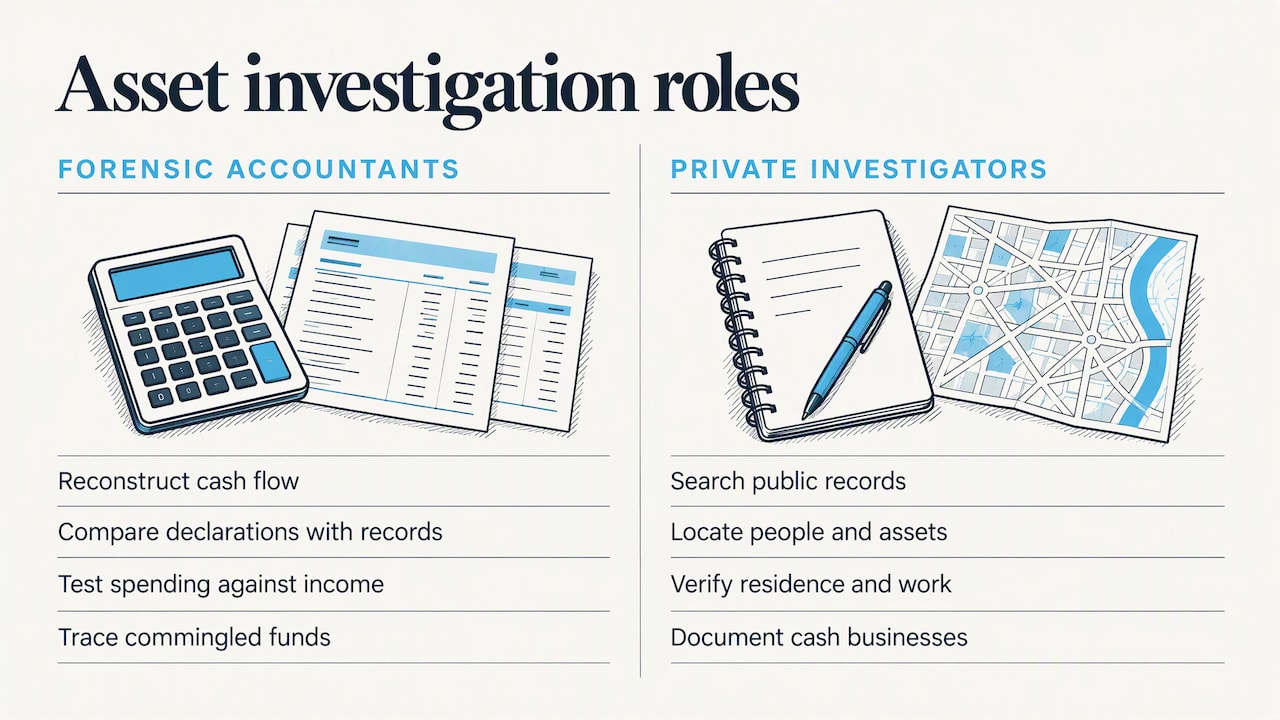
Forensic accountants reconstruct cash flow. They compare declarations with bank, tax, business and property records, then test spending against reported income. The American Bar Association’s description of lifestyle analysis says the expert tabulates income and expenses, historical spending, returns, statements and other records to test income claims and locate hidden income or assets.
When funds are commingled, they apply recognized methods. CBIZ describes direct tracing, exhaustion (or community-out-first) analysis, minimum-sum-balance analysis and clearinghouse tracing as ways to separate separate-property funds from marital ones.
Skoloff and Wolfe’s article in the American Journal of Family Law recommends a plain sequence: identify assets and how they were funded, identify liabilities and what they paid for, list all income sources and family expenses, then test unexplained acquisitions, loan or sale proceeds and missing income.
Licensed private investigators do the work that does not live in a ledger: public-record searches, locating a person or an asset, verifying where someone lives and works, documenting a business that appears to operate on cash, and lawful surveillance that shows lifestyle or activity. Our own asset search investigation service is built around this kind of evidence, and our guide to how to locate hidden assets covers the methods and their limits in more detail.
Surveillance in an asset case
Surveillance is not the first tool in an asset search, but it earns its place in specific situations.
- A spouse claims a business is failing, yet customers keep arriving and cash changes hands.
- A person says they live modestly but regularly visits a property, storage unit or second residence you were not told about.
- Income is reported as reduced while a lifestyle continues unchanged.
- You need to know who a spouse meets, such as an accountant, a relative holding transferred funds, or an overseas contact.
The value is evidence a court can use. Photos and video taken by a licensed investigator, with dated logs and a clear chain of custody, carry weight that your own snapshots do not. Our surveillance services are designed to produce court-ready material, and surveillance is published on our site at $1,000 to $1,450 one-off; see our cost guide for what that covers.
Lawful surveillance stays in public places and follows local privacy and surveillance law. Anyone who offers to track a device or intercept messages is offering you a legal problem.
Finding people and assets around the world
Money rarely stays in one country. Warning signs can include new overseas accounts or properties, offshore trusts, shell companies and crypto wallets. Guides from England and Wales firms, such as Payne Hicks Beach and Vardags, list these as common routes. One English court judgment, AW v AH, describes a forensic inquiry into whether shares in a Hong Kong company, held by a business associate, were beneficially owned by a spouse.
Cross-border searches usually come down to two questions: where is the person, and where is the asset?
Locating people is a core part of what we do. We handle missing-persons work, and our case of a missing person found in the UK shows how a search reaches beyond one country. A former business partner, a relative holding a transferred asset or a spouse who has left the jurisdiction can all be located through public records, open-source research, and inquiries on the ground.
A few practical points for international cases:
- Jurisdiction decides what can be compelled. A U.S. subpoena does not reach a foreign bank by itself. Your attorney may need local counsel or a treaty route.
- Local law governs the investigator too. A reputable firm works within the privacy and surveillance rules of each country, and tells you what it cannot do.
- Digital assets leave trails. Exchange accounts and wallet transfers can appear in bank records as payments to a platform. A forensic accountant can follow those.
Hiring former FBI staff and former military investigators for advice
Many readers ask whether a former federal agent or a former soldier is worth hiring. The honest answer: the badge is not the product, the skill is.
Former law-enforcement investigators bring habits that matter in asset cases: building a timeline, documenting everything, knowing how evidence must be handled so it survives a challenge, and interviewing people calmly. Our firm, established in 2006, draws on experienced investigators from police, military and polygraph backgrounds, and our team includes former FBI and military agents. If you want an adviser who has run serious investigations, our former FBI agent page explains how that experience applies to missing persons and child abduction cases and to related work.
An adviser with a military background brings surveillance discipline, patience, planning and comfort working in unfamiliar places, which helps when a search takes you to another country. The same applies if you are looking for someone with a special-forces background, including a former SAS soldier: ask what the person actually did, what investigative or surveillance work they have done since, and whether they hold the license required where you need the work done.
Questions to ask any adviser, whatever their background:
- Are you licensed for the work in the place it will be done?
- Have you worked family-law matters, and will you work with my attorney?
- How will you document findings so a court can use them?
- What will you refuse to do? (A good answer includes hacking and pretexting.)
- How are you billed, and what is the likely range?
A war record does not make someone a good financial investigator. Look for the combination: field skill, record skill, and respect for the law.
Our view: evidence beats suspicion
In our experience, divorce clients rarely lose because they lacked a hunch. They lose because they lacked evidence in a form a judge can rely on. Our approach is to tailor each investigation to the client’s situation and to build it so it holds up in legal proceedings.
We favor starting with the lawful route, your attorney’s disclosure requests, and using investigation to answer the questions those documents raise: where is this person, what do they own, who holds it for them, and does their daily life match what they have sworn to?
That is why our team combines former police, military and polygraph specialists with careful documentation. Our claim is not that we find everything. It is that what we find is gathered lawfully and presented clearly, so your lawyer can use it.
P.i Melbourne
What hidden-asset evidence can change
The consequences depend on the court and the facts. Some examples from the research:
- In Australia, hidden-asset evidence may lead to compelled disclosure, costs orders, adverse inferences, contempt where established, or setting aside property orders or agreements when statutory grounds are met, according to the Pearce & Lock guide. Outcomes are discretionary and fact-specific.
- In England and Wales, the official Form E1 warns that incomplete disclosure may lead to an order being set aside, and that false statements under a statement of truth may lead to contempt proceedings.
- In Rose v Rose (2022), an English Family Court listed direct evidence of undisclosed assets, breaches of disclosure orders and a lifestyle inconsistent with disclosed resources as bases for adverse inferences.
These are not U.S. rules, and U.S. courts apply their own state statutes. They show a common pattern: courts take concealment seriously, and well-documented evidence moves a case.
Working with a private investigator on an asset search
A workable order of operations looks like this:
- Hire a family-law attorney first. They control disclosure and tell you what is admissible in your state.
- Gather what you already have. Old tax returns, statements, loan applications, receipts and a list of what you suspect.
- Define one question at a time. Where does this person live now? Does this business trade? Who owns this property?
- Brief the investigator through your attorney where possible. That helps keep the work organized and, in many cases, protected.
- Review findings together. Decide which belong in a disclosure request, a subpoena or a forensic accountant’s brief.
Our guide to asset recovery investigation walks through how hidden assets are found once you move from suspicion to action.
Talk to us about your case
We handle asset searches, surveillance, missing-persons work and evidence collection for family-law matters, and we serve clients worldwide. Each engagement is scoped to your situation and your attorney’s needs. Start with our asset search investigation page, or see all our private investigation services and our family law support.

Tell us what you know and what you need to prove, and we will tell you plainly whether investigation can help and what it would involve.
FAQ
How much does an asset search for divorce cost?
It depends on the scope: a records review costs far less than a multi-country location search with surveillance. Our surveillance is published at $1,000 to $1,450 one-off, and other work is quoted to the matter. Ask any provider for a written scope before you start.
Can I search my spouse’s accounts myself?
You can review joint accounts you legitimately hold and documents you are lawfully entitled to. Logging into your spouse’s private accounts or devices may be a crime. Ask your attorney to obtain the rest through discovery or a subpoena.
What is the difference between asset tracing and an asset search?
People use both terms for the same goal. Tracing usually refers to following funds through accounts and transactions, often with a forensic accountant. A search leans toward locating people, property and holdings through records and fieldwork. Most real cases need both.
Does high spending prove my spouse is hiding money?
No. Spending that does not match reported income is a reason to ask questions, but it is not proof by itself. Courts look for patterns, such as transfers, missing documents and changes in paperwork, alongside lifestyle.
Can an investigator find assets in another country?
Often they can locate people, companies and property through public and open-source records and local inquiries. Compelling a foreign bank or registry to produce records is a legal step for your attorney, usually with local counsel.
Sources
- Uncovering hidden assets in family law disputes, Grant Thornton Australia
- United States chapter, International Fraud and Asset Tracing, Baker & Hostetler
- How to Find Hidden Assets During a Divorce, Nolo
- Find Out if Your Spouse Is Hiding Assets During Divorce, Coover Law
- Finding Hidden Assets During Divorce, American Bar Association
- Discovery (Financial) in Family Matters, Connecticut Judicial Branch
- Financial Disclosure and Hidden Assets in Divorce, Pearce & Lock
- Lifestyle Analysis in Divorce Cases, American Bar Association
- Applicable Asset Tracing Methods in a Divorce Matter, CBIZ
- Building the Financial Aspects of a Divorce Case, Skoloff and Wolfe
- Hiding Assets in Divorce: Your Options, Payne Hicks Beach
- Asset Tracing in Divorce, Vardags
- AW v AH judgment, Royal Courts of Justice
- Form E1 Financial Statement, GOV.UK
- Rose v Rose & Ors [2022] EWFC 192, BAILII