
A child custody investigation is a fact-finding exercise: someone observes how a child is actually cared for and records it so a judge can rely on documented facts instead of two competing stories. A private investigator does this for one parent by lawfully documenting behavior, routines and living conditions. The result only helps if it was collected legally, recorded carefully and kept in a form a court will admit. That is why experienced investigators, not a worried parent with a phone, should do the watching.
At P.i Melbourne, custody and family law work sits alongside surveillance, missing persons and child recovery. Our investigators are former police, ex-military and polygraph specialists, and the team includes former FBI and military agents. This guide explains what a custody investigation covers, how it differs from a court-ordered evaluation, where the legal limits are and how to hire well.
TL;DR
- A private custody investigation documents observable facts (supervision, visitation compliance, living conditions, substance use, safety) so a judge has records rather than accusations.
- It is different from a court-ordered custody investigation or evaluation, which the court controls and which ends in a recommendation to the judge.
- Illegally gathered material can be excluded and can expose both the investigator and the client to criminal charges, so method matters as much as findings.
- Judges weigh whether a specific claim is supported, not how much material you bring: a few well-documented, authenticated items beat a thick folder.
- Our surveillance work is listed from $1,000 to $1,450 one-off; other family law and child recovery work is scoped to the case.
Table of Contents
- What a child custody investigation actually is
- What a private investigator for custody can lawfully do
- What an investigator must not do
- How evidence becomes usable in court
- Where a private investigation fits next to a court evaluation
- Hiring ex-FBI, ex-police and ex-military investigators
- Finding a parent or child who has disappeared
- Related situations that often travel with custody cases
- How to choose a custody investigator
- Our approach to custody and family law work
- Our perspective
- FAQ
- Sources
What a child custody investigation actually is
The phrase covers two different things, and mixing them up leads to wasted money.
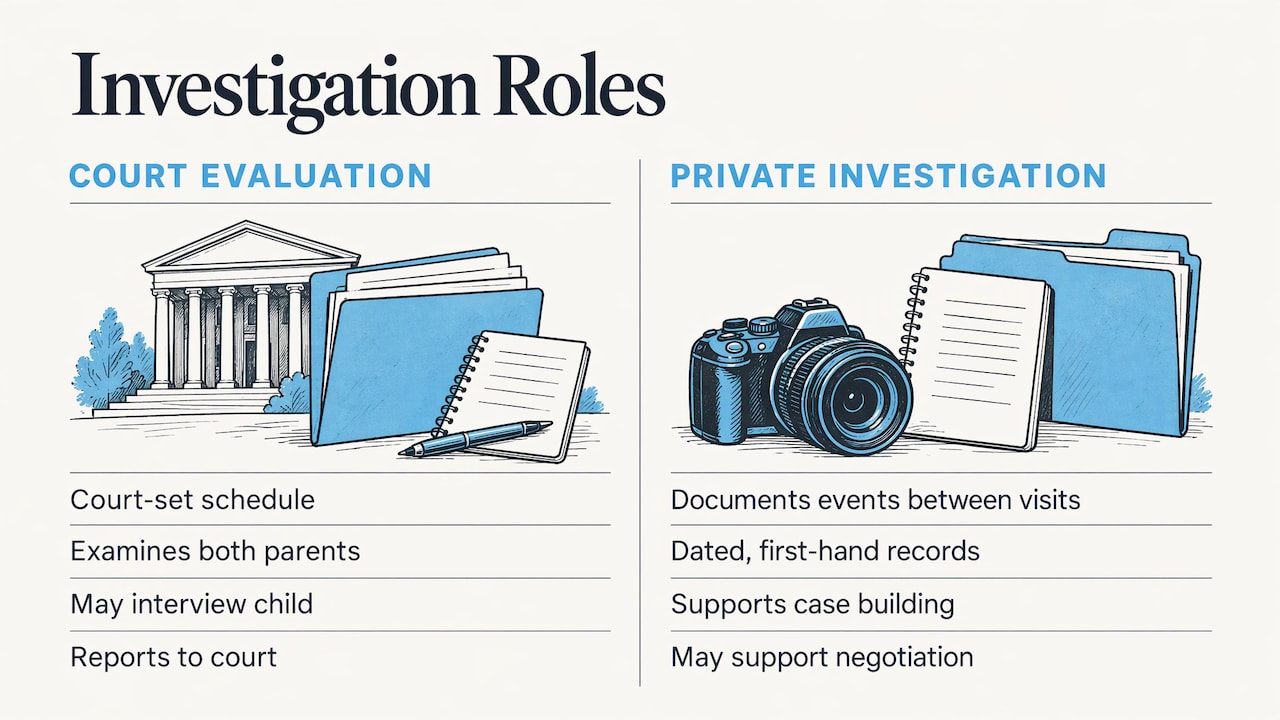
The first is a court-ordered investigation or evaluation. A judge appoints someone, such as a court staff investigator or a mental health professional, to examine the family and report back. Michigan’s Friend of the Court manual describes the purpose of its investigations as inquiring, examining, summarizing information and making a recommendation to the court, with the judge making the final decision. California’s Rule of Court 5.220 sets the framework for court-ordered evaluations, investigations and assessments, including what a full evaluation covers: the child’s health, safety, welfare and best interests.
The second is a private custody investigation, which one parent commissions. It does not replace the court’s process. It produces evidence that you and your attorney can put in front of the judge, or that you can use to decide whether to go to court at all.
In practice the private route answers questions like these:
- Is the other parent actually following the parenting schedule?
- Who is supervising the child during their time, and is it the person they claimed?
- What are the living conditions at the home?
- Is there drinking, drug use or dangerous driving while the child is in their care?
- Is a parent planning to relocate or leave with the child?
Investigators document this kind of day-to-day behavior, living conditions and quality of care through photos, video, background records and witness accounts, which gives the court something concrete to read.
What a private investigator for custody can lawfully do
The lawful toolkit is narrower than most parents expect, and that is a strength. Evidence a court will accept comes from observation in public places, records and properly handled witness information.
Surveillance
Surveillance is the core of most custody investigations. An investigator follows a pre-agreed scope: pickups and drop-offs, who is present during parenting time, where the child is taken, and whether the other parent is where they said they would be. The output is time-stamped photos and video with a written log of what was seen, by whom, and when.
Quality here is a skill. A single day of surveillance can be dismissed as unrepresentative, so scoping matters: which days, which exchanges, which locations. Our surveillance service is listed at $1,000 to $1,450 one-off, and we use advanced technology to produce court-ready photos and video. Our experienced ex-police and ex-military investigators know how to stay unnoticed in a school pickup line or a suburban street, which is where an untrained parent is spotted within minutes.
Background and records work
Investigators can verify claims that can be checked on paper: criminal and court history, who else lives at an address, and whether statements made to the other side are consistent with public records. Where a custody case also involves money, our team can run an asset search in a divorce, which matters when child support or hidden income is part of the dispute.
Witness accounts
Neutral witnesses with direct observations, such as a coach, a teacher or a neighbor, can be valuable. A careful investigator records what each person saw first-hand and separates it from opinion. A statement that begins with “I heard that” is hearsay and carries little weight.
Digital and social media material
Public posts can show activity, location and associations. How you capture them matters: a cropped screenshot with no date is easy to attack. Our guide to social media evidence covers what courts accept and how to preserve it.
What an investigator must not do
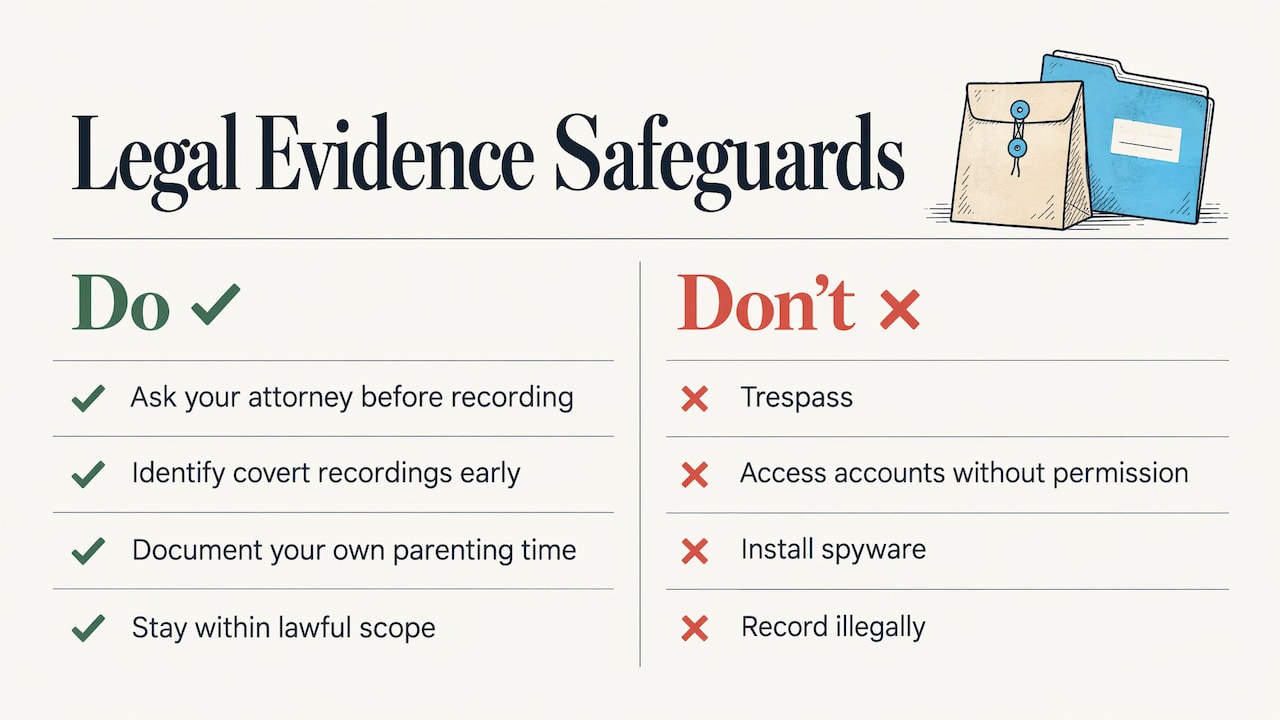
This is the part that protects you. Evidence gathered through illegal methods is typically inadmissible, and both the investigator and the client who directed the activity can face criminal charges. Trespassing, accessing someone’s accounts without permission, installing spyware and illegal recording are the usual traps.
The rules on recording vary sharply by state. Washington’s statute on illegally recorded private conversations, for example, was read by the state court as a rule of evidence aimed at the trial court rather than at the parties. In Nevada, the state supreme court said a father’s secret recording of his child and the mother likely violated state law, yet allowed a court-appointed psychologist to consider it because the child’s best interests outweighed the deterrent effect of suppression (Abid v. Abid, 2017). That outcome was specific to the facts and the expert-evidence statute involved. Nobody should plan a case around it. Ask your attorney what your state allows before anyone records anything.
The same caution is spreading beyond the US. The UK Family Justice Council’s 2025 guidance says covert recordings in children’s cases should be identified at the earliest possible stage so the court can manage admissibility, authenticity and welfare implications before the hearing.
One more practical point: a parent’s own recordings of a child, or evidence gathered by watching the other parent instead of documenting your own parenting time, can backfire. Documented’s research team notes that material gathered by watching the other parent rather than recording your own time can damage the person who brings it. A professional working to a lawful scope keeps you out of that trap.
How evidence becomes usable in court
Collecting facts is half the job. The other half is making them admissible and believable.
Authentication
Under Rule 901 of the Federal Rules of Evidence, each exhibit must be authenticated, meaning there must be enough to support a finding that the item is genuine. For a photo or message, that usually means someone explains how it was captured. State courts apply their own versions, but the idea is the same. An investigator who took the footage can testify to exactly that.
Chain of custody
Chain of custody is a documented record of who collected each item, when, how it was stored and who handled it. For digital files it includes preserving the original metadata. Our explainer on chain of custody shows how this keeps evidence admissible, and our guide to video evidence in court covers when footage is accepted and how to prove it.
Selection, not volume
A judge sees only the small selected set an attorney offers and the court admits. A judge deciding whether a schedule works needs the two photos that show what matters on the dates that matter, not four hundred. Other useful evidence a parent can assemble alongside an investigator includes school records, medical records, complete parenting communications and schedules showing actual overnights. Keep full conversations rather than cropped screenshots, and separate what you observed from what you inferred.
Some records are easier to admit than others. Massachusetts, for example, treats school records as generally admissible official records and police reports as admissible business records to the extent they record officers’ firsthand observations. Your attorney will know what your state allows.
Connect conduct to the child
Courts decide on the child’s best interests. A finding that a parent drinks is a lead; a finding that the parent drank and then drove the child to school is evidence. A good report ties adult conduct to its effect on the child and avoids character attacks.
Where a private investigation fits next to a court evaluation
Court-ordered investigators follow strict procedures. In Michigan they must cite all sources, including conflicting information, explain which version was given more weight, report both positive and negative information about the parents and send the report to the court, attorneys and parties at least seven days before the hearing. Minnesota’s statute lets a court-ordered investigator consult anyone with information about the child and requires a report stating each party’s position, an evaluation of the statutory factors and a recommendation with reasons.
California adds specific protections: where a court finds a serious allegation of child sexual abuse, any later evaluation counts only if it meets the minimum requirements in Family Code section 3118, including consulting child welfare services and law enforcement and filing a confidential report at least 10 days before the hearing. If abuse is suspected, contact the authorities and your attorney immediately.
The two processes support each other. A court evaluator examines both parents on a schedule the court sets and can interview the child. A private investigator produces dated, first-hand documentation of specific events between those visits and gives your attorney material to build a case or to negotiate. Michigan’s manual even notes that a well-written, objective report can spark productive discussions between parents in mediation and lead to agreement without a trial. Solid documentation often shortens disputes.
Hiring ex-FBI, ex-police and ex-military investigators
Many parents searching this topic ask whether to hire former FBI staff or former special forces soldiers, including ex-SAS, for advice. The background matters for specific reasons, not as a badge.
Former FBI and law enforcement investigators understand how evidence is built for prosecution: documenting a scene, preserving it, writing reports that survive cross-examination, and knowing what a judge will not accept. They also understand how abduction cases unfold. Our team includes former FBI and military agents, and we run a dedicated former FBI agent, missing persons and child kidnapping service for cases where a child has been taken.
Former military personnel bring disciplined surveillance habits: patience, route planning, low-profile positioning and accurate note-taking. If you are weighing ex-military hire, the questions to ask are about the work, not the résumé. Can they keep a surveillance log that holds up under questioning? Do they know where the legal line sits? Will they stay inside the scope you agreed? Our investigators include ex-military specialists alongside ex-police and polygraph experts.
One boundary applies to every background. A custody investigator is not a mercenary or an enforcer. Anyone who offers to confront the other parent, take a child or get evidence “by any means” is exposing you to criminal liability and to losing the case. The value of experience is knowing what not to do.
Finding a parent or child who has disappeared
Sometimes the investigation is not about conduct but about location: a parent has stopped responding, moved without notice or left the country with a child. Finding people across borders involves public records, travel and address history, interviews and coordination with authorities. Our guide on how to locate a missing person explains the first steps, and we have written about a case where a private investigator found a missing person in the UK.
If a child has been abducted or taken abroad, contact the police and your attorney first and at once. Our child recovery service works alongside that process; it does not replace it. Where the court or police hold a step, such as issuing an order or an alert, that is part of the process, and we work within it.
Related situations that often travel with custody cases
Custody disputes rarely arrive alone. These are the connected issues we see in the service lines we offer:
- Safety concerns after separation. If you are gathering material for a protection order, read our guide to restraining order evidence.
- A new partner living in the home. Proof of who lives where can affect support and parenting arrangements; see our guide to cohabitation investigation.
- Infidelity as part of the breakdown. Our guide to proof of cheating explains what courts accept.
- A teenager at risk. Our teenage monitoring service is built for parents worried about an older child.
How to choose a custody investigator
Use this short list before you sign anything:
- Check licensing where it applies. Many states require private investigators to be licensed. Look up your state’s issuing agency and confirm the license and any disciplinary history. Licensing is treated as the single most important credential by hiring guidance because a licensed investigator knows the legal lines.
- Ask about custody-specific experience. Surveillance of a parent at a school exchange is different from following a cheating spouse.
- Agree a written scope. It should state what will be observed, on which days, what you will receive and the total estimated cost.
- Ask how evidence is handled. You want original files, a log and a clear chain of custody.
- Involve your attorney early. They decide what is relevant in your state and what the court will admit.
Our approach to custody and family law work
Our family law investigations are tailored to each client’s circumstances. A former-police or ex-military investigator handles the fieldwork, using technology that produces court-ready photos and video. If surveillance is the right tool, our listed price is $1,000 to $1,450 one-off; for other services, we scope the work to the case. You can see the full range on our private investigation services page.

If you are ready to talk through your situation in confidence, start at pimelbourne.com.au.
Our perspective
Parents come to us afraid, and fear makes people reach for shortcuts: a hidden recorder, a borrowed password, a confrontation at a handover. Every one of those can cost you the case and put you at legal risk.
We take the opposite approach. The question is what a judge needs to see to decide what is best for your child, and how to collect it lawfully, record it accurately and keep it intact. Our investigators come from policing, the military and polygraph work, and the team includes former FBI and military agents. They are trained to observe without being noticed, to write down only what they saw and to keep the record clean.
We tailor every investigation to the person who hires us. A parent worried about supervision needs different evidence from a parent whose ex has gone silent with a child. Evidence suitable for legal proceedings is what we aim for in every case, so your attorney has something solid to work with.
P.i Melbourne
FAQ
Can a private investigator be used in a child custody case?
Yes. A private investigator can lawfully document a parent’s behavior, supervision, living conditions and compliance with the schedule, and give your attorney photos, video and a written log. Your attorney decides what is relevant and presents it to the court. The investigator must work within your state’s laws on surveillance and recording.
Is a private custody investigation the same as a court custody evaluation?
No. A court evaluation or investigation is ordered by the judge, follows the court’s procedures and ends in a recommendation to the court. A private investigation is commissioned by one parent to gather evidence. The two can run in parallel, and good documentation can help both.
What evidence matters most to a judge?
Judges look for whether a specific claim is supported, not how much material exists. School and medical records, complete communications, schedules showing actual overnights, neutral witnesses and authenticated photos or video on key dates tend to carry the most weight. Always keep original files and a record of how each item was captured.
Can an investigator find a parent who has left with a child?
Locating people is a core investigative skill, including across borders. If a child has been taken, call the police and your attorney immediately. Our child recovery and missing persons services can work alongside that process to establish where the person is.
Sources
- Michigan Friend of the Court Custody and Parenting Time Investigation Manual
- Minnesota Statutes section 518.167
- California Rule of Court 5.220
- California Family Code section 3118
- Massachusetts Guide to Evidence, section 1115
- Abid v. Abid, Nevada Supreme Court, 2017
- Kearney v. Kearney, 974 P.2d 872
- UK Family Justice Council guidance on covert recordings, 2025
- North Carolina child custody evidence guide
- What private investigators look for in a child custody case
- How to hire a private detective