
A polygraph is better than guessing and worse than its advertising. Examiners and polygraph companies often quote figures of 90% or higher. The most thorough independent review, by the National Research Council, found that accuracy varies widely from study to study and that errors are not rare. Whether a given test is trustworthy depends on the question asked, the examiner, the technique and the stakes. This guide explains what accuracy figures actually measure, where tests go wrong, what they cost and when they help a real investigation.
TL;DR
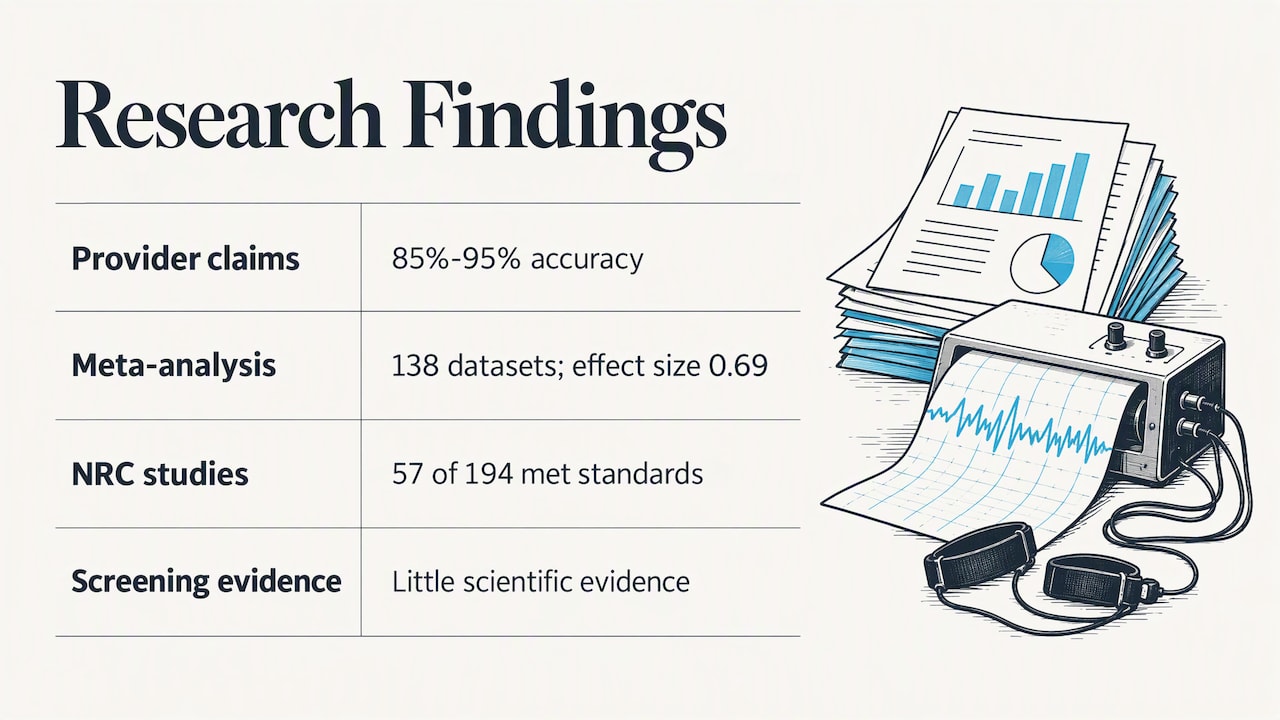
- Polygraph accuracy is real but imperfect: studies disagree, and the National Research Council found only 57 of 194 studies met minimal scientific standards.
- A “90% accurate” claim does not mean 90% of results are right. The share of correct calls depends on the decision threshold and on how many examinees are actually lying.
- A failed test does not prove a lie. The machine records stress responses, and honest people get nervous too.
- Results are generally inadmissible as trial evidence, and US federal law restricts most private employers from using them on staff.
- Treat a polygraph as one input to an investigation, alongside surveillance and documents, never as a verdict.
Table of Contents
- What a polygraph actually measures
- How accurate are polygraph tests?
- What an accuracy percentage really means
- False positives, inconclusive results and countermeasures
- What happens if you fail a polygraph?
- Polygraphs and the law
- How much does a polygraph test cost?
- When a polygraph helps, and when it does not
- Our perspective
- Surveillance, former FBI advice and ex-military experience
- Finding people anywhere in the world
- Working with us
- FAQ
- Sources
What a polygraph actually measures
A polygraph does not detect lies. It records several physiological signals, usually three indicators of arousal such as breathing, heart activity and skin conductance, and an examiner infers truthfulness or deception from the pattern of responses. The inference is the weak link. According to the Cornell Legal Information Institute, the test cannot separate responses that accompany dishonesty from those caused by anxiety during questioning.
That is why technique matters. In the widely used comparison question test, the examiner asks relevant questions (“Did you take the money?”) and control questions designed to make most people a little uneasy. The theory is that a guilty person reacts more strongly to the relevant questions, and an innocent person reacts more strongly to the controls. Whether that theory holds up in practice is the entire accuracy debate.
How accurate are polygraph tests?
The honest answer is a range, not a number.
The high-end claims. Providers and some professional bodies cite figures between 85% and 95%. Some of that comes from solid work. A 2020 meta-analysis of 138 datasets on the comparison question test found an effect size of 0.69 and concluded the technique can be accurate. The same paper notes that earlier reviews generally produced overall estimates above 85%.
The skeptical view. The National Research Council’s 2003 review, The Polygraph and Lie Detection, set a stricter bar. Of 194 studies, only 57 met minimal standards of scientific adequacy and gave useful data on validity. Its authors also warned that accuracy varies across studies and that errors are not infrequent. An earlier federal review, from the Office of Technology Assessment in 1983, found some evidence of validity when polygraphs are used as an adjunct in criminal investigations, but little scientific evidence that they work for screening.
Why the numbers disagree. Laboratory studies often use mock crimes, where examinees know the “truth” and have little at stake. Field studies use real cases, but researchers rarely know for certain who lied. Different studies also count inconclusive results differently, which can lift or lower a headline percentage without the test changing at all.
What an accuracy percentage really means
The National Research Council made a point that gets lost in marketing: its accuracy index does not translate directly into percent correct. The share of correct decisions depends on two things.
- The threshold. An examiner can set the bar for “deceptive” low or high. A low bar catches more liars but also flags more honest people. A high bar spares the honest but lets more liars through.
- The base rate. If almost everyone you test is honest, even a small false positive rate produces many wrongly flagged people. If most examinees are guilty, the same test looks far better.
Here is a worked example with made-up round numbers, to show the logic only. Imagine 1,000 employees screened for one serious offense, and only 10 are guilty. Say the test catches 90% of the guilty and wrongly flags 10% of the innocent. It catches 9 of the 10 guilty people. But it also flags 99 innocent people out of 990. Of the 108 people flagged, 99 are innocent. The test is “90% accurate” and still wrong about most of the people it accuses. This is the reason the National Academies concluded that polygraph screening of employees is not sufficient to justify reliance, since it forces an unacceptable choice between falsely accusing loyal people and missing real threats.
False positives, inconclusive results and countermeasures
False and inconclusive results
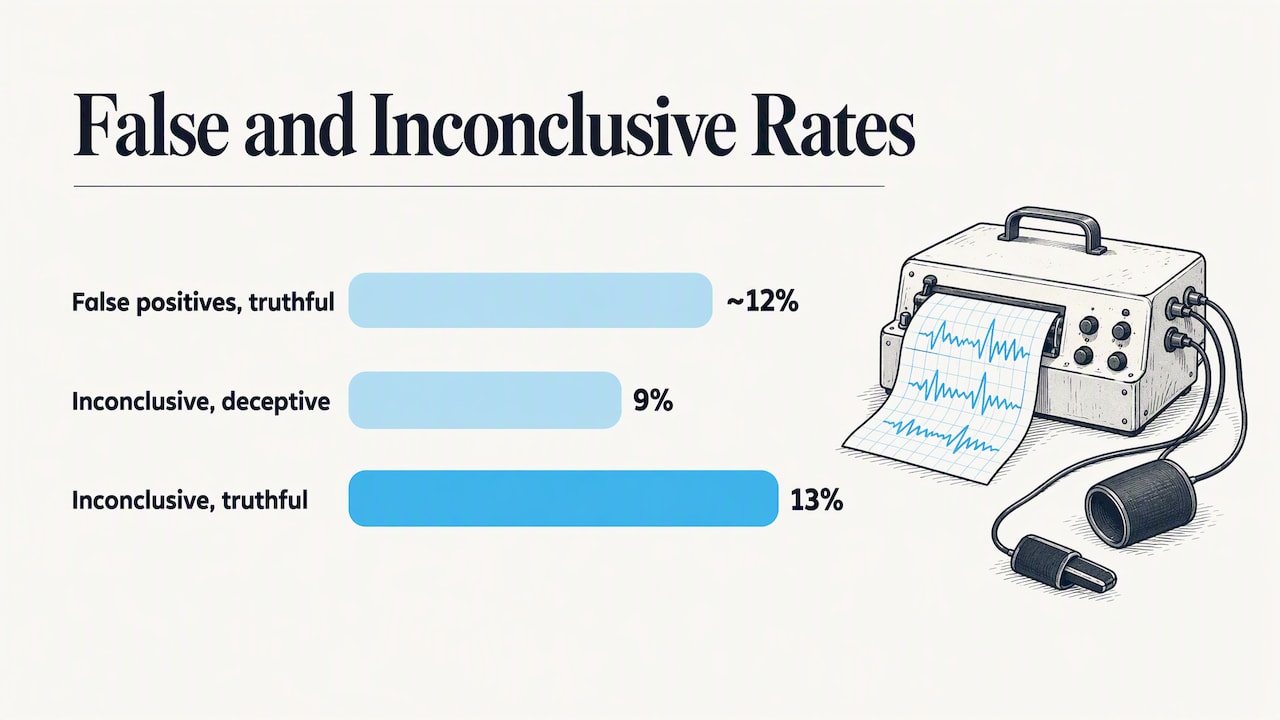
Diagnostic polygraphs, the kind used on a specific incident, can still misclassify. Research summarized in the federal review points to false positive rates of roughly 12% for truthful examinees in diagnostic testing. A 2015 review by Nelson reports inconclusive rates of 9% for deceptive and 13% for truthful examinees. An inconclusive result is not a pass or a fail. It usually means a retest or a different line of inquiry.
Factors that push results off course include the examinee’s psychological health, emotional stability and fear of detection. Medical conditions, medication, exhaustion and a hostile testing environment can all muddy the signals.
Can a test be beaten?
Sometimes. The federal review said physical movement and drugs could affect validity, though research was limited and conflicting. Peer-reviewed work by Honts and Kircher in 1994 found that mental or physical countermeasures, such as biting the tongue or doing mental arithmetic, can degrade accuracy enough to let deceptive examinees pass. A trained examiner watches for these tricks, which is another reason examiner skill matters as much as the instrument.
What happens if you fail a polygraph?
Nothing legally automatic, and nothing that proves guilt. Polygraphs measure physiological responses linked with fear, stress and anxiety, and results are generally inadmissible as trial evidence in US courts. A failed test might change how an investigator or a private party views a person. It does not establish that someone lied.
If you take a test and fail, ask the examiner exactly which questions drew the response, whether the test was single-issue, and whether the result was marked deceptive or merely inconclusive. If a decision about your job, custody or finances hangs on the result, speak to an attorney before acting on it.
Polygraphs and the law
In the United States, the Employee Polygraph Protection Act of 1988 bars most private employers from using polygraphs to screen job applicants or test current staff, with narrow exemptions. If you are an employer, check the current text with the Department of Labor or an employment attorney before asking anyone to sit a test. Where internal misconduct is the issue, documented evidence is a safer foundation, and our guides on payroll fraud investigation and employee theft investigation show how that works in practice.
Rules differ abroad. South Africa’s labor mediation body, the CCMA, says a polygraph may be one factor when weighing probabilities in an internal investigation, but dismissals based solely on a failed test have generally been found unfair. The pattern is similar across jurisdictions: a polygraph can inform an inquiry, but it should not carry the whole case.
How much does a polygraph test cost?
Private polygraph prices in the US typically run from a few hundred dollars for a simple single-issue exam to well over a thousand for a complex, multi-issue one. Industry sources commonly quote an average of around $800, with complicated exams exceeding $2,000. Those are market figures, not fixed prices, and they move with several factors:
- Number of issues tested. A single-issue exam about one event costs less than a multi-issue one.
- Examiner experience and credentials. Longer track records and specialist training cost more.
- Travel and location. Mobile examiners add travel time.
- Pre-test and post-test work. Interviews, question design and written reports add hours.
- Urgency. Rush bookings usually cost extra.
A cheap test with a poorly written question list is worth less than a pricier one built properly. Ask any examiner to explain the technique, how questions are formulated, and what the report will contain before you pay.
When a polygraph helps, and when it does not
Given the limits above, a polygraph earns its place in narrow situations:
- Focused, single-issue questions. “Did you transfer funds from this account on this date?” is testable. “Have you ever been unfaithful?” is vague and prone to false readings.
- Voluntary participation. A willing examinee is calmer and the data is cleaner.
- Corroboration. A result that matches surveillance footage, bank records or messages is meaningful. A result that contradicts them should make you question the test, not the evidence.
- Narrowing a field. Among several people with access to the same information, a test can help an investigator decide where to look first.
It does not help when the question is fuzzy, when the person is highly anxious or medicated, when you plan to use the result as proof in court, or when you intend to confront someone based on the score alone. Many people who ask us about lie detectors really need to know what happened. For that, direct evidence beats an inference from a heart rate.
Our perspective
We have worked on infidelity, corporate fraud, family law and missing person matters since 2006, and one pattern repeats. People reach for a polygraph because they want certainty quickly. The technique cannot reliably give it. What it can do, in the hands of a properly trained examiner with a tight question list, is structure an interview and surface inconsistencies worth following up.
Our team includes polygraph specialists alongside former law enforcement and ex-military investigators, and you can read about Steve van Aperen, our polygraph examiner and private investigator. We use the polygraph as one tool, never the only one. When a client brings us a suspicion, we first ask what evidence could confirm or refute it independently: footage, financial trails, digital records, witness accounts. A result that stands up in a dispute or a courtroom is built from those. How we structure a job is laid out in how a private investigator works on a job.
— P.i Melbourne
Surveillance, former FBI advice and ex-military experience
People who read about lie detectors often end up asking what else a professional can do. Three questions come up repeatedly.
Surveillance. Where a test infers, surveillance observes. Photos and video of what a person actually did, taken lawfully by a trained investigator, are far easier to rely on than a physiological reading. This is the backbone of cheating partner, staff monitoring and family law work, and our surveillance service lists published pricing of $1,000 to $1,450 for a one-off engagement.
Advice from former FBI staff. Some clients want a former federal agent’s view on a kidnapping, a missing person or a cross-border problem before deciding what to do. We can put you in touch with that kind of experience through our former FBI agent page, and a consultation is a sensible first step when the situation is serious and you are unsure of your options.
Ex-military specialists. Clients ask about hiring former soldiers, including ex-special forces, for advice on personal security, risk assessment or recovery planning. We work with experienced ex-military professionals, and the scope is explained on our ex-military security page. We work within the law. We do not offer anything that crosses it, and we will tell you plainly if a request is something an investigator cannot ethically do.
Finding people anywhere in the world
Locating someone overseas is rarely a single search. It is a layered process: public records, business registrations, social media and open-source material, and where needed, contacts on the ground in the country concerned. Our social media investigation work shows how much a digital trail can reveal, and our missing persons and wider services cover tracing across borders. Legal limits differ by country, so we tell you early what can and cannot be done where the person is believed to be.
Working with us
If you are weighing a polygraph because you suspect a partner, an employee or someone close to you, we can help you decide whether it is the right tool or whether surveillance, records work or an asset check will give you something firmer. We tailor each engagement to the situation and keep the work discreet. Start with our private investigation services.
For employers, our corporate investigations team handles misconduct and fraud with documented, defensible evidence. For families, our family law support covers evidence gathering for legal proceedings.
FAQ
How accurate are lie detector tests?
Studies range widely. Supportive meta-analyses suggest a well-run comparison question test can be accurate, while the National Research Council found accuracy varies and errors are not infrequent. Treat any single percentage as an estimate that depends on the examiner, technique and population tested.
Can a polygraph prove someone is lying?
No. It records stress-related physiological responses, which can also come from anxiety or fear of being disbelieved. Results are generally inadmissible as trial evidence and should be corroborated by other evidence.
Can you beat a polygraph test?
Research suggests mental and physical countermeasures can reduce accuracy, and the 1983 federal review noted that movement and drugs could affect results. Trained examiners look for these tactics, and attempts can also lead to an inconclusive or deceptive reading.
How much does a polygraph cost?
Industry sources commonly quote a few hundred dollars to over a thousand in the US, with an average around $800 and complex exams above $2,000. Price depends on the number of issues, examiner experience, travel and report requirements.
Can my employer make me take a polygraph?
In the US, federal law restricts most private employers from requiring polygraphs for hiring or during employment, with limited exemptions. Check with the Department of Labor or an employment attorney for your situation.
Sources
- The Polygraph and Lie Detection, ch. 7 (National Academies, 2003)
- The Polygraph and Lie Detection, ch. 6 (National Academies, 2003)
- Comprehensive meta-analysis of the comparison question test (Wiley, 2021)
- Lie detector test (Cornell Legal Information Institute)
- Scientific Validity of Polygraph Testing (Office of Technology Assessment, 1983)
- Scientific Basis for Polygraph Testing (Nelson, 2015)
- Honts and Kircher, 1994 (APA PsycNET)
- Conclusions and Recommendations (National Academies, 2003)
- Polygraph Testing info sheet (CCMA, 2021)