
An online romance scam investigation does three things: it works out who is really behind the profile, it preserves the evidence in a form that police, banks and courts can use, and it traces where your money and the scammer’s trail went. You can start protecting yourself today, but identifying a person who hides behind stolen photos, foreign numbers and crypto wallets is professional work. Our investigators at Pi Melbourne include former law enforcement, ex-military and polygraph specialists, and we take on cases like this for clients anywhere in the world.
TL;DR
- Stop sending money and information, but do not confront the person. Contact your bank first, then save everything before you block anyone.
- Catfishing (a fake identity used to build a relationship) and a romance scam (the same thing aimed at your money) look alike early on. The difference is the first request for payment.
- Reports are the first step, but identifying anonymous, overseas offenders is slow. A private investigation can run in parallel and gives you organized, court-ready material.
- Our team of ex-FBI, ex-military and ex-police investigators works cross-border cases, including locating people abroad.
Table of Contents
- What an online romance scam investigation actually is
- How scams and catfish profiles usually reveal themselves
- What to do in the first 24 hours
- What good evidence looks like
- Why identifying a scammer is hard without help
- Finding people all over the world
- Hiring former FBI staff and ex-military investigators
- Where surveillance fits in
- When the scam touches your business or family
- Perspective
- Talk to us about your case
- FAQ
- Sources
What an online romance scam investigation actually is
A romance scam is a fraud in which someone builds an emotional relationship online, usually on a dating app or social network, and then uses that trust to get money. A catfish is a person who invents or borrows an identity to do it. Sometimes the motive is money, sometimes it is control or attention. Either way, the question you want answered is the same: who is this?
An investigation answers that question in layers:
- Identity review. Photos, names, phone numbers, email addresses, usernames and the story told to you are compared against public records and open sources, looking for stolen images, recycled personas and contradictions.
- Evidence preservation. Chats, payment records, wallet addresses and dates are collected and organized into a timeline that someone else can read without you explaining it.
- Money trail. Where the payments went, which accounts or exchanges received them, and what that suggests about who is on the other end.
- Location and contact. When the person is real and reachable, working out where they are, which can be a different country from the one they claim.
The pages on social media investigation and on how a private investigator works on a job explain how this kind of open-source work is done and how a case is run.
How scams and catfish profiles usually reveal themselves
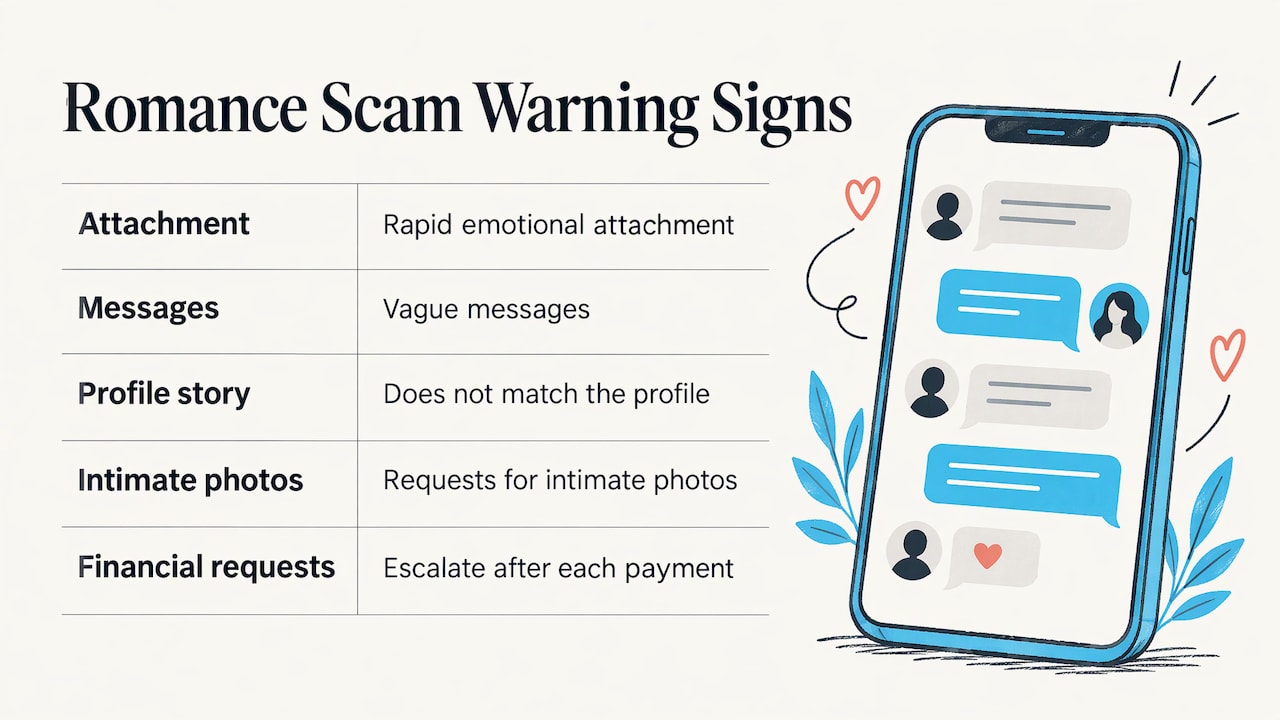
The warning signs are consistent across agencies in different countries. Europol’s guide to romance scams lists rapid emotional attachment, vague messages, a story that does not match the profile, requests for intimate photos, and a slide toward financial requests. It adds that new payment requests tend to escalate after each payment is made.
U.S. Immigration and Customs Enforcement adds claims of living or working abroad, a minimal online presence, excuses to avoid video calls, pressure to move to apps like WhatsApp or Telegram, and requests for payment in cryptocurrency or gift cards. The same page says scammers push conversations off dating platforms to avoid the detection built into those platforms, which is why the conversation history on the original platform matters as evidence.
On a catfish versus a scam, Australia’s eSafety Commissioner notes that a low friend count, few posts and never being tagged by other people can point to a faked background. A catfish with no money request is still a deception worth investigating, especially when children, a marriage or a business are involved. The moment money enters the conversation, treat it as fraud.
Will a scammer get on a video call?
Often they will refuse, and the Australian Federal Police say that refusing to video-call or meet in person suggests a scammer. The same guidance warns that scammers can now use AI during live video to imitate another person’s face and voice. A video call that goes well is therefore not proof of identity. That is one reason a verified identity check matters more than a feeling of connection.
What to do in the first 24 hours
The steps below protect your money and your evidence. They also make any later investigation faster and cheaper, because the material is intact.
- Stop paying and sharing. Do not send more money, account details or intimate images. Do not confront the person: the U.S. Postal Inspection Service advises against trying to physically locate or confront the person and says to hand evidence to law enforcement.
- Call your bank or payment provider. Use the number on your card or in the official app, and ask them to stop or reverse recent payments. Guidance from a dating platform’s support team stresses never paying an upfront fee to anyone promising to recover your money.
- Save before you block. Screenshots, usernames, receipts, dates and amounts should be copied somewhere the scammer cannot reach, per the same recovery guidance. Blocking first can make the profile disappear from view.
- Secure your accounts. Change passwords, starting with your email, and turn on two-factor authentication.
- Report it. Report the profile to the platform and the fraud to the authorities in your country. In the United States that means the FBI’s Internet Crime Complaint Center (ic3.gov), the FTC and your local police.
- Talk to someone you trust. The FTC recommends telling a friend or family member and cutting off contact. Europol stresses that being targeted is not a personal failure, because these scams are designed to manipulate trust.
The scale explains why this matters. The FTC reported $547 million in romance-scam losses in 2021, about 80% more than in 2020. In the UK, Lloyds research found a 52% rise among people over 55 in a year, with average losses of £5,219.
What good evidence looks like
Evidence is what turns “I was scammed” into a case someone can act on. A well-built file includes:
- Full message history from every platform and number used, not only the highlights.
- Profile screenshots, usernames and the URLs of the accounts.
- Payment records: dates, amounts, recipient names, account numbers, and for crypto the wallet addresses and transaction IDs.
- Any fake documents, IDs or photos that were sent to you.
- A written timeline of who said what and when money moved.
A recovery guide for victims also recommends keeping copies in more than one place, such as cloud storage and a printed folder. Take wide screenshots that show the date and the handle, and keep the originals unedited.
This is where professional help pays for itself. We collect evidence for legal proceedings as part of our service, and our investigators use advanced technology to produce court-ready photos and video where a matter calls for it. A file organized by people who know what a lawyer, bank or police fraud unit will ask for is far easier to act on than a folder of screenshots.
Why identifying a scammer is hard without help
Research on how platforms and law enforcement respond is blunt about the obstacles: anonymity, overseas operations, hidden IP addresses, slow mutual legal assistance and limited specialist resources all slow down attribution and prosecution. Some countries also lack a specific offense for catfishing, so a police report may not lead anywhere quickly.
That gap is what a private investigation fills. A private investigator is not a substitute for reporting to police, and you should still do that. But an investigator is not bound by an agency’s caseload, and can spend time on the one question you care about: who is this person, and where are they?
Academic research backs the instinct to check. A peer-reviewed study by Cassandra Cross and Rebecca Layt found that many complainants used internet searches to test their suspicions, and that image searching can be effective for assessing authenticity. An investigator takes that same idea much further, across languages, platforms and records you would not know how to reach.
Finding people all over the world
Romance scammers rarely sit in the city on their profile. The person may be in another country entirely, and a real catfish may live down the road from you. Tracing someone across borders takes judgment about which records exist in which country, and how to approach them lawfully.
We work with clients worldwide, and locating people abroad is part of what we do. You can see an example in our write-up of a private investigator finding a missing person in the UK, and our guide on how to locate a missing person sets out the first steps and where expert help fits in.
If the scam involved a person you met online who then vanished, or someone you now fear is trying to reach you in person, those same skills apply.
Hiring former FBI staff and ex-military investigators
People often search for “FBI for hire” or “ex-military for hire” after a scam. Here is what is realistic. A serving agency investigates crimes through its own process and does not take private clients. What you can hire is a private investigator who spent a career in law enforcement or the military and now works for clients.
At Pi Melbourne, our investigators include former FBI and military agents, former police and polygraph specialists. You can read about our former FBI agent’s work on missing persons and child abduction cases. What that background brings to a romance scam case:
- Case discipline. Ex-federal investigators are trained to build a case file that stands up, with a clear timeline and documented sources.
- Cross-border instinct. Fraud and abduction work both involve people who are hard to find, and our team applies that experience.
- Surveillance and field skills. Ex-military and ex-police team members are experienced at observing a subject quietly and recording what they see.
- Calm advice. A first conversation with someone who has handled fraud before helps you decide what to do and in what order, before you spend more.
We do not offer anything illegal, and “mercenary” work is not what we do. Our work is lawful investigation: evidence, identification and location.
Where surveillance fits in
Surveillance is relevant when the person behind the profile turns out to be local, or when a romance deception is part of something else, such as a partner leading a double life. A cheating partner using fake or secondary profiles is a common variation, and our cheating partner surveillance exists for exactly that. Surveillance is also used when a scam is run by someone you know, such as an ex who built a fake persona to influence you.
Our surveillance service is listed at $1,000 to $1,450, one-off. The final scope depends on the situation, so we tailor each investigation to the client. If you want to understand how a surveillance job is done properly, see our page on surveillance services done the right way.
When the scam touches your business or family
Romance fraud is not always personal. Some scams draw in employees who then move company funds, and some target a family member who may be sending money without telling anyone. The answer differs by case:
- A staff member diverting money: this is a corporate matter, and our corporate investigations and internal fraud investigation pages describe how we handle it.
- Stolen personal details used in the scam: see our guide to identity theft investigation.
- A teenager being groomed or deceived by an online contact: our teenage monitoring service is built for that concern.
- Money moved into assets during a separation: an asset search can trace where it went.
Perspective
Most people who contact an investigator after a romance scam are not asking for revenge. They want to know whether any of it was real, and they want someone to take the problem off their hands.
Our approach starts with the person’s own situation. We have former FBI, military and police investigators on the team, and we pair that with polygraph expertise and modern technology so the material we collect holds up when it matters.
A police report is the right first step, and we encourage it. What we add is time, focus and experience: an investigation shaped around your case, with evidence organized the way lawyers, banks and authorities expect to receive it.
P.i Melbourne
Talk to us about your case
If you believe you are the target of a romance scam or catfish, or you need to find someone who has disappeared with money or contact details, our private investigators can review what you have and tell you what an investigation could establish. We handle cheating partner surveillance, fraud investigations, missing persons and evidence collection for court, and you can see the full range on our private investigation services page.

To discuss your matter confidentially, start at Pi Melbourne.
FAQ
Can a private investigator find out who is behind a fake profile?
Often, they can narrow it down considerably by examining the photos, names, contact details and payment trail you hold. Results depend on how much the person has hidden and where they are. We will tell you at the start what looks achievable from your material.
Is a catfish illegal?
That depends on the country and on what the person did. Researchers note that some countries have no dedicated offense for catfishing, while fraud laws usually apply once money is taken by deception. This is why a well-documented file matters, and a lawyer can advise on your specific case.
Should I keep talking to the scammer to gather evidence?
No. The FTC advises that if you suspect a scam you should stop communicating with the person immediately. Save what you already have before blocking, and let an investigator or the authorities decide what to do next.
Can I get my money back?
Contact your bank straight away, since speed matters and recovery is never guaranteed. Be wary of anyone who asks for an upfront fee to recover money, which is a known second scam. An investigation can trace where funds went, which supports your bank and police reports.
Do you work on cases outside Australia?
Yes. We serve clients worldwide, and our team includes former FBI and military investigators. Send us the details of your case and we will explain what is possible.
Sources
- Europol: Romance scams, recognising manipulation before it escalates
- ICE: Protect Yourself Against Romance Scams
- eSafety Commissioner: Catfishing
- Australian Federal Police: ClickFit, Romance scams
- United States Postal Inspection Service: Romance Scam
- FTC: What to Know About Romance Scams
- Bumble Support: Recovering from romance fraud
- Romance scam victim recovery guide
- Cross and Layt: Romance Fraud study (2022)
- Romance Scam Research Center: Platform and Law-Enforcement Responses
- The Guardian: the signs it might be a romance scam