
Proving whistleblower retaliation comes down to showing a chain: you reported something protected, your employer knew, something bad happened to your job, and the report played a part in it. Each link needs a record, and records are easier to build while you are still employed than after you are gone. Experienced investigators, including the former law enforcement and ex-military specialists at Pi Melbourne, build exactly this kind of evidence file for corporate and workplace matters, so the case you or your lawyer bring is organized, dated and credible.
This guide explains the legal test in plain terms, the evidence that usually decides these cases, and how to preserve it. It is written around U.S. law. Other countries, including EU states and the UK, have their own rules.
TL;DR
- Most U.S. retaliation claims need four things: protected activity, employer knowledge, an adverse action, and a causal link between the report and that action.
- Under several federal laws the causal link is a low bar: the report only has to be a contributing factor, not the sole reason.
- Timing, comparisons with similar employees, performance reviews and written communications are the evidence that most often carries a case.
- Filing deadlines run from 30 to 180 days depending on the statute, so start your record and your complaint early.
- A structured, dated evidence file, built within the law, is the best protection against the employer’s claim that it acted for other reasons.
Table of Contents
- The four things you have to show
- How hard the causation test is depends on the law
- The evidence that usually decides these cases
- Deadlines and what an investigation looks like
- Where an investigator adds value
- Perspective
- If you need help building the file
- FAQ
- Sources
The four things you have to show
The U.S. Department of Labor’s administrative judges describe the structure for Sarbanes-Oxley claims, which cover employees of publicly traded companies who report suspected fraud. The employee must prove, by a preponderance of the evidence (meaning more likely than not), four elements: protected activity, employer knowledge of it, an unfavorable personnel action, and that the protected activity contributed to the action. Other statutes use similar building blocks.
In plain terms:
- Protected activity. You reported, or refused to take part in, something the law protects. Reports to a supervisor, a compliance hotline or a government agency can all qualify, depending on the statute. Most anti-retaliation laws do not require you to be proven right, only that you held a reasonable belief that a violation occurred.
- Employer knowledge. The decision-maker knew, or must have known, about your report. An email, a hotline ticket or a meeting note proves this.
- Adverse action. Firing is the obvious one. The National Whistleblower Center’s FAQ explains that the action can also be discrimination in pay, terms, conditions or privileges, such as demotion, cut hours or a sudden change of duties.
- Causation. The report must have played a role in the action. How big a role depends on the law, which is the next section.
What does not count as protected activity is just as important. Ordinary complaints about a manager’s style, a pay dispute that raises no legal violation or a personal grievance usually fall outside whistleblower statutes, even though other laws may cover them. A lawyer can tell you which statute fits your facts.
How hard the causation test is depends on the law
This is where people are most often confused, because the standard changes by statute. A Rutgers worker-justice guide describes three tiers:
| Standard | What it means | Examples of laws using it |
|---|---|---|
| But-for | The adverse action would not have happened without the protected activity | Title VII, FLSA and OSH Act anti-retaliation provisions |
| Motivating factor | The protected activity was one of the reasons | Some local wage-theft laws and federal environmental statutes |
| Contributing factor | The protected activity affected the decision in any way | Sarbanes-Oxley, Affordable Care Act, Federal Railroad Safety Act |
The American Bar Association notes that SOX and most DOL-enforced laws use the favorable contributing-factor test, while the False Claims Act and Dodd-Frank require but-for causation.
The contributing-factor test is lenient. The Labor Department’s judges call it not a demanding standard: the employee must show only that the protected activity, alone or together with other factors, tended to influence the decision. Once you do, the burden flips. The employer avoids liability only by proving, by clear and convincing evidence, that it would have taken the same action anyway.
California follows a similar path. In Lawson v. PPG Architectural Finishes (2022), the state supreme court held that Labor Code section 1102.6 governs claims under section 1102.5, so the employee shows that retaliation was a contributing factor and the employer must then prove by clear and convincing evidence it would have acted for legitimate, independent reasons. The employee does not have to prove the employer’s stated reason was a pretext.
Worked example. A finance analyst at a public company emails her controller about inflated revenue entries on a Monday. Three weeks later her performance rating drops from “exceeds” to “needs improvement,” and a month after that she is laid off. Her file shows the email (protected activity and knowledge), the layoff (adverse action) and the earlier ratings and timing (causation). Under a contributing-factor standard, that may be enough to shift the burden to the employer. Under a but-for standard, she would also need evidence that the layoff would not have happened without the email, such as colleagues with weaker reviews who kept their jobs.
The evidence that usually decides these cases
Direct proof, such as a manager saying “you are fired for reporting this,” is rare. Most cases rest on circumstantial evidence, and that is legally fine. The National Whistleblower Center lists the typical indicators of retaliatory motive:
- The employer showed hostility toward the matter you reported.
- The timing: discipline or termination soon after the report.
- Similarly situated employees were treated better.
- High performance ratings before the report and low ones after.
- No history of earlier complaints about you.
- You were accused of “disloyalty” for reporting.
Turn each of these into documents:
Before and after performance records. Annual reviews, bonus letters, praise emails and promotion discussions create the “before” picture. Rutgers’ guide lists the documents investigators typically request: job descriptions, handbooks, appraisals, written personnel actions such as reprimands and termination notices, and pay statements showing reduced hours or pay.
A dated timeline. List every event: when you reported, to whom, what was said, and each change afterward. The same guide recommends date-stamped written complaints, and agencies keep a case activity log of every contact. Do the same for yourself, writing notes the same day.
Comparators. Who else made similar mistakes or had similar attendance and kept their job? Name them in your timeline with dates, without taking confidential files that are not yours.
Witnesses. Note who was present at meetings, who heard the remarks and who saw the change in treatment. Government investigators interview witnesses separately and privately, and the New Jersey state manual notes that reluctant or intimidated witnesses may be contacted again outside the workplace. That tells you how fragile witness accounts are: people forget, and people are pressured.
Digital traces. Messages, calendar entries and posts can show knowledge and motive. Capture them in a way that preserves dates and context; our guide to social media evidence explains what courts tend to accept and how to preserve it.
Stay inside the law while you collect
Preserve what you legitimately have access to: your own emails, your own reviews, your own messages. Do not forward large volumes of confidential company data to a personal account, access systems you are not authorized to use, or secretly record people before checking your state’s rules. Recording laws differ by state, and some require every party’s consent. An employment attorney can tell you what is safe in your situation, and that conversation should happen before you collect anything sensitive.
If the stress of the situation is affecting how you handle the workplace day to day, structured workplace conflict resolution support can help keep communication on record and professional while your claim develops.
Deadlines and what an investigation looks like
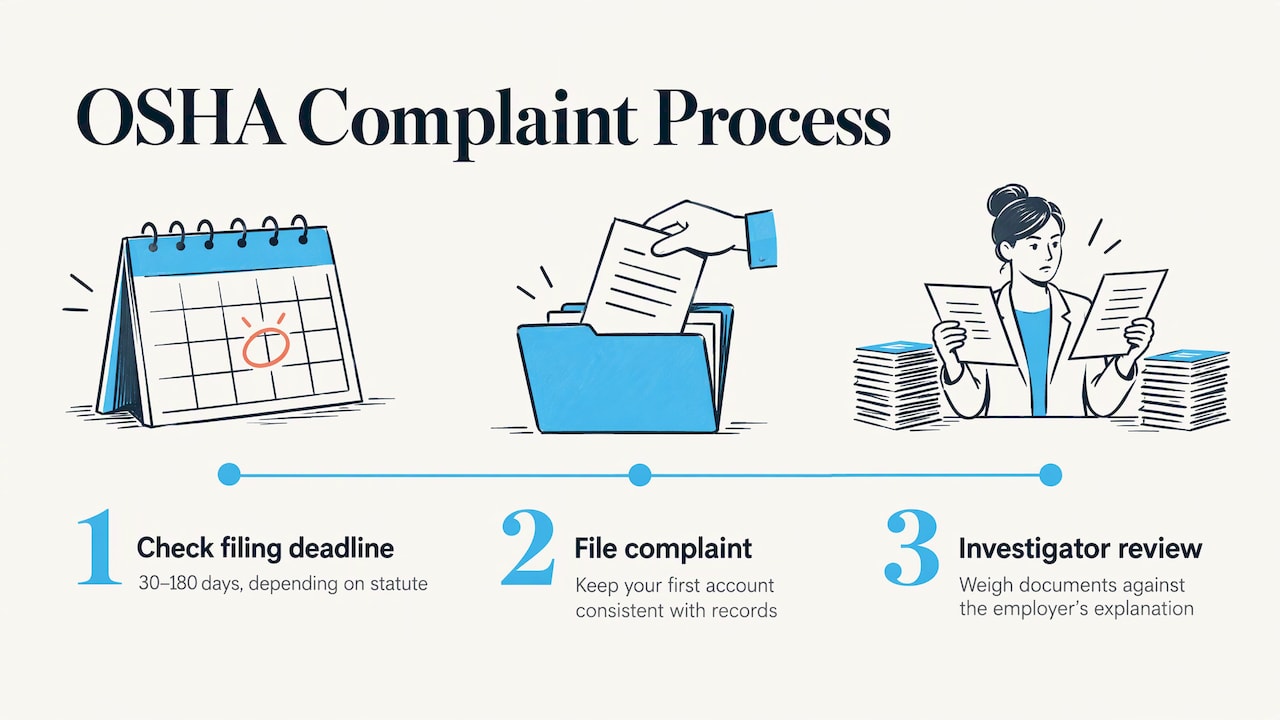
Time limits are short. OSHA’s complaint page states that the filing deadline is 30 to 180 days, varying with each statute. If you were disciplined or fired, check the deadline for your law right away, because a strong file does not rescue a late complaint.
Once a complaint is filed with OSHA, an investigator tests both sides. OSHA’s investigations manual says the agency looks for reasonable cause: evidence supporting each element that suggests the claim could succeed at a hearing. That is somewhat lower than the preponderance standard used at the hearing, and it means the investigator weighs your documents against the employer’s explanation. An earlier edition of the manual requires the investigator to make clear the agency represents neither party and to take a written memorandum of the complainant’s account at intake. So your first account matters, and it should match your records.
Employers are expected to run fair internal investigations too. OSHA’s recommended practices for anti-retaliation programs advise objective review that listens to all sides before a judgment. If you are an employer or HR lead handling a claim, our guides on workplace misconduct investigations and workplace harassment investigations set out terms of reference, evidence and who should lead.
Where an investigator adds value
An attorney builds the legal case. An investigator builds the factual record the attorney works from, and that is a different skill. Our team includes former police, ex-military personnel and polygraph specialists, and our work includes collecting evidence for court and corporate investigations. Our website describes court-ready photos and video from our surveillance work.
In a retaliation matter, that can mean organizing your timeline against the documents, identifying who witnessed key events and keeping a clean chain of dates. It can also mean lawful surveillance in cases where, for example, an employer claims you were fired over conduct that the facts contradict. Because our investigators come from law enforcement and military backgrounds, they are used to writing records that must survive cross-examination. Our workplace surveillance guide explains what monitoring is lawful on the employer side, which also helps you understand what your employer may legitimately hold on you.
Some readers ask whether they should hire former FBI staff or ex-SAS and other special-forces soldiers for advice. Our firm works with ex-FBI and ex-military specialists, and our ex-FBI agent page describes that experience. Those backgrounds teach interview discipline, evidence handling and operational planning, all of which matter when a case turns on who said what and when. The same goes for locating a witness who has moved or a former colleague who left the company: we work across borders, and our guide to locating a missing person covers the first steps.
Perspective
Retaliation cases are rarely lost because nothing happened. They are lost because what happened was never written down in an order a decision-maker can follow.
In our experience as investigators, the people who hold up best are those who treat their own situation like a file: dated entries, original documents, a list of who saw what, and a clear separation between fact and opinion. That discipline is what our former police, ex-military and polygraph specialists bring to every engagement.
We tailor each investigation to the client’s circumstances, whether that is an individual facing pressure at work or a business that needs to show it handled a complaint fairly. A single well-built chronology, backed by evidence that can be put in front of a court, changes the conversation with an employer, a regulator or a judge.
P.i Melbourne
If you need help building the file
If you are facing retaliation and want the facts organized for your attorney, or you are an employer who needs a fair, documented review, our team handles corporate investigations and evidence collection for legal proceedings.
You can see the full range on our investigation services page or start at pimelbourne.com.au.
FAQ
How hard is it to prove retaliation?
It depends on the law. Under contributing-factor statutes such as Sarbanes-Oxley, the standard is described by the Labor Department’s judges as not demanding, so strong timing plus a paper trail can be enough. Under but-for statutes you need to show the action would not have happened without your report, which takes stronger comparisons and documents.
Do I have to be right about the wrongdoing I reported?
Usually not. The American Bar Association notes that most anti-retaliation laws require only a reasonable belief that a violation occurred, not proof that it did. Your report should still be specific and made in good faith.
What is the first thing I should do if I think I’m being retaliated against?
Write a dated timeline the same day, keep your own copies of reviews, notices and messages you are entitled to hold, and check the filing deadline for your statute. Then speak to an employment attorney, because deadlines can be as short as 30 days.
Does the employer get to explain its side?
Yes. Investigators test both your allegations and the employer’s stated non-retaliatory reasons. Under contributing-factor laws, the employer must then show by clear and convincing evidence that it would have acted the same way without your report.
Sources
- USDOL/OALJ: SOX whistleblower digest, burden of proof
- USDOL/OALJ: SOX whistleblower digest, causation
- Lawson v. PPG Architectural Finishes, Inc. (Cal. 2022)
- Rutgers Worker Justice Law: Tool 11, Retaliation Investigation
- American Bar Association: Navigating the Maze of Corporate Whistleblower Protections
- National Whistleblower Center: Protection from Retaliation FAQ
- New Jersey PEOSH Whistleblower Investigations Manual
- OSHA: File a Whistleblower Complaint
- OSHA Whistleblower Investigations Manual CPL 02-03-011
- OSHA Whistleblower Investigations Manual (2016 edition)
- OSHA: Recommended Practices for Anti-Retaliation Programs