
A private investigator can watch and photograph people in public, search public and court records, interview witnesses, trace people, and turn the findings into a written report that a lawyer or court can use. A PI cannot arrest anyone, break into accounts, trespass or pretend to be police. The rest of this guide covers where those lines sit, what an investigator can find, and how to hire the right kind of expert for your situation.
TL;DR
- Private investigators gather, analyze and report information for clients on legal or personal matters, using interviews, record searches and surveillance.
- They have no police powers. No arrests, no trespassing, no hacking, no vehicle trackers, no impersonating officers.
- Typical work: infidelity, employee theft, fraud, missing persons, asset searches, background checks and evidence for court.
- Experience matters. Former federal agents, ex-military personnel and polygraph specialists bring different skills, and you should ask exactly what each person has done.
- Rules differ by country and state, so a good investigator works within the law where the job happens.
Table of Contents
- What a private investigator actually does
- Who hires a private investigator, and why
- What information can a private investigator find?
- Can a PI get phone records?
- What a private investigator can legally do during surveillance
- What a private investigator cannot do
- Can I refuse to talk to a private investigator?
- How the law changes from country to country
- Finding people anywhere in the world
- Hiring former FBI staff for advice
- Hiring ex-military investigators, including former SAS soldiers
- Perspective
- Choosing an investigator and getting the most from the engagement
- How we can help
- FAQ
- Sources
What a private investigator actually does
The US Bureau of Labor Statistics describes the job simply: private detectives and investigators gather, analyze and report information to clients regarding legal or personal matters. Their services include verifying backgrounds, finding missing persons and investigating crimes, and they may also look into employee theft and infidelity.
In practice that breaks down into a handful of activities:
- Interviewing people. Witnesses, neighbors, former colleagues, associates.
- Searching records. Online, public and court records.
- Surveillance. Observing a person or location and documenting what happens.
- Reporting. Turning all of it into evidence a client, lawyer or employer can act on.
The same federal source notes that investigators must obey the law when they collect and document evidence. That last point is what separates a professional from someone with a camera and a theory.
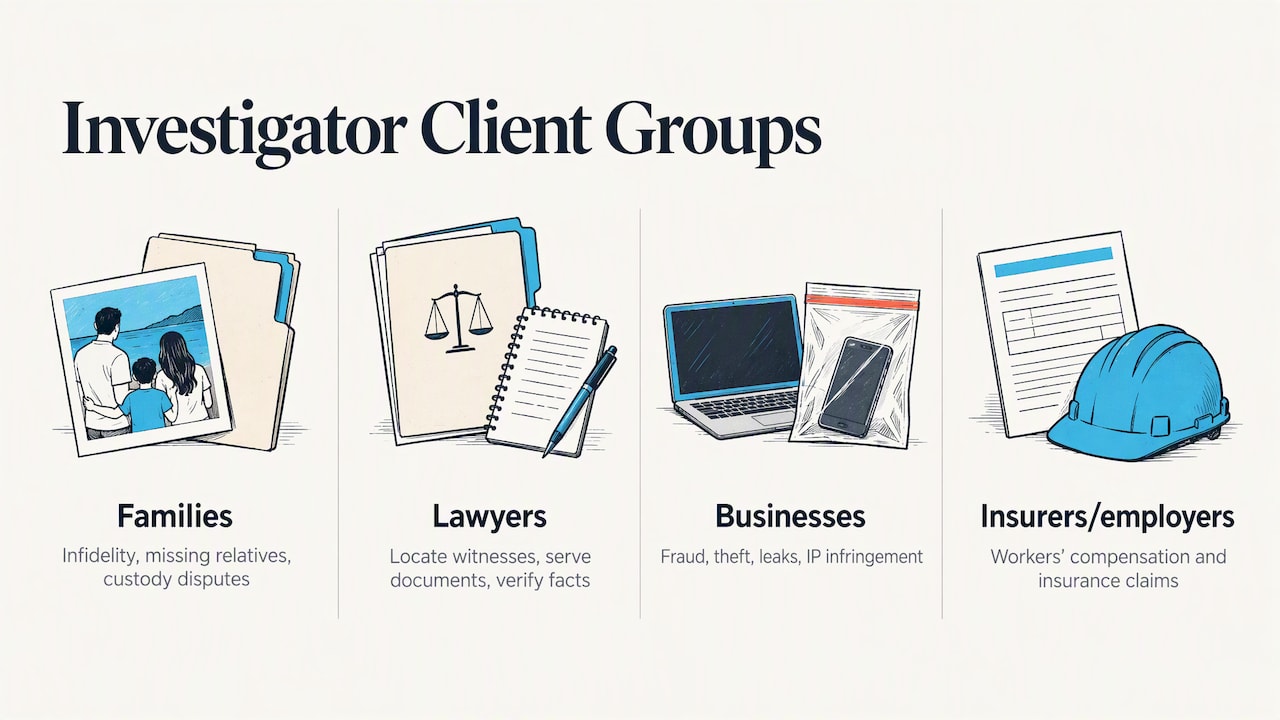
Who hires a private investigator, and why
The client list is wider than most people expect.
Individuals and families. Suspected infidelity, a missing relative, a teenager in trouble, a custody dispute, or a child taken across a border. Family law work is some of the most sensitive an investigator handles.
Lawyers. Legal investigators often help attorneys by locating witnesses, serving legal documents and verifying facts for civil or criminal defenses. The American Bar Association notes that investigators can collect information about parties, potential witnesses and jurors in litigation, including evidence relevant to the dispute.
Businesses. The same ABA guidance lists alleged employee fraud, theft, sexual harassment, information leaks and other misconduct as things an investigation may examine. It also names intellectual-property infringement, contract compliance, asset location and due diligence before a merger or major contract.
Insurers and employers. Workers’ compensation and insurance claims are a large share of surveillance work. If that is your situation, our page on insurance fraud investigation explains how it works.
What information can a private investigator find?
This is the question behind “what do private investigators have access to.” The honest answer: a great deal, as long as it is lawfully obtainable.
According to the Maryland People’s Law Library, investigators can find court records, government filings, vital statistics, property ownership records, vehicle and vessel records, photographs and witness statements. Add to that:
- Public social media. Posts, photos and connections that anyone can see. Our guide to social media investigation shows how this is done and documented.
- Business and corporate filings. Who owns what, who is a director, what has been registered.
- Asset information. Property, vehicles and other holdings that can matter in a divorce, a debt recovery or a fraud claim. We lay out the process in six steps to an asset search that holds up in court.
- Information from people. Interviews often turn up what no database holds.
The skill is not only access. It is knowing which sources apply, cross-checking them, and documenting each step so the result stands up if challenged.
Can a PI get phone records?
No, not by lawful means available to a private citizen. Call logs, text content and similar data are protected. In the United States, the Electronic Communications Privacy Act gives only limited law-enforcement access to communications and records, and unauthorized wiretapping or electronic eavesdropping is a federal crime carrying imprisonment and fines.
An investigator who offers to pull someone’s phone records is offering something illegal. That is a reason to walk away, because evidence gathered that way can ruin your case and expose you to liability too.
What a private investigator can legally do during surveillance
Surveillance is the core of the trade, and the rules are reasonably clear. Nolo’s legal guidance says an investigator may observe and photograph a person in public, record video of activities visible from public property, review public social-media posts and interview neighbors, coworkers or friends.
In real jobs, that means:
- Establishing a person’s routine from a public location.
- Following a vehicle on public roads while keeping a safe, lawful distance.
- Photographing and filming meetings, arrivals and departures that are visible from public places.
- Logging times, places and observations in a report that can be tied to the footage.
The American Bar Association adds that, depending on the case, investigators may provide written reports, photographs, film or video surveillance, audio recordings of witness interviews and tangible evidence such as counterfeit products or altered accounting records.
Good surveillance is quiet, patient and well documented. If you want to see how a job runs, read how a private investigator works on a job and our piece on surveillance done the right way.
What surveillance costs
On our own site, surveillance is listed at $1,000 to $1,450 as a one-off figure. Your final cost depends on the scope of the job, so see our breakdown of what a private investigator costs in Melbourne.
What a private investigator cannot do
The limits are as important as the powers. According to Nolo, PIs cannot trespass, enter a home without consent, hack private accounts, place a tracker on a vehicle or impersonate law enforcement.
Add the obvious ones:
- No arrests. A PI has the same powers as any private citizen. What they find may lead police to act, but the arrest is the police’s job.
- No badge that suggests authority. Presenting as law enforcement is off limits.
- No intercepting calls or messages. See the federal wiretapping point above.
- No pretexting to get protected records. Posing as someone else to obtain confidential data is illegal in many places.
Outside the US the same logic holds. In England, hacking voicemails, breaking into email accounts or paying public officials for confidential information may be criminal under several statutes, including the Bribery Act 2010, which carries up to 10 years’ imprisonment.
Can I refuse to talk to a private investigator?
Yes. Nolo’s guidance says you can refuse to speak with or interact with a private investigator. They may observe you in public and ask questions, but you owe them no answers. If you are in a legal dispute, speak to your lawyer before responding to anyone who approaches you about it.
How the law changes from country to country
Laws on investigators, surveillance and privacy are not universal. Some examples:
- United States. Rules differ by state, including licensing and what can be recorded.
- England. Physical surveillance is not illegal, but investigators must follow local law, and the ICO has launched a data protection code of conduct for private investigators covering covert surveillance, tracking devices, background checks and tracing people.
- Australia. The Privacy Act has no special provisions for investigators, so they must comply with the standard privacy principles, according to the Australian Law Reform Commission.
For employers, there is a further layer: what you may monitor at work. Our guide to workplace surveillance laws covers it.
Finding people anywhere in the world
Tracing a person is among the most common requests, and borders do not make it impossible. They make it a matter of knowing the local rules and having the right contacts.
A typical tracing job combines:
- Records and database work in the country where the person was last known to be.
- Interviews with relatives, former employers and neighbors.
- Public online footprints, such as social media and business registrations.
- Local verification, so that an address is confirmed rather than assumed.
This matters for missing relatives, for debtors who have moved overseas, and for parents whose child has been taken abroad. Our child recovery service exists for the last of those, and we have written up a case where a private investigator found a missing person in the UK. For more on our reach, see our page on private investigators in Australia and how we work with clients abroad.
Tracing rules vary widely. In the UK, for example, the ICO code mentioned above includes guidance on tracing and locating people. A reputable investigator will tell you up front what can lawfully be done in the country involved, rather than promise everything.
Hiring former FBI staff for advice
People often search for “FBI for hire.” What they usually want is an investigator who has worked serious cases, such as kidnappings, fraud, missing persons and organized crime, and who knows how evidence is built.
A former federal agent no longer has federal authority. What they bring is experience: how investigations are structured, how to interview, how to document a timeline, and how to judge whether a situation is a police matter or a private one. That is valuable when:
- You are not sure whether to go to the police, a lawyer or an investigator first.
- A child has been taken or a person has vanished and you need a plan quickly.
- You need a second opinion on a fraud or a case file.
Pi Melbourne’s team includes former FBI and military investigators, and our page on a former FBI agent for missing persons and child kidnapping cases explains how that experience is applied. Ask for an advisory conversation first. A good investigator will tell you what is realistic before taking your money.
Hiring ex-military investigators, including former SAS soldiers
People also ask about “ex military for hire” and, in some markets, about former SAS soldiers. Strip away the film-style language and the useful skills are real: patient observation, discipline, planning, composure under pressure and the ability to work unseen for hours.
Those skills suit surveillance, protective planning, and advice on risky or hostile situations. They do not give anyone extra legal rights. A former soldier who works as an investigator is bound by the same laws as everyone else. Be wary of anyone advertising mercenary-style services, because anything involving force, entering property or intercepting communications is illegal and will put you at risk.
When you speak with an ex-military investigator, ask:
- What exactly did you do, and for how long?
- Which of those skills apply to my case?
- What licence do you hold where the work will happen?
- How will you document and report what you find?
An honest professional will answer clearly and say plainly where their background stops being relevant. Our team combines former police, ex-military and polygraph specialists, so each case can be matched to the right person.
Perspective
Most clients come to us on a bad day. A partner is behaving differently, a manager suspects someone is stealing, a parent cannot find a child. What they need first is clarity about what is possible, then a plan.
We built Pi Melbourne in 2006 around tailored investigations rather than a fixed package. The right team for a missing-person case is not the right team for a fraud inquiry, so we match experienced ex-police, ex-military and polygraph specialists to the problem in front of us.
Our view is that evidence is only worth having if it is lawful and well documented. Court-ready photos and video, careful notes and discreet fieldwork are what turn a suspicion into something a lawyer, an employer or a court can use. Cutting corners produces material that gets thrown out and puts the client at risk.
That is why we explain the limits as openly as the powers. Clients who understand both make better decisions and get better results.
P.i Melbourne
Choosing an investigator and getting the most from the engagement
The American Bar Association’s guidance on hiring an investigator is a good outline for any buyer. In practice:
- Define the question. “Is my partner meeting someone?” is a clear brief. “Find out everything” is not.
- Check credentials. Ask about licensing where the work will be done, and about the specific experience of the person on your case.
- Ask about methods. If the answer involves phone records, hacked accounts or entering property, stop.
- Agree the reporting. You should know what you will receive: reports, time-stamped photos, video.
- Confirm confidentiality. Discretion is the point of the service.
- Involve your lawyer early if the result may be used in court.
Surveillance should also be proportionate. The Association of British Insurers advises that it should be used only where there is reasonable suspicion or necessity, and not as the first or only method. That is sound advice for any client: sometimes records and interviews answer the question faster.
How we can help
We handle cheating-partner surveillance, fraud investigations, missing persons, staff monitoring, evidence collection for court, child recovery and family law matters. For employers, we also cover corporate investigations, and for parents there is our teenage monitoring service.
Every job starts with a conversation about what you need and what is lawful. See everything we offer on our private investigation services page.
If you are not sure which service fits, start with a confidential discussion through Pi Melbourne.
FAQ
Can a private investigator arrest someone?
No. A private investigator has the same powers as any private citizen. They can gather evidence that leads police to act, but only law enforcement can make an arrest.
What can private investigators legally do?
They can search public and court records, interview witnesses, observe and photograph people in public, review public social media and write reports. They cannot trespass, hack accounts, place trackers on vehicles or impersonate police.
Can a PI get my phone records?
Not lawfully. Phone records and communications are protected, and unauthorized wiretapping or eavesdropping is a federal crime in the US. Anyone offering to obtain them is offering something illegal.
Can I refuse to talk to a private investigator?
Yes. You do not have to answer questions or engage with one. If the approach relates to a legal dispute, talk to your lawyer before you respond.
Can a private investigator find someone overseas?
Often, yes, using records, interviews and online research in the relevant country, within that country’s laws. A good investigator will explain what can lawfully be done there before you commit.
Sources
- Private Detectives and Investigators, Occupational Outlook Handbook (BLS)
- Private investigators: About (UMGC Vault)
- Using a Private Investigation Service (Maryland People’s Law Library)
- Hiring a Private Investigator (American Bar Association)
- Are You Being Investigated for a Workers’ Comp Claim? (Nolo)
- Privacy: An Overview of the Electronic Communications Privacy Act (Congressional Research Service)
- Client Alert on private investigators (Milbank)
- New data protection code of conduct for UK private investigators (ICO)
- Private investigators (Australian Law Reform Commission)
- Private investigators guidelines (Association of British Insurers)