
A sound fraud investigation runs in a set order: assess the suspicion quickly, plan, preserve evidence, test a theory, interview in the right sequence, trace the money, report, and then recover. Most cases are won or lost in the first few days, when evidence is still intact and the suspect does not know anyone is looking. That is why many business owners, families and legal clients bring in experienced investigators at step one, rather than after a mistake has already damaged the evidence. At Pi Melbourne, our investigators include former FBI, military and police personnel and polygraph specialists, and we build every file so the evidence can stand up in a legal proceeding.
TL;DR
- Do an initial assessment fast. The ACFE advises acting within about three days of learning of an allegation.
- Preserve evidence before anyone is confronted, and keep a written chain of custody for every item.
- Work from a hypothesis, test it, and interview from the least involved person to the suspect last.
- Civil cases need proof on the balance of probabilities, criminal cases need proof beyond reasonable doubt, so plan the evidence for the higher bar.
- Surveillance, tracing people across borders and court-ready reporting are where experienced investigators save the most time and risk.
Table of Contents
- Why the first days matter most
- The fraud investigation process in eight steps
- What evidence proves fraud
- Where surveillance fits
- Finding people anywhere in the world
- Hiring former FBI and military staff for advice
- How we can help
- Our view
- FAQ
- Sources
Why the first days matter most
Fraud is rarely a single event. It is usually a pattern that has been running for months, and the person responsible controls some of the records. The moment they sense suspicion, emails disappear, files are “tidied” and stories are rehearsed.
The Association of Certified Fraud Examiners (ACFE) says the initial assessment after an allegation should be quick, finished within a few days, ideally with action within three days of learning about the incident. That assessment has to establish whether fraud occurred at all, when it began, whether it is internal or external, and whether it is still going on.
KPMG’s fraud intelligence team adds a warning: a rushed, unstructured start can lose important evidence and confuse everyone involved. Speed matters, but speed with a plan.
The fraud investigation process in eight steps
Professional frameworks name the phases differently. The ACFE’s course material, for instance, groups the work into pre-investigation, planning, execution and conclusion. The eight steps below follow that arc in the order you would actually do them.
Step 1: Assess the suspicion
Ask what you actually know. Is the suspicion based on hard evidence such as accounting documents, reports and emails, or only on rumor? Is the information traceable and reliable? Which evidence exists, and where is it? KPMG lists these preliminary questions for good reason: they stop you from launching an expensive inquiry on a hunch, and they stop you from ignoring a real warning.
Where it goes wrong: the person who spotted the problem starts confronting people or rummaging through the suspect’s desk. That tips off the suspect and can taint the evidence.
Step 2: Set the scope and assemble the team
Decide what you are investigating, over what period, who will be involved, and who must not be told. A conflict check matters here. If the investigator or an internal manager has a relationship with the suspect, the findings can be challenged later. The ACFE framework puts scope of work, conflicts checks and a signed engagement letter before the real work starts.
For a business owner, this is the point to decide whether to run the inquiry in-house. Our internal fraud investigation guide explains how to run one properly, and our corporate team can take the whole matter off your hands through our corporate investigations service.
Step 3: Write a plan and a first hypothesis
A plan lists known facts, goals, scope, time frame, roles and whether law enforcement should be involved. The ACFE notes the plan is updated continuously as facts come in. The United Nations Office on Drugs and Crime (UNODC) recommends a preliminary theory of the likely offenses and their elements, plus the main questions the investigation must answer.
A hypothesis can be plain: “The bookkeeper is issuing payments to a shell supplier.” It tells you which records to pull first and which to leave alone.
Step 3 and a half: Check the law before you collect
Before you monitor, record or search anything, check what the law allows where you are. Rules on workplace monitoring, recording conversations and accessing devices differ by country and state. In Victoria, Australia, our workplace surveillance laws guide sets out what employers can legally monitor. Evidence gathered unlawfully can be thrown out and can expose you to a claim of your own.
Step 4: Preserve and secure the evidence
This is the step amateurs most often get wrong. The Federation of Red Cross and Red Crescent Societies (IFRC) toolkit requires secure storage with restricted access, analysis on copies, and a log of the provider, source, date, time and condition of each document. The Belgian forensic audit standard goes further for digital data: an original, a backup and a working copy, with hash values to prove nothing changed.
The reason is chain of custody, the documented trail showing who held a piece of evidence and when. KPMG warns that a broken chain can make evidence inadmissible in court. Our own page on chain of custody explains how evidence stays admissible.
A practical checklist for the first day:
- List every place relevant data lives: laptops, email, messaging apps, file servers, backups, phones and paper files.
- Stop automatic deletion and restrict the suspect’s access where the business has authorized it.
- Copy, never edit. Work only on the copies.
- Log every item as it is collected.
Step 5: Test the theory
The ACFE calls this the fraud theory approach: analyze the data, form a hypothesis, test it with new information, and refine it until it is provable, or until you conclude there was no fraud or that it cannot be proven. A good investigator is trying to disprove the theory as hard as to prove it. That is also what makes the final report credible.
UNODC advises beginning with the least intrusive techniques and notes that in many jurisdictions courts expect you to show you exhausted them before more intrusive methods such as surveillance are authorized. Records first, surveillance second.
Step 6: Interview in the right order
The IFRC toolkit sets the sequence: the reporter first, then the victim, then other witnesses, and the subject last. Leaving the subject until the end prevents interference and lets you test their account against facts already gathered. Recording needs the interviewee’s explicit written consent.
The Belgian standard says findings should be validated as supported by reliable evidence before the confrontational interview, and that the subject must be able to comment and supply documents. Where the matter is an internal discipline issue, natural justice and procedural fairness apply. Our workplace misconduct guide covers the terms of reference for a fair process.
Our investigators include polygraph specialists and former law enforcement and military personnel, which matters most at this step: knowing which question to ask, in which order, and what to do with the answer.
Step 7: Follow the money
Fraud ends in a transfer of value, so the money trail is the backbone of the case. The International Anti-Corruption Resource Center guide describes proving illicit payments by tracing out from the payment or back from the receipt. In practice that means bank statements, invoices, supplier records, property transfers and company registries.
If the money has moved into property, vehicles or other holdings, our asset search investigation and our guide to how hidden assets are found show what that tracing involves. For crypto losses, the same logic applies: the trail has to be documented before any recovery step is possible.
Step 8: Report, then act
The report is the product. Government counter fraud standards in the UK require a closing report with background, summary, information obtained, conclusions and recommendations, factually correct, impartial and free of speculation. The IFRC toolkit asks for a neutral tone, “stated” rather than “claimed”, and for each allegation to be set out with facts, interview outputs, analysis and a conclusion.
Then comes the decision: discipline, a civil claim, a police referral, or recovery of assets. The report should let you take any of those routes without redoing the work.
What evidence proves fraud
The IFRC toolkit defines good evidence as accurate, precise, relevant, sufficient and material. It separates direct evidence, circumstantial evidence and hearsay: a witness who saw it or a document that says it, many small facts that point the same way, and second-hand reports that are best avoided.
The standard of proof depends on where the case goes. In the United States, the government must prove every element of a financial crime beyond a reasonable doubt, and mail and wire fraud require a scheme to defraud, intent, use of the mails or wires, and materiality. Internal investigations in Australia generally use the lower civil standard, the balance of probabilities, while criminal cases require proof beyond reasonable doubt. Build the file to the higher bar and you keep every option open.
For specific fraud types, see our guides on embezzlement, employee theft, insurance fraud, identity theft and fraud in small business.
Where surveillance fits
Surveillance is not the first step, but when records cannot answer the question it becomes the most direct one: is the employee who claims to be unable to work actually working elsewhere, is the manager meeting the supplier outside the office, is the person you are chasing living where they say they are?
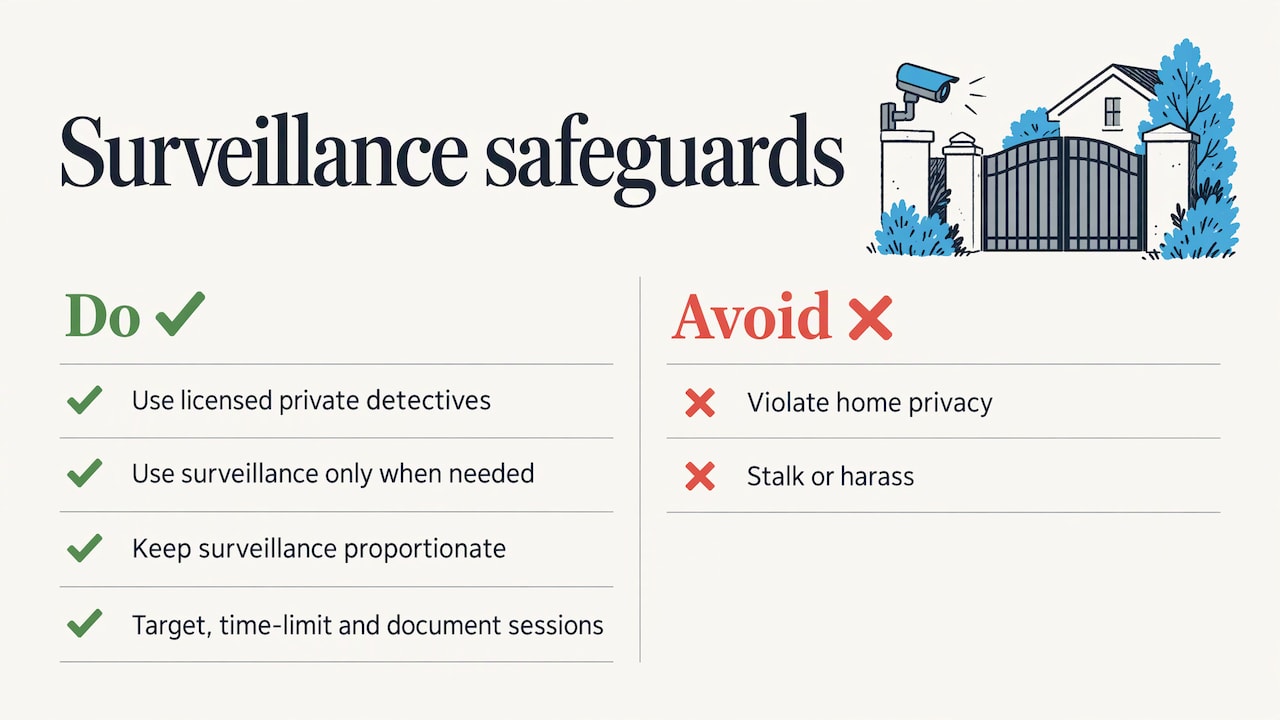
The Belgian standard says surveillance should be done only by licensed private detectives, used only when other activities do not suffice, and kept proportionate, respecting the privacy of the home and avoiding stalking or harassment. Those are sensible principles anywhere. Surveillance that is targeted, time-limited and documented is also the surveillance a court is willing to hear about.
We produce court-ready photos and video, with each session logged. Our surveillance engagements are listed at $1,000 to $1,450 one-off, and our page on what a private investigator costs in Melbourne explains the range. For the approach itself, see surveillance services done the right way. The same discipline applies to Victorian WorkCover investigations.
Finding people anywhere in the world
Fraud often ends with a person who has moved: a former employee who relocated, a business partner who left the country, a scammer behind an untraceable name. Locating them is its own step, and it usually runs alongside tracing the money.
The starting points are the same everywhere: last known addresses, company and property records, relatives and associates, and the digital footprint someone leaves behind. What changes from country to country is which records are public and which contacts can be approached lawfully. Our guide on how to locate a missing person covers the first steps, and an example of an overseas result is our missing person case located in the UK. Our team also handles child recovery and missing persons work, and a serious case may call for a team with experience on more than one continent.
Hiring former FBI and military staff for advice
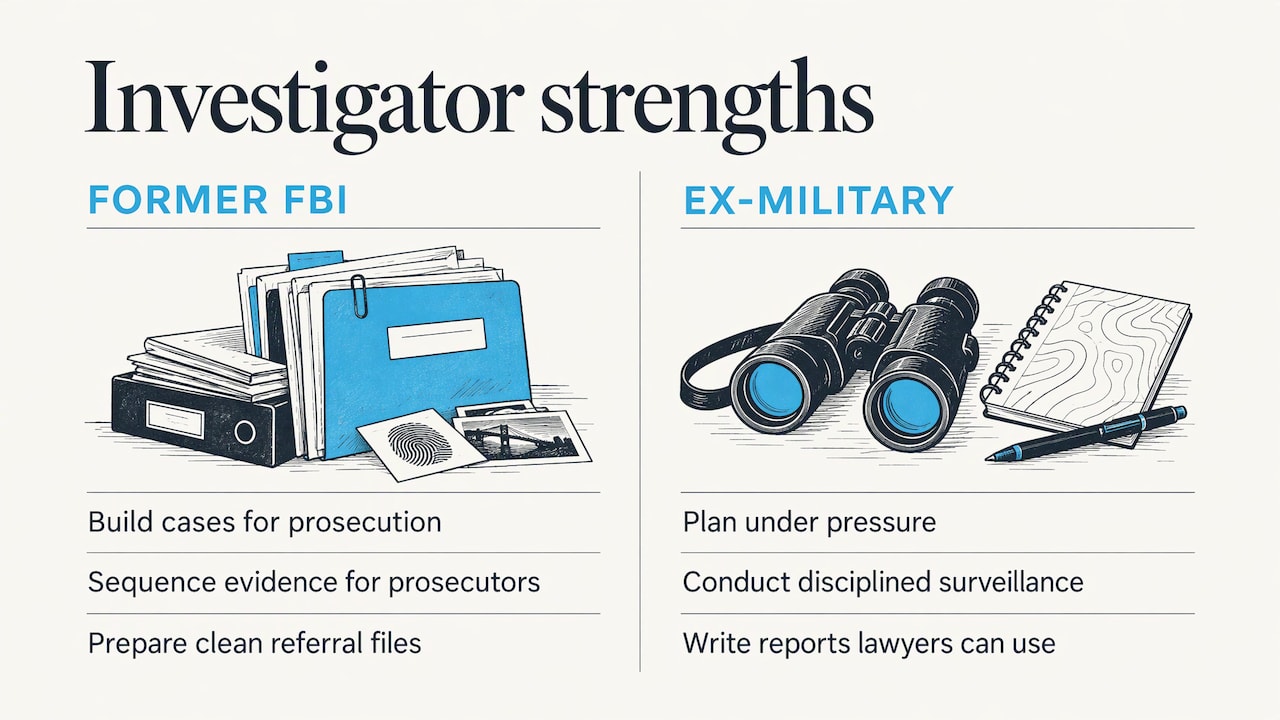
People often ask whether they can hire former FBI agents or ex-military personnel for advice on a fraud case. At Pi Melbourne, our team includes former FBI and military agents alongside ex-police and polygraph specialists, and the point of that experience is practical. A former federal agent knows how a case is built for prosecution: what a prosecutor needs, how evidence is sequenced, and why a referral sometimes fails for lack of a clean file. Our page on our former FBI agent explains that background in the context of missing persons and child abduction work.
Ex-military investigators bring a different strength: planning under pressure, disciplined surveillance, patience, and the ability to stay unnoticed. If you are looking to hire ex-military expertise, you are looking for people who can run a methodical operation and write it up in a way a lawyer can use. Our investigators are used to being given a defined objective and delivering evidence rather than opinions.
In both cases the sensible use is a short strategy conversation early, before you collect anything, so the plan and the evidence rules are right from the beginning. We are an investigation firm, not a security force, and we do work that is lawful, documented and aimed at proceedings or recovery.
How we can help
If you suspect fraud in your business, or you are a family or legal client who needs evidence that will hold up, we run the investigation from assessment to report. That covers fraud investigation, missing persons, evidence collection for court and related services, delivered by experienced former law enforcement, ex-military and polygraph specialists using advanced technology. Each engagement is tailored to the client’s situation, and we have operated since 2006.

To discuss your situation in confidence, start at pimelbourne.com.au.
Our view
Most fraud cases we are asked about were made harder by well-meaning action in the first week: a confrontation, a deleted email, a rushed audit. The facts were there. The evidence was not.
Our approach is to slow the first hours down just enough to protect the file. We settle what is known, decide who must not be told, secure the records, and only then move to interviews and surveillance. Each step is recorded so it can be explained later to a lawyer, a regulator or a court.
Our investigators come from policing, military service and polygraph work, and our methods are shaped by that background. We tailor every investigation to the client, because a bookkeeping fraud, a staff theft ring and a person who has vanished with money need different plans but the same standard of proof.
That standard is why we prefer to be involved early. Evidence that can be defended is far cheaper to build than to repair.
P.i Melbourne
FAQ
What are the first three steps when dealing with fraud?
Assess the suspicion quickly, secure the evidence, and limit who knows. The ACFE advises completing the initial assessment within days, ideally acting within three days of learning of the incident. Do not confront the suspect before the records are preserved.
How long does a fraud investigation take?
It depends on the size of the scheme, how much data must be reviewed and whether the suspect or money has moved abroad. A focused case on one employee can move quickly, while a multi-year scheme with tracing takes longer. A written plan with checkpoints gives you a realistic timeline from the start.
What evidence is needed to report fraud?
Reporting bodies differ by country, so check the agency in your own jurisdiction. In general, bring a clear timeline, the documents or messages showing the loss, bank or payment records, and the names of those involved. An investigator’s report with a logged chain of custody makes a referral much easier to act on.
Can I run the investigation myself?
You can handle the first assessment and preserve what is in front of you. Interviews, surveillance, tracing and the final report are where mistakes turn into inadmissible evidence or legal exposure. Bringing in our team at the planning stage keeps those steps lawful and documented.
Sources
- Planning and Conducting a Fraud Examination, ACFE (2022)
- Investigation dos and don’ts, KPMG
- The Anatomy of a Fraud Investigation, ACFE Fraud Conference
- How to conduct a Fraud Investigation, CPNQ (2023)
- Practical Guide on the Investigation of Corruption Cases, UNODC (2024)
- How to investigate allegations, IFRC Good Practice Toolkit
- Forensic Audit Standard, IFA Belgium (2023)
- The Basic Steps of a Complex Fraud and Corruption Investigation, IACRC
- Government Counter Fraud Professional Standards and Guidance, GOV.UK
- Financial Crime 2026, USA, Chambers