
Evidence of employee misconduct holds up when it is specific, dated, first-hand and collected fairly. A hunch, a rumor or a pile of screenshots with no source does not. If the stakes are a dismissal, a fraud loss or a legal claim, the strongest position is a documented file built early, and for covert or complex cases, an investigator who collects evidence designed for formal proceedings. Our team at Pi Melbourne, a private investigation firm established in 2006, works with employers on exactly this.
TL;DR
- Misconduct is generally a willful or controllable breach of duty. Honest mistakes and simple inefficiency usually do not qualify.
- Gather three kinds of evidence: testimony, documents and physical records such as photos and video.
- Keep a separate investigation file, preserve emails, messages and video early, and record how each item was obtained.
- Give the employee a fair chance to respond before you decide anything.
- Covert surveillance, cross-border inquiries and fraud cases are where an experienced investigator protects the quality of the evidence.
Table of Contents
- What counts as misconduct, and why the definition matters
- The three kinds of evidence
- How to document suspected misconduct
- Interviews and fairness
- Surveillance as evidence
- When to bring in an investigator
- Finding people anywhere in the world
- Making the decision
- Work with us on your case
- Our view
- FAQ
- Sources
What counts as misconduct, and why the definition matters
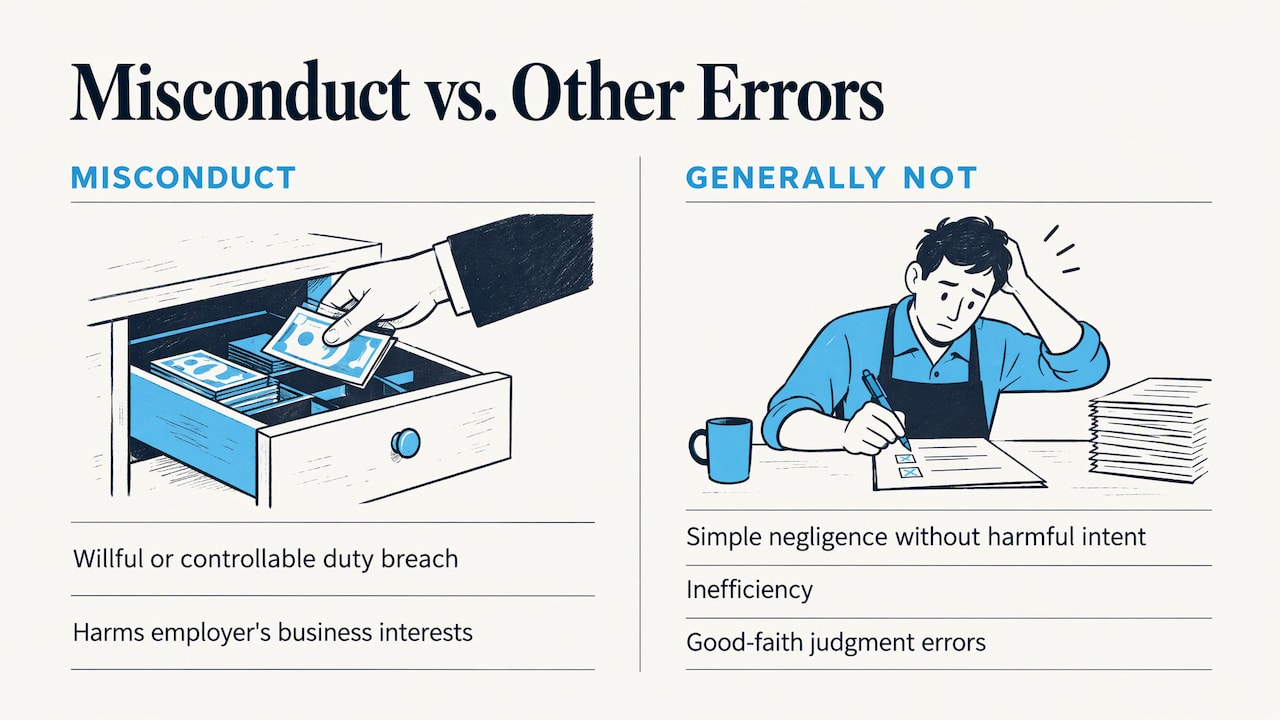
Before you collect anything, decide what you are trying to prove. The U.S. Department of Labor, in its guidance on discharge for unemployment insurance, describes misconduct as a willful or controllable breach of an employee’s duties or expected behavior that harms the employer’s legitimate business interests. The same guidance treats simple negligence without harmful intent, inefficiency and good-faith errors of judgment as generally not misconduct.
That distinction shapes your evidence. If you allege theft, you need proof of intent and of the act. If you allege poor performance, you need a pattern of documented expectations and results. Mixing the two weakens both.
The same guidance asks for the specific incident or incidents that led to the discharge, not a laundry list of grievances. It also expects records of who issued any warnings, how many, what the behavior was and when. It notes that gross misconduct such as stealing or unprovoked insubordination need not be preceded by warnings. A tidy, specific allegation is easier to prove than a long vague one.
Laws vary by country and by state. This article covers principles that apply broadly and points to U.S. sources where it cites rules. Your employment lawyer decides what your jurisdiction allows.
The three kinds of evidence
The U.S. Coast Guard’s guidance on documenting misconduct sorts evidence into three categories. It is a useful frame for any employer.
| Type | Examples | What makes it strong |
|---|---|---|
| Testimonial | Witness statements, the accused’s own account | Signed, dated, first-hand, consistent with other records |
| Documentary | Timesheets, training records, incident reports, emails | Original, complete, with a clear source |
| Physical | Photographs, video and audio recordings | Clear date, time and location, unaltered |
The same guidance says evidence is weighed on credibility and probative value, meaning how much it actually proves. Direct evidence outweighs indirect or vague evidence. A manager who watched a cash drawer being emptied is worth more than a colleague who heard about it.
It also states the burden of proof in such cases: a preponderance of the evidence, meaning it is more likely than not that the misconduct occurred. That is lower than the criminal standard of proof beyond a reasonable doubt. You do not need a perfect case, but you do need a case where each piece points the same way.
The Australian Public Service Commission’s investigation guide adds a ranking worth borrowing. It prefers first-hand evidence over hearsay and contemporaneous records, those made at the time, over later recollections. It also lists electronic records such as system logs and building access data as legitimate sources.
How to document suspected misconduct
Documentation is where most internal cases are won or lost. A practical routine:
- Open a separate investigation file. The Oregon State Government Investigations Toolkit says the file should hold interview notes, witness statements, documents that support and refute the allegation, the investigator’s report, recordings and transcripts, relevant policies and closure notices. Keep it apart from the personnel file.
- Preserve records before they vanish. The same toolkit advises preserving business records, including emails, instant messages and video surveillance, once a dispute is known, and not destroying evidence until the time to file a claim has passed. Auto-delete settings on messaging tools and short CCTV retention windows are the usual ways evidence disappears.
- Record how each item was obtained. Acas, the UK’s workplace relations service, advises keeping a written record of how and why each piece of evidence was obtained. Its list of sources includes emails, receipts, computer and phone records, CCTV, attendance records and vehicle trackers.
- Write facts, not conclusions. The Berkeley CPER Pocket Guide to Workplace Investigations says investigator notes should be factual, succinct and objective, kept separate for each witness. It also says reports may be disclosed in later hearings, just-cause discipline or litigation, so write every note as if a third party will read it.
- Date everything. The Oregon toolkit expects findings with specific dates or timeframes. “Late repeatedly” is a complaint. “Late on 14 occasions between March 3 and April 28, per badge logs” is evidence.
- Keep the chain intact. If a physical item or digital file may end up in front of a judge, you must be able to show who held it and when. Our guide to chain of custody explains how evidence stays admissible, and the page on social media evidence covers preserving posts before they are deleted.
What a good report contains
The Oregon toolkit lists what an investigation report should include: the scope, the allegations, the facts with dates, the policies that apply, witnesses interviewed, summaries of their statements, documents reviewed, key findings with credibility determinations, conclusions, recommended next steps and any unresolved issues. If you cannot fill a heading, you have found the gap in your case.
Interviews and fairness
Evidence collected unfairly can be thrown out of the process or turn a justified dismissal into a claim against you. Fairness is part of the evidence strategy.
The Australian guide says the person under investigation should get a reasonable opportunity to respond to all the evidence, and the decision-maker should genuinely consider that response. Where the employee points to evidence that supports their side, it should be gathered where practicable. The same guide reminds investigators that conflicting versions do not necessarily mean someone is lying, and that unconscious bias is a risk to guard against.
The Berkeley guide gives a simple discipline for interviews: do not guess why a witness answered the way they did. Ask, and note the answer. It also suggests recording obstacles, such as a reluctant witness, and how you resolved them.
Two cautions on process:
- Recording interviews. Rules differ. The Coast Guard guidance says recording interviews does not comply with its policy, and a UK council protocol permits written notes but not audio or video. Check your own policy and your state’s consent law before you press record.
- Representation and notice. Public-sector frameworks in the UK, such as North Lincolnshire Council’s protocol, give at least five working days’ notice and a right to bring a colleague or union representative, and tell the interviewer to make clear that no opinion has yet been reached. Private U.S. employers have different obligations, but the tone is a good model.
For the structure of the inquiry itself, our page on terms of reference for workplace misconduct investigations sets out how to define scope so the decision stands up later.
Surveillance as evidence
Some misconduct leaves no paper trail. An employee claiming sick leave while working elsewhere, someone passing stock to a third party after hours, a manager meeting a competitor: records will not show these, but observation can.
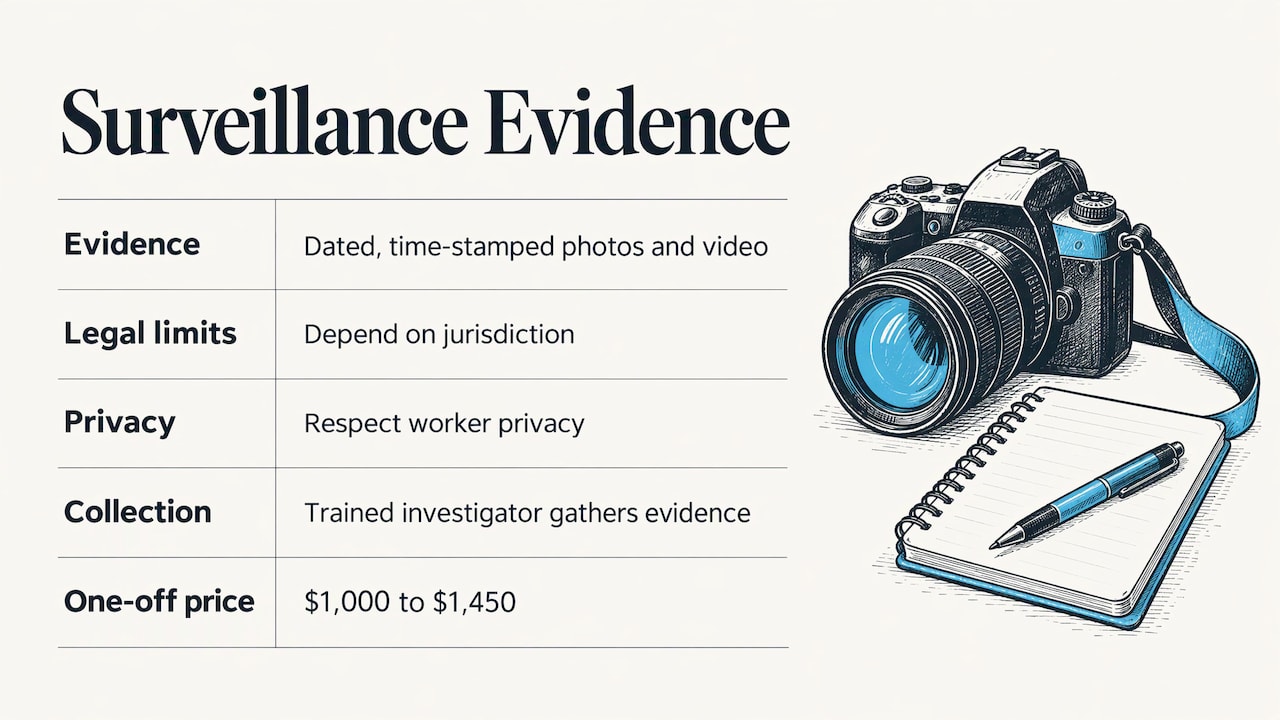
Surveillance done properly produces dated, time-stamped photographs and video that show what happened, where and when. Our surveillance service is delivered by experienced investigators using advanced technology to produce court-ready photos and video, and our published surveillance pricing runs from $1,000 to $1,450 one-off. Our page on surveillance done the right way describes the approach.
The legal side comes first. What you may monitor on company premises, systems and vehicles depends on your jurisdiction, and you should read what employers can legally monitor before you start. Acas makes the same point from the UK angle: follow data protection and employment law, respect the worker’s privacy and make monitoring methods such as CCTV clear to staff.
When you use an investigator, you also keep the employer’s hands clean. Your managers do not tail anyone, and a trained professional who knows what a tribunal or court will want does the collecting.
When to bring in an investigator
Most minor conduct issues can be handled by HR with a good file. Bring in a specialist when:
- You suspect theft, fraud or embezzlement and do not want to tip off the person. See our guides to employee theft, payroll fraud and embezzlement investigations.
- The behavior happens off-site, out of hours or outside your systems.
- The matter involves harassment and you need someone independent. Our page on workplace harassment investigations covers evidence and who should lead.
- An employee may claim retaliation after reporting something. Our guide to whistleblower retaliation proof shows what to gather.
- The case is heading to court or a regulator and you need a clean, defensible record.
Who does the work matters
Our investigators include former police, former military personnel and polygraph specialists, and the firm draws on former FBI and military agents. For an employer, the benefit is practical: people trained in evidence handling, interviewing and surveillance discipline, who know how the material will be tested. Some clients come to us wanting advice from a former FBI agent on how an inquiry should be structured, and our former FBI agent page explains that work. Others want the discipline and field experience of ex-military operators, including the kind of background associated with elite units such as the SAS, for sensitive or high-risk matters. Our ex-military security page describes what we offer there. Either way, the first conversation is about your facts and what you need to prove.
Finding people anywhere in the world
Misconduct cases often depend on someone who has left: a former employee who moved interstate, a witness who now lives abroad, or a supplier contact in another country. Their statement may be the first-hand evidence your case lacks.
Locating people across borders is part of our investigative work. Our guide on how to locate a missing person sets out the first steps, and our page on a missing person found in the UK shows that work across borders. If the issue is hidden money rather than a missing witness, our asset search investigation service applies.
Making the decision
Once the file is complete, match the response to what you can prove. A UK council policy such as Thanet’s shows a typical ladder: a first written warning, a final warning, then dismissal, with summary dismissal usually reserved for gross misconduct. U.S. employers differ, and at-will rules vary by state, so confirm with employment counsel.
The lesson from UK tribunal decisions is consistent across borders. In Wainwright v Asda Stores, a dismissal was found unfair because the employer called the conduct malicious with no evidence and never let the employee answer that point. Do not label behavior beyond what your evidence shows.
Work with us on your case
If you are facing a misconduct or fraud problem and need evidence you can rely on, our corporate investigations service is built for it. We tailor each investigation to the client’s situation, and our investigators have police, military and polygraph backgrounds. You can also see our full range of private investigation services, including fraud investigation and evidence collection for court.
The basics of how we approach business matters are set out in our overview of corporate investigations.
Our view
Most employers lose misconduct cases before the investigation starts. They act on suspicion, confront the employee, and only then try to collect proof, by which point messages have been deleted and the employee knows what you are looking for.
We tailor each investigation to the situation in front of us. Our people come from policing, the military and polygraph work, and they are used to the standard that evidence has to meet when someone else tests it. That is why we think the first call should come before the confrontation, not after.
Good evidence is boring: dated, specific, first-hand and gathered fairly. Our job is to deliver that for you, whether it takes surveillance, interviews or locating a witness on the other side of the world.
P.i Melbourne
FAQ
What is the best evidence of employee misconduct?
Direct, first-hand and contemporaneous evidence is the strongest. That means records created at the time, such as video, system logs and signed witness statements, rather than later recollections or hearsay. Several pieces of different types pointing to the same conclusion are better than one dramatic item.
How do I document employee misconduct properly?
Keep a separate investigation file, date every entry and record how each item was obtained. Write facts rather than opinions, preserve emails and video before they auto-delete, and keep a record of the employee’s response. The Oregon toolkit cited above is a good checklist for what the file should hold.
Can I secretly monitor an employee I suspect?
It depends on your jurisdiction, your policies and what you monitor. Rules on recording audio, tracking vehicles and reading private communications are stricter than rules on company systems you have told staff about. Take legal advice first, then speak to us about lawful surveillance carried out by trained investigators.
What standard of proof applies to misconduct?
In many workplace settings it is the balance of probabilities, called preponderance of the evidence in the U.S.: it must be more likely than not that the misconduct happened. This is lower than the criminal standard, but a decision still needs evidence behind it and a fair hearing for the employee.
Sources
- GUIDE SHEET 2 DISCHARGE, U.S. Department of Labor
- Documenting Misconduct (PSC-CPM-2), U.S. Coast Guard
- Chapter 8: Investigation and determination, Australian Public Service Commission
- Oregon State Government Investigations Toolkit
- Step 3: Carrying out an investigation, Acas
- Pocket Guide to Workplace Investigations, Berkeley CPER
- Investigation protocol, North Lincolnshire Council
- Disciplinary Policy & Procedure, Thanet District Council
- Wainwright v Asda Stores Ltd, Employment Tribunal judgment