
Proving intellectual property theft takes three things: proof that you own the asset, proof that someone had access to it, and proof that they copied, disclosed or used it. Suspicion alone is not enough. A court, a prosecutor or a regulator will ask for records, and those records have to be gathered and kept in a way that survives challenge. Our team at Pi Melbourne includes former law enforcement, ex-military and polygraph specialists, and we build corporate investigations around exactly that standard: evidence that can be put in front of a lawyer or a court.
This guide is for business owners and managers who suspect that a trade secret, design, client list or source code has walked out the door. It covers what you must show, what to preserve, how a corporate espionage investigation works, and when to call law enforcement or a lawyer.
TL;DR
- Proof has three parts: you own the asset, the suspect had access, and the asset was copied, disclosed or used.
- Trade secrets only count if you took reasonable steps to keep them secret, so policies, NDAs and access controls are part of your evidence.
- Preserve first, investigate second: image devices, keep logs and write down every step you take.
- Surveillance and monitoring must follow privacy law, or the evidence can hurt you instead of the suspect.
- Early contact with law enforcement and counsel opens options a private company cannot use alone.
Table of Contents
- What you actually have to prove
- The evidence that proves ownership
- The evidence that proves access and misuse
- How to preserve evidence so it stays usable
- How a corporate espionage investigation works
- Surveillance and monitoring: stay inside the law
- Who to hire: former FBI, ex-military and police investigators
- When insiders are the source
- When to call law enforcement and a lawyer
- Reducing the risk before it happens
- Start with an investigation built for evidence
- Our perspective
- FAQ
- Sources
What you actually have to prove
The word “theft” covers several different rights, and each has its own proof. A patent, a copyright, a trademark and a trade secret are all intellectual property, but the evidence differs and varies by jurisdiction. Registered rights come with a certificate. Trade secrets do not, so the burden of showing the asset exists falls on you.
For trade secrets, the World Intellectual Property Organization describes the usual elements: you must have standing to sue, identify the secret with enough specificity, show it qualifies for protection, prove misappropriation, and, if you want money, prove damages or the defendant’s profits. In the United States, the Congressional Research Service explains that protection generally requires information with economic value that is not generally known or readily ascertainable, plus reasonable measures to keep it secret.
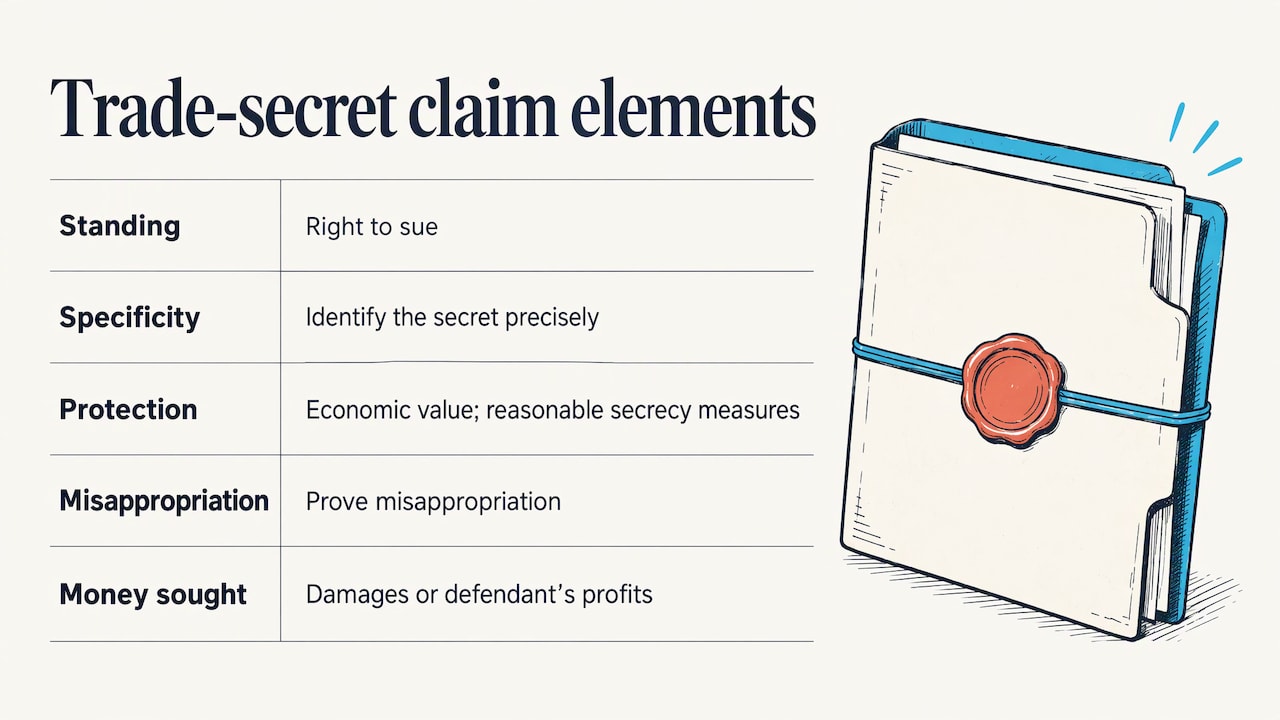
That last element surprises many owners. If you never restricted access, never used NDAs and never secured your network, the information may fail the test before the suspect’s conduct is even discussed.
Theft, espionage and where the line sits
Corporate espionage is the term people use for deliberate, covert acquisition of a competitor’s confidential information. Under U.S. law the label matters. The FBI distinguishes economic espionage, which benefits a foreign government or its agents, from commercial trade-secret theft intended to benefit someone other than the owner. Both are criminal under the Economic Espionage Act, as the CRS overview notes. These are U.S. rules. If your business or the suspect sits in another country, the definitions and thresholds will differ.
The evidence that proves ownership
Start with the asset itself, because you cannot prove a secret was stolen until you can describe it precisely.
- A specific description. Not “our customer data” but the exact pricing model, formula, file set or process, with version numbers and dates.
- Proof of value. Revenue it generates, development cost, or the advantage a competitor would gain.
- Proof of secrecy measures. Written confidentiality policies, signed NDAs, employment agreements, access lists, badge records, password policies and network security settings.
- Dated creation records. Drafts, repository history, lab notebooks and design files with timestamps.
WIPO advises documenting reasonable protective steps such as policies, NDAs, security controls and access restrictions. Gather these before anything else. They are the part of the file that exists today and cannot be disputed later.
The evidence that proves access and misuse
Ownership shows the asset was yours. Misuse is what links a person to it. The strongest files combine several kinds of record:
- System records: file access logs, download and print history, email forwarding rules, cloud sync activity, USB connection history and VPN logs.
- Communications: emails, messages and chat logs that show the suspect discussing, sending or offering the material.
- Agreements: NDAs, non-compete clauses, contractor terms and any licence the suspect signed.
- The output: a competitor’s product, a pitch deck or a website that mirrors your design, side by side with your dated originals.
- Behavior: after-hours access, sudden interest in files outside someone’s role, or a resignation followed by a rival’s launch.
Direct proof such as a confession or an intercepted file transfer is rare. WIPO notes that circumstantial evidence can support reasonable inferences of misuse, so a pattern of access followed by a similar product can carry real weight when it is documented properly.
A worked example
A manufacturer notices that a former engineer’s new employer has launched a component almost identical to an unreleased design. The file looks like this: the design’s dated repository history proves ownership; the access log shows the engineer copied the project folder to an external drive eleven days before resigning; the NDA and access list prove secrecy measures; and the competitor’s launch date and specifications show use. No single item is conclusive. Together they let a lawyer plead the claim with specificity.
How to preserve evidence so it stays usable
Preservation is where most cases are won or weakened. The U.S. Department of Justice’s guide for victims of IP crime recommends documenting each investigative step, including the names and contact details of people with knowledge, recording interviews in writing or on tape, preserving physical, documentary and digital evidence, and examining a suspected computer using a digital image or copy rather than the original.
In practice:
- Do not browse the suspect’s laptop. Opening files changes timestamps and can taint the record. Image the drive and work from the copy.
- Freeze automatic deletion. Suspend email retention purges, log rotation and device wipes for the people involved.
- Keep a log of who did what and when. Every person who touches the evidence should be recorded.
- Write down how you discovered it. The date, the trigger and who noticed first.
The American Bar Association notes that the period right after a key employee leaves is critical for identifying, preserving and collecting evidence of trade-secret theft. Delay is the enemy: devices get reissued and logs roll over.
If litigation is likely, it also helps to understand how courts handle discovery of computer records, documents and forensic copies, because what you preserve now is what gets requested and produced later.
The handling of each item matters as much as the item. Our guide to chain of custody explains how a documented trail keeps evidence admissible, and our piece on social media evidence shows how to capture posts and messages so a court will accept them.
How a corporate espionage investigation works
An investigation turns suspicion into a structured file. The DOJ’s reporting checklist asks for the suspected conduct, how it was discovered, suspect identifiers, possible beneficiaries, where the information may be stored or used, and any evidence from an internal investigation. A good investigator works through the same questions.
Step 1: Define the loss
Write down exactly what is missing or exposed and who could have reached it. Narrow the list of people with access. Most leaks trace back to a small group.
Step 2: Secure the digital record
Image devices and export logs before anyone is confronted. This is the step that is hardest to repair if it is done late or done badly.
Step 3: Establish the link
Connect the person to the asset and the asset to the beneficiary. That can mean tracing who is now working with a competitor, who holds the product, and where the information went. Our corporate team handles this kind of work under our corporate investigations service, and our overview of corporate investigations sets out how a matter is scoped.
Step 4: Observe lawfully
When the question is what someone is doing in person, such as meeting a competitor or handing over material, professional surveillance can produce dated, court-ready photos and video. We deliver that kind of evidence, and our surveillance service is published at $1,000–$1,450 for a one-off engagement.
Step 5: Hand the file to counsel
The output should be organized so a lawyer can use it: timeline, exhibits, custody records, and a clear statement of what each item shows.
Surveillance and monitoring: stay inside the law
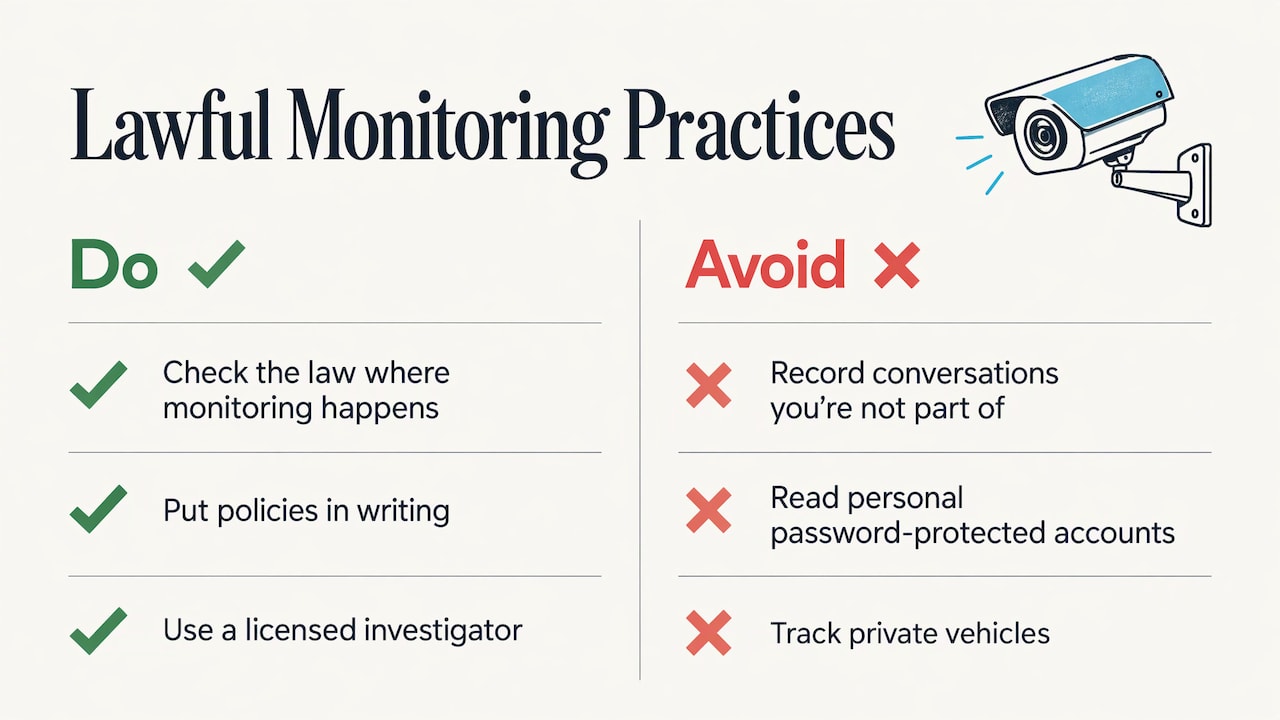
Evidence collected unlawfully can be excluded or expose you to claims. In the U.S., workplace monitoring sits under a mix of federal law, such as the Electronic Communications Privacy Act, and state rules on consent and notice, which vary. Recording a conversation you are not part of, reading a personal password-protected account or tracking someone’s private vehicle can create liability for you. Rules differ across the U.S., Australia, the UK and elsewhere, so check the law where the monitoring will happen before it begins, and take advice from a lawyer in that jurisdiction.
Two practical habits help. First, put monitoring policies in writing and have staff acknowledge them. Our page on workplace surveillance laws explains what employers can generally monitor. Second, let a licensed investigator do the observation rather than a manager acting alone. Our approach to surveillance done the right way is built around lawful, documented collection.
Who to hire: former FBI, ex-military and police investigators
Many business owners ask whether they can hire a former FBI agent or an ex-military operator for advice on a theft like this. The experience that matters is investigative: building a case from records and witnesses, handling evidence so it holds up, and planning observation. Our investigators come from police, military and polygraph backgrounds, and we have a former FBI agent on our team who works on missing persons and child kidnapping matters; see our former FBI agent page. Ex-military discipline suits long, careful observation, and that is why we recruit it.
What you should ask of any such investigator is simple: that they work within the law, document everything, and write for a court. We do that on every engagement, tailored to the client’s situation.
When the suspect has left the country
IP theft often involves someone who has moved interstate or overseas, or a competitor on another continent. Locating a person abroad is a distinct skill, and we have done it: our team found a missing person in the UK, and our guide to locating a person sets out the first steps. For finding where money or property has gone, our asset search investigation is built to hold up in court.
When insiders are the source
Most leaks involve someone with legitimate access. If you suspect an employee, our guides on employee theft investigation and internal fraud investigation cover the process, including how to run interviews and protect the HR process. If the same person also moved money, see embezzlement investigation.
When to call law enforcement and a lawyer
The DOJ recommends contacting law enforcement soon after you detect suspected IP crime. Early referral can help secure evidence and open avenues a private company does not have, including warrants and undercover activity. A civil route also exists. The American Bar Association explains that the Defend Trade Secrets Act created a federal civil claim for trade-secret misappropriation, including a civil seizure mechanism in narrow cases that a court may order to prevent further spread of the secret.
Speak to an intellectual property attorney before you confront the suspect, send a demand letter or sign a settlement. The investigation and the legal strategy should be planned together. The authority and the court take the steps the law reserves to them, and we prepare the evidence file they will work from.
Reducing the risk before it happens
Prevention is also your best evidence. WIPO says leakage of trade secrets should ideally be avoided through a good trade secret management policy and high security standards. The CRS lists need-to-know access, physical safeguards, NDAs and secure networks as examples of reasonable secrecy measures. Keep an inventory of what is secret, limit who sees it, log access, and run exit procedures when people leave.
Start with an investigation built for evidence
If you suspect theft, the next step is a scoped corporate investigation. We have worked since 2006 and tailor each engagement to the client’s scenario, using former police, military and polygraph specialists and advanced technology to produce evidence suited to legal proceedings. Describe the situation through our corporate investigations page.

For wider needs such as fraud, staff monitoring or evidence for court, see the full list of private investigation services.
Our perspective
Intellectual property cases are rarely lost because the theft did not happen. They are lost because the file was thin: the secret was never described, the laptop was opened before it was imaged, or the surveillance could not be tied to a date and a person.
We start from the courtroom and work backward. Every item gets a date, a source and a custody record, and every observation is photographed or filmed so a lawyer can use it. Our investigators come from police, military and polygraph backgrounds, and that discipline is what we bring to a corporate matter.
Each client’s situation is different, so we tailor the investigation rather than run a template. Whether the suspect is down the hall or on another continent, the aim is the same: a clear, lawful record that lets you and your counsel decide what to do next.
P.i Melbourne
FAQ
What is the best proof of intellectual property theft?
The best proof combines three layers: dated records that show you created and own the asset, evidence of secrecy measures, and logs or communications that link a specific person to copying or use. Circumstantial patterns can be enough when well documented. The exact requirements depend on the type of right and the jurisdiction.
Can I secretly monitor an employee I suspect of stealing?
Not without checking the law first. Federal and state rules on interception, notice and consent differ, and unlawful monitoring can create liability or taint your evidence. Have a lawyer confirm what is permitted, and use a licensed investigator for observation.
Should I confront the suspect first?
No. Preserve devices, logs and records before anyone is confronted, because a warned suspect can delete files. Speak with an attorney about timing.
Do I need law enforcement or just a lawyer?
Often both. The Department of Justice recommends contacting law enforcement soon after detecting suspected IP crime, while an attorney advises on civil claims and protects your position. An investigator prepares the evidence for either route.
Sources
- An Introduction to Trade Secrets Law in the United States (Congressional Research Service)
- FBI: Economic Espionage
- WIPO Guide to Trade Secrets and Innovation, Part V
- Reporting Intellectual Property Crime (U.S. Department of Justice)
- Explaining the Defend Trade Secrets Act (American Bar Association)
- How Can Digital Forensics Prevent the Misappropriation of Trade Secret and Confidential Information? (American Bar Association)