
When you hire a private investigator, confidentiality means two things: the investigator keeps what they learn about you and your case to themselves, and they handle the evidence so it can be used when it counts. In the United States, this is set by state licensing rules and the contract you sign, not by one national law. The firm you choose decides how well it is kept. At Pi Melbourne, our investigators are ex-police, ex-military and polygraph specialists. We work from a written engagement, and your case stays between you, us and the people you authorize.
TL;DR
- State licensing rules typically require investigators to keep client information confidential and for the client’s use only, with exceptions for the law, court orders and subpoenas.
- Confidentiality is not the same as legal privilege. An investigator’s conversations with you are not automatically privileged, but work done under a lawyer’s direction can be.
- Good confidentiality also means record handling: separate files, secure storage, an audit trail for digital evidence and a documented chain of custody.
- If the work crosses borders, the investigator must follow the privacy law of each country involved.
- Ask any firm how it stores your file, who sees it and what it will do if a court demands it, before you pay a retainer.
Table of Contents
- What confidentiality means when you hire an investigator
- When an investigator can or must share information
- Confidentiality is not the same as privilege
- How a careful firm protects your identity, records and evidence
- Surveillance and confidentiality
- Hiring ex-FBI, ex-military and former SAS experience
- Finding people across borders
- Common situations, and what confidentiality means in each
- Where we help
- Our perspective
- FAQ
- Sources
What confidentiality means when you hire an investigator
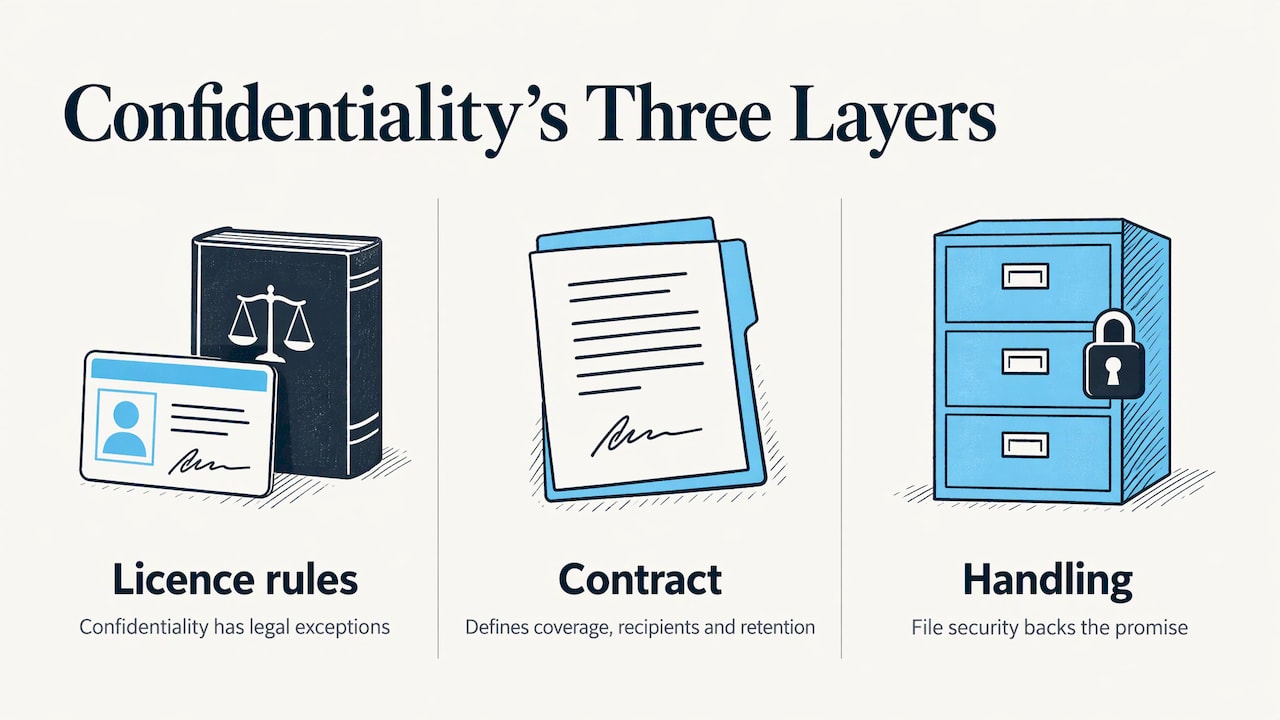
Three layers protect you, and they work together.
The licence rules. Most US states license investigators, and many write confidentiality into the licence conditions. Colorado’s rules, for example, require licensees to keep all information from all cases confidential and for the client’s use only, except where state or federal law requires otherwise. Those rules do not stop a client from waiving confidentiality, and they do not override a valid subpoena. Vermont treats it as unprofessional conduct for a licensed investigator to disclose confidential client information except with the client’s permission, under a court order, to establish or collect a fee, or to prevent a crime the client intends to commit.
The contract. A written engagement agreement should say what is covered (your identity, the reason you hired the firm, photos, video, reports), who may receive it, and how long the file is kept. Professional codes point the same way. The Council of International Investigators’ code says members protect client confidences, and that duty survives the end of the engagement.
The handling. A promise is only as good as the file room behind it. More on that below.
None of these layers is absolute. Every one has exceptions for the law, and you should know them before you start.
When an investigator can or must share information
Confidentiality has limits, and they are narrow and predictable. Across the sources we reviewed, the same situations come up again and again:
- With your permission. You can authorize the investigator to share findings with your attorney, your accountant or your HR team.
- A court order or valid subpoena. Colorado’s rule expressly leaves compliance with a subpoena or summons intact. Kentucky’s code of ethics says the same, and also lets an investigator divulge information about a criminal offense to a law enforcement officer or prosecutor.
- Fee disputes and defense. Vermont allows disclosure when necessary to collect a fee. Colorado and Kentucky allow information to be used to defend a claim against the investigator.
- Serious danger. The international code allows disclosure where it is necessary to prevent a serious and imminent threat to life or safety.
The practical lesson: do not hire anyone, including us, on the understanding that a determined court cannot reach the file. What you can expect is that nothing leaves the file without a legal reason or your say-so.
Confidentiality is not the same as privilege
People often assume that talking to a private investigator is like talking to a lawyer. It is not.
A confidentiality agreement is a contract. It binds the investigator not to share what they learn. Attorney-client privilege is a legal protection that lets you refuse to hand over certain communications in a case. An investigator has no privilege of their own in most settings.
There is a route to protection, though. Under the long-standing Kovel doctrine, privilege can extend to a third-party investigator when the lawyer hires and controls them. One case summary database describes the rule as requiring that the lawyer hire and control the private investigator, although the client can pay. Courts look at the primary purpose of the work, so an investigation commissioned for general business reasons may not qualify.
What this means for you:
- If you are in a custody dispute, divorce or lawsuit, tell your attorney first and ask whether the investigation should run through their office.
- If you are a business owner investigating internal fraud or misconduct, involve counsel before interviews begin, not after.
- If there is no lawyer yet, rely on the engagement agreement and expect that the file could be subpoenaed later.
Our Chain of Custody guide explains how the evidence itself is kept admissible once it exists.
How a careful firm protects your identity, records and evidence
Regulators spell out what good handling looks like. They are a useful checklist when you interview a firm.
Separate files, secure storage. Colorado’s recordkeeping rule requires a separate, distinct file per client kept at least seven years, stored securely, producible within 10 days of a demand, and destroyed so it cannot be reconstructed.
Contemporaneous notes. The Victorian (Australia) regulator’s code of practice calls for written day-book records and retention of produced material for seven years. It also requires a full audit trail for digitally stored evidence, logging every copy, access and action, so the evidence holds up in court.
Collect only what is relevant. The same code says investigators should gather only information relevant to the investigation and should not record interviews without authorization and the interviewee’s permission. Less collected means less to leak.
Proportionate retention. The international code asks members to keep personal information only as long as necessary or as required by law.
When you speak with any firm, ask:
- Who on the team can open my file?
- Where are photos and video stored, and is there an access log?
- How long is the file kept, and how is it destroyed?
- What happens if my spouse’s lawyer, an employer or a court demands records?
- Will you sign a written confidentiality clause?
We are glad to answer these, and a written engagement is where the answers belong.
Surveillance and confidentiality
Surveillance produces the most sensitive material an investigator holds: photos, video, locations and routines of a named person. Two risks follow. One is the subject learning they are being watched. The other is the footage ending up where it should not.
Our surveillance work is done by experienced former law enforcement and ex-military investigators using advanced technology to capture court-ready photos and video. Discretion in the field and discipline in the file are one skill. Our surveillance approach explains how we work. Our published surveillance price is $1,000 to $1,450 one-off, and the details are on our surveillance cost page.
If you are an employer, the law on what you can monitor matters as much as who does the watching. See our guide to workplace surveillance laws before you start.
Hiring ex-FBI, ex-military and former SAS experience
Many readers come to us asking for a former FBI agent or a soldier. The reasoning is sound: people trained in federal investigations or military operations are used to handling sensitive material, working discreetly and writing precise reports.
Our team includes former FBI and military agents alongside ex-police and polygraph specialists. For missing-person and child-abduction concerns, see our page on a former FBI agent for missing persons and child kidnapping.
A few points for anyone seeking advice from this kind of background:
- Advice versus fieldwork. A conversation with a former federal agent or ex-military investigator can help you judge what is realistic: what evidence exists, what a court would accept, what a case needs. Fieldwork is the engagement that follows.
- Former status is not a licence. A former FBI agent or former special forces soldier has no special legal powers when working privately. Everyone, whatever their past, is bound by the same laws as any other citizen and the same licensing rules. That is a reason to value investigators who respect those limits.
- “Mercenaries for hire” is not what we do. We do not offer armed or unlawful operations. Our ex-military investigators apply their training to lawful surveillance, evidence gathering and recovery work. If you fear for someone’s immediate safety, call 911 first.
We do not name specific units. If a military background matters to you, tell us what you need and we will explain how our team’s experience applies. The private investigator vs police guide sets out when each is the right call.
Finding people across borders
When someone has moved abroad, confidentiality gets more complicated because the privacy rules change with the country.
The international code says members working across borders must take reasonable steps to understand each jurisdiction’s legal requirements and may not rely on ignorance of local law. Recent examples show why:
- In November 2024 the UK’s data protection regulator launched a data protection code of conduct for private-sector investigators under UK GDPR.
- Belgium enacted a reform of private investigations in December 2024. A law firm guide notes that breaches can lead to evidence being rejected in court.
- In July 2024 Germany’s Federal Labour Court ruled that covert detective surveillance of an employee suspected of faking illness breached the GDPR, and awarded the employee EUR 1,500 in damages.
The point for you: evidence gathered by unlawful methods can be thrown out, and it can create liability for the client who commissioned it. That is why a missing-person search overseas should be run by a firm that checks local law first. Read how we approached a case in finding a missing person in the UK, and our guide on how to locate a missing person.
Common situations, and what confidentiality means in each
Suspected infidelity. You want to know whether the other person is told you hired someone. They are not. Your findings go to you. If divorce follows, ask your attorney how the material will be used. Our guides on proof of cheating and signs of infidelity cover what courts tend to accept.
Employee monitoring and internal fraud. Business owners worry that word will reach staff. Keep the circle small: you, your counsel, and the investigator. See internal fraud investigation and corporate investigations.
Child welfare and family law. Families need discretion and careful handling of anything involving minors. Our family law and teenage monitoring services are built around this.
Crypto and online scams. Report to the authorities and keep every record. If you want an investigator to trace funds or identify the people behind a fraud, give them the file under a written confidentiality agreement and expect that findings may go to law enforcement.
Where we help
If you have a situation that needs an investigator and you want it handled discreetly, we start with your circumstances. Our investigations are tailored to each client’s situation and carried out by ex-police, ex-military and polygraph specialists, with evidence prepared for legal proceedings.
See our private investigation services or contact us through Pi Melbourne.
Our perspective
We have been running investigations since 2006, and we regard discretion as part of the work itself, not an add-on to it.
A client who calls us is usually in the hardest week of their year: a marriage, a business or a child is at stake. They need to know that what they tell us stays with us, and that the evidence we produce will stand up if it is ever needed in a legal proceeding.
That is why our investigators come from policing, the military and polygraph work. Those backgrounds teach people to keep a confidence, to write things down accurately and to respect the line between what is lawful and what is not.
Our approach is tailored to each client. We listen first, we propose the work that fits, and we keep the file in line with the law that applies to your case.
P.i Melbourne
FAQ
Will a private investigator tell anyone I hired them?
A licensed investigator is generally bound by state rules and the engagement agreement to keep your information confidential. Exceptions are narrow: your permission, a court order or subpoena, and in some states fee collection or preventing a crime.
Is what I tell a private investigator protected like talking to a lawyer?
Not automatically. Privilege can cover an investigator’s work when your attorney hires and directs them, under the Kovel doctrine. If a case is coming, speak to your lawyer before the investigation starts.
Can a private investigator be sued for invasion of privacy?
Yes. Investigators are bound by the same laws as anyone else, and unlawful methods can create liability and make evidence inadmissible. Under EU GDPR, people can complain to a data protection authority about unauthorized disclosure of personal data. If you are concerned, speak to an attorney in your state.
How long does an investigator keep my file?
It depends on the rules where they operate. Colorado requires at least seven years, and Victoria’s code also requires seven years for produced material. Ask for the retention and destruction terms in writing.
Sources
- Code of Colorado Regulations, 4 CCR 750-1 (confidentiality)
- Code of Colorado Regulations (recordkeeping)
- Vermont Laws, Title 26, Chapter 59
- Kentucky Board of Licensure for Private Investigators, laws and regulations
- Council of International Investigators, Code of Ethics
- WorkSafe Victoria, Code of practice for private investigators
- ICO, data protection code of conduct for UK private investigators
- Chambers Global Practice Guides, comparison
- Ius Laboris, Workplace Data Privacy Update, January 2026
- Lexology, Privacy, Data Protection and Cybersecurity: EU Overview
- McGuireWoods, Attorney-Client Privilege and Work Product Case Summary Database