
A chain of custody is the chronological record of who held a piece of evidence, where it was, and what happened to it, from the moment it was collected until it is presented in court or disposed of. It is the paper trail (or digital log) that lets a judge trust the item is the same one that was found, and that it has not been changed. If the record has gaps, the evidence can be challenged, excluded or given less weight, however damning it looks.
This guide explains what the chain consists of, what you must document, where chains break in real cases, how digital evidence differs, and what to look for if you hire a private investigator, including one with a former FBI background.
TL;DR
- Chain of custody is a chronological record of custody, control, transfer, analysis and disposition of evidence, physical or electronic.
- Each link needs who, when, where and why. One missing link gives the other side something to attack.
- The fewer people who touch an item, the fewer places the chain can fail. Start the log the moment something is identified as evidence.
- Digital files need hashing and secure storage, not just a folder on a laptop.
- If you are paying an investigator, ask how they document custody before you hire them. Former federal agents are trained in strict handling procedures, but you should still ask for specifics.
Table of Contents
- What chain of custody means in plain terms
- What a defensible chain must record
- How chains break, and what it costs
- Digital evidence: photos, video, messages and files
- If you are collecting evidence yourself
- Why a professional investigator changes the odds
- Hiring former FBI agents: what it gets you
- Our perspective at Pi Melbourne
- Where custody matters most: common case types
- Working with us
- FAQ
- Sources
What chain of custody means in plain terms
Think of it as a logbook that travels with the evidence. NIST’s glossary describes it as a process that tracks evidence through collection, safeguarding and analysis by documenting each person who handled it, along with the date and time of collection or transfer. The National Institute of Justice’s training material puts it simply: it is a recorded means of verifying where the evidence has travelled and who handled it before the trial.
The purpose is authentication. The court has to be assured that the item presented is the same one collected, in the same condition. The StatPearls entry on chain of custody calls it the most critical process of evidence documentation for exactly that reason.
The concept is not limited to criminal cases. It applies in:
- Family law disputes, where photos, video or messages may be contested.
- Employment and corporate fraud matters, where laptops, ledgers and access logs are evidence.
- Insurance and compensation claims, where surveillance footage is often the central item.
- Civil litigation over assets, contracts and property.
The word also appears in supply chains (certified timber, for example, and the ISO 22095 standard on terminology and models). This article is about the legal and investigative meaning.
What a defensible chain must record
A chain of custody is not a form you fill in once. It is a live log, and every transfer is an entry, even a handoff between a detective and an evidence clerk. A defensible record captures, for every link:
- Who: the full identity of each person who handled the item, and their role.
- When: the exact date and time of each transfer.
- Where: the location of the item at each stage, including storage.
- Why: the purpose of each transfer, such as analysis, copying, review or delivery to counsel.
- Signatures: a signed and dated acknowledgment from both sides of each handoff.
- Description: enough detail at the start (make, model, serial number, condition, how it was found) that the item can be identified later.
This list follows the general description of chain of custody documentation and the NIST definition above. Specific courts, agencies and labs add their own forms, so if your matter is headed to litigation, ask your lawyer which format the court expects.
A simple example
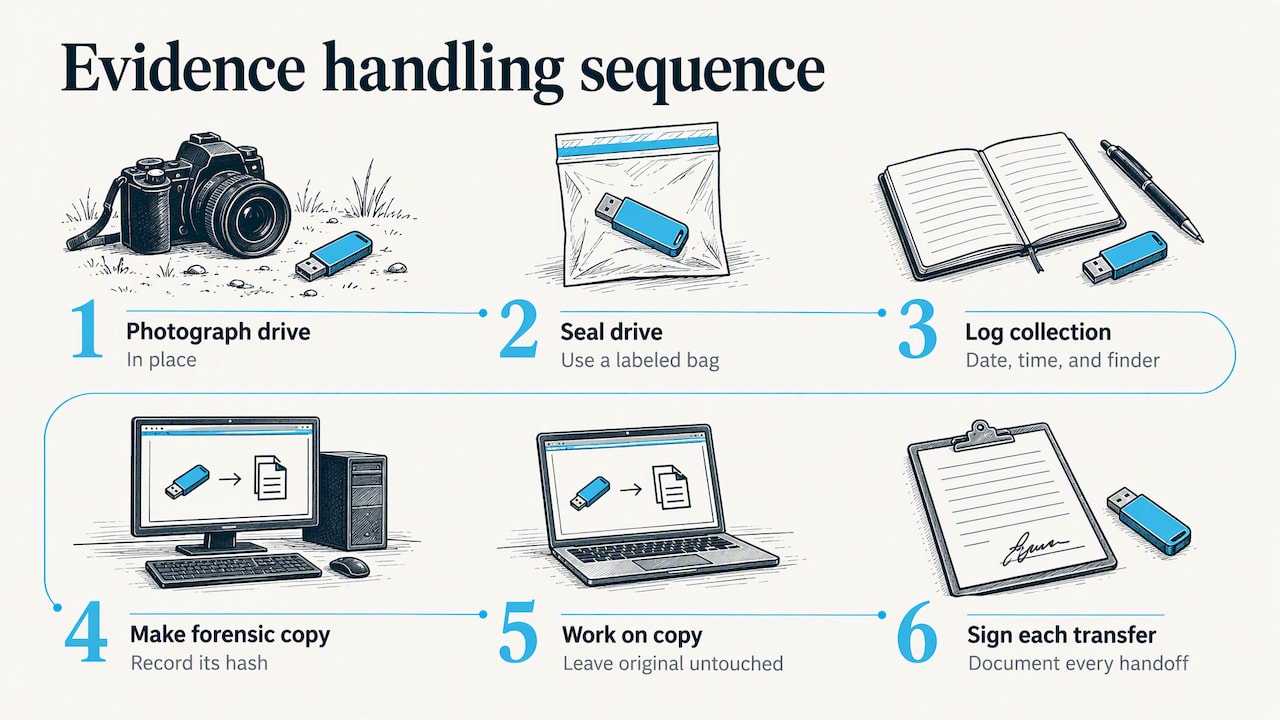
Suppose a business owner suspects an employee of copying client files to a personal drive. A weak approach: the owner plugs the drive into an office computer, browses it, emails a few files to a manager and later hands the drive to a lawyer. Four people have touched it, none of it is logged, and the files’ timestamps now show the owner’s own browsing.
A stronger approach: the drive is photographed in place, sealed in a labeled bag, and logged with the date, time and finder’s name. A forensic examiner makes a copy, records its hash, and works only on the copy. Each transfer is signed. Months later, anyone can account for the drive at any moment.
How chains break, and what it costs
Chains rarely break through dishonesty. They break through gaps: an item left on a desk overnight, a handoff nobody signed, a phone that stayed connected to the network, a video file re-saved before anyone recorded its original state.
The consequence is that evidence may be declared inadmissible or given significantly less weight by a judge or jury when a break raises questions about integrity, tampering or contamination. Gaps in the record do not prove tampering. They just let the opposing lawyer suggest it, and that is often enough.
The most common failure points:
- Starting late. Experts consistently flag that custody begins the moment an object is identified as evidence. The NIST evidence management report stresses trained personnel, documented processes and appropriate facilities as the foundation of a solid program. Evidence found first and documented later is the classic pitfall.
- Too many hands. Every extra person who touches an item is another point of failure. Good practice is to keep handling to the minimum.
- Undocumented storage. “It was in my drawer” is a custody gap unless you can show who else had access.
- Assuming that finding equals admissible. Clients often assume that because they found a document or photo, it can be used. In practice, proving who found it, how it was stored and who handled it matters as much as what it shows.
- Altering the original. Opening, renaming, editing or re-saving a file changes metadata and may change the hash.
Authentication in US courts
In US federal courts, Rule 901 of the Federal Rules of Evidence sets out how to authenticate or identify evidence, including testimony from a witness with knowledge that an item is what it is claimed to be. A clean chain of custody is one of the most practical ways to support that testimony. State rules differ in detail, and the rules in Australia, the UK and elsewhere differ again, so a lawyer in the relevant jurisdiction should confirm what applies to your case.
The duty also runs both ways. In an adversarial system, a party presenting evidence is expected to handle it fairly and disclose relevant material to the other side, one reason that sloppy handling can lead a court to exclude material.
Digital evidence: photos, video, messages and files
Photos, surveillance video, emails and phone data are now the bulk of what private clients bring to a lawyer. They are also easy to alter by accident.
NIST’s guidance on digital evidence preservation points to cryptographic hashing as the core integrity tool. A hash (often called a digital fingerprint) is a unique value computed from a file with an algorithm such as SHA-256. Change even one bit and the hash changes, which signals tampering or corruption.
Practical rules for digital handling:
- Hash at the point of collection and record the value in the log.
- Store hash values separately from the original files, so nobody can alter both together.
- Work on copies. Keep the original sealed, and verify each copy against the recorded hash.
- Record the device and context: which camera or phone, what settings, what the time source was, who operated it.
- Control access. Use a secure location with a log of who opened it and when.
- Keep the log itself. If a hash comparison later fails, the log helps show whether the change was accidental or something else.
Screenshots of chats and social posts are the weakest form of digital evidence for this reason: they show an image, not the underlying data, and there is no clean record of who captured them or how. If a message matters to your case, tell your lawyer before deleting, forwarding or “organizing” anything.
If you are collecting evidence yourself
Sometimes you have to act before a professional arrives. Keep it conservative:
- Stop and photograph the item where it sits, before touching it.
- Write down the basics: what it is, where you found it, the date and time, and who was present.
- Limit handling. Use one person, and keep a note of every time it moves.
- Store it securely (sealed envelope or bag, locked location) and note who has keys or access.
- Do not edit, open or repair files or devices. Leave devices as they are and ask a professional how to power them down.
- Call your lawyer before sharing it with anyone else, including the other party.
If the evidence relates to something you only suspect (an affair, a hidden asset, an employee’s activities), self-help has another risk. Unauthorized access to someone’s phone, email or accounts can be illegal in many places and can taint the very evidence you were trying to gather. Laws on surveillance, recording and access differ by country and state, so ask a lawyer before you act.
Why a professional investigator changes the odds
A trained investigator does more than watch and photograph. The job includes producing material that survives cross-examination. That means planning custody before the first photo is taken: how footage is captured, how it is copied, who sees it, how it is stored and who can testify about each step.
One point from the research is worth stating plainly: the best way to avoid contamination is to reduce the number of people who handle the evidence. A single investigator who collects, logs and delivers the material, and who can then testify, is a stronger witness than a chain of five people nobody can recall.
Hiring former FBI agents: what it gets you
Many clients ask specifically for former FBI agents, so here is a balanced view.
What the background offers. Federal agents work under rigid standard operating procedures for evidence handling, and they spend years writing reports and testifying under cross-examination. Evidence-management guidance such as the NIST report puts trained personnel and documented processes at the center of any reliable program, and that is the habit set a former agent brings. Firms that hire former agents often point to this discipline, plus experience in how investigations look from the government’s side of the table.
What it does not guarantee. A badge in someone’s past is not a license today. Former agents have no law enforcement powers once they leave. They work under the same private investigator licensing rules as anyone else, and those rules vary by country, state and territory. A good résumé does not substitute for current licensing, insurance and a clear written process.
What to ask any investigator, former agent or not:
- Are you currently licensed where the work will be done?
- Who will collect the evidence, and will that same person be available to testify?
- How do you log custody for physical items and for digital files?
- Do you hash video and photo files at the point of capture, and where are the originals stored?
- Can you show me a sample custody log, with details removed?
- How do you handle legal limits on surveillance, recording and access to accounts?
- Will the report and exhibits be formatted for the court or tribunal that will hear my case?
If you want to see how we describe this kind of background, our page on a former FBI agent working missing persons and child abduction cases sets out what that experience looks like in practice.
Our perspective at Pi Melbourne
We have been running investigations since 2006, and the pattern we see most is this: clients arrive with real evidence and a weak trail behind it. A photo taken on a phone and forwarded through three people, a file copied to a USB stick that has been in a glove box for a month, a recording nobody can date. The content is often accurate. The problem is that nobody can prove it.
Our view is that custody is a planning decision, not an admin task at the end. Before a job begins, we decide what will be collected, by whom, with what equipment and how it will be stored, because the investigators on our team come from police, military and polygraph backgrounds, where documented procedure is part of the job, and including former FBI personnel. We aim to produce court-ready photos and video, and we tailor each investigation to the client’s situation, because a family law matter, a staff-theft case and a WorkCover claim have different evidentiary needs.
We also tell clients what not to do. Do not confront the person first. Do not go through their phone. Do not forward the footage around. Each of those moves hands the other side an argument. A little restraint at the start protects whatever the investigation later turns up.
— Global
Where custody matters most: common case types
| Situation | What gets collected | Custody risk |
|---|---|---|
| Family law and child welfare | Surveillance video, photos, messages | Footage edited or shared before reaching your lawyer |
| Employee theft or misconduct | Devices, access logs, CCTV, documents | Multiple managers handling the same laptop or files |
| Insurance or WorkCover fraud | Activity footage with dates and locations | Undated or uncorroborated video |
| Asset tracing | Records, registry searches, financial documents | Unclear source or collection date for each record |
| Infidelity | Surveillance photos and logs | Informal screenshots and self-collected material |
If your matter fits one of these, our related guides go deeper: how to run an employee theft investigation, how workplace misconduct investigations are structured, what an insurance fraud investigation involves and six steps to an asset search that holds up in court.
Working with us
If you need evidence that will stand up in a legal proceeding, speak to us before you collect anything. We build each engagement around your scenario, and our investigators deliver court-ready photos and video, with documented handling from capture onward.
Our surveillance work is listed at $1,000 to $1,450 one-off. Other services, including family law support, corporate investigations and fraud work, are scoped to the matter, so there is no published price for them. Start at our main site to describe your situation. Your first conversation should include your lawyer’s requirements, if you have a lawyer.
FAQ
What is the chain of custody in simple terms?
It is the written history of a piece of evidence: who found it, who held it, where it was kept and why it moved, from collection to court. Its job is to show that the item in front of the judge is the same one that was collected and has not been altered.
What happens if the chain of custody is broken?
The court may exclude the evidence or give it less weight, because the gap lets the other side argue it was altered, contaminated or swapped. Whether a particular break is fatal depends on the court, the type of evidence and how well you can explain the gap. Ask your lawyer to assess it early.
Does chain of custody apply to photos and digital files?
Yes. Digital items need the same who, when, where and why log, plus integrity checks such as hashing, so that any later change to the file can be detected. Keep the original untouched, work from copies and store the hash values separately.
Can I start a chain of custody myself?
You can begin one by photographing the item in place, noting the date, time and location, limiting handling and storing it securely. Do not open, edit or repair it. Then pass it, with your notes, to your lawyer or a qualified investigator so the record continues without a gap.
Sources
- Chain of custody (Wikipedia)
- Chain of Custody, StatPearls (NCBI Bookshelf)
- Chain of custody glossary entry (NIST CSRC)
- Law 101: Legal Guide for the Forensic Expert, Chain of Custody (National Institute of Justice)
- Evidence Management Steering Committee Report (NIST)
- Digital Evidence Preservation: Considerations for Evidence Handlers (NIST)
- Chain of custody, Research Starters (EBSCO)
- The role of victims in the trial (Victorian Law Reform Commission)
- ISO 22095:2020 Chain of custody