
Fraud in a small business usually comes from two places: an insider with access to money, or an outsider who tricks someone into sending it. Prevention is cheap and mostly about process. Investigation, once you suspect something, is billed by the hour plus expenses, and a typical engagement starts with a retainer. This guide covers both: how small-business fraud works, how to cut your exposure, and what hiring a private investigator costs, with the limits of those numbers stated plainly.
TL;DR
- Small businesses lose a lot per case: the ACFE’s 2024 study found a median loss of $141,000 per case for firms under 100 employees, and only 27% had an anti-fraud hotline versus 82% of larger firms.
- Fraud needs pressure, opportunity and rationalization. You can only control opportunity, so split duties and verify every payment change on a second channel.
- Private investigators bill time plus expenses. In the US, one 2026 survey found an average of $132 an hour; Australian surveillance rates run roughly $90 to $175 an hour.
- Call your attorney before you confront anyone. Early legal involvement can protect an investigation under privilege.
Table of Contents
- How fraud actually shows up in small businesses
- Why trusted people commit fraud: the fraud triangle
- Controls that cost little and work
- Warning signs worth taking seriously
- When to bring in a private investigator
- How much does a private investigator cost?
- Protect the investigation before you start
- Our perspective
- If you need evidence, start here
- FAQ
- Sources
How fraud actually shows up in small businesses
Big companies have audit committees, internal audit teams and compliance staff. A ten-person business has an owner, a bookkeeper and a lot of trust. That gap explains why small firms are hit hard. The ACFE data above shows the missing controls: no hotline, little proactive data monitoring, and often one person who both handles cash and records it.
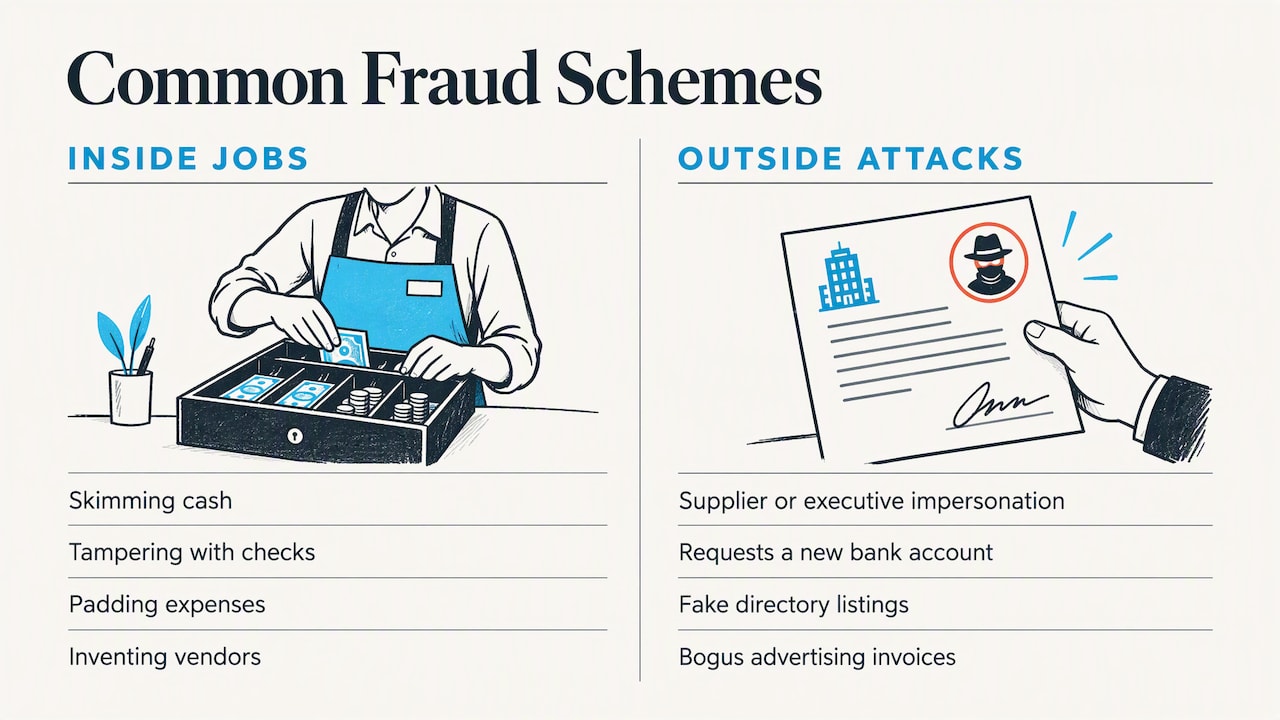
The schemes tend to fall into two groups.
Inside jobs. An employee skims cash, tampers with checks, pads expenses, invents a vendor, or inflates payroll. The ACFE report singles out check tampering and skimming as schemes that small organizations are especially exposed to. These cases often run for months before anyone notices, because the amounts are small enough to hide in normal noise.
Outside attacks. The costliest is payment redirection, also called business email compromise: a criminal impersonates a supplier or executive and asks you to pay a new bank account. The FBI’s 2025 internet crime figures, as summarized by one security firm, put roughly three billion dollars in losses on payment-workflow scams. In Australia, payment redirection cost A$166.8 million in 2025, and banks reimburse only a small share of it. Assume money sent to a fraudulent account is gone.
There are also the nuisance scams aimed at small firms, such as fake directory listings and bogus advertising invoices. The FTC publishes a guide to scams aimed at small businesses that covers them.
Why trusted people commit fraud: the fraud triangle
Most owners picture a fraudster as a stranger with bad intentions. The research says otherwise. The fraud triangle holds that three elements must be present: opportunity, pressure and rationalization. Pressure might be debt or a family crisis. Rationalization is the story the person tells themselves: I’m only borrowing it, the owner underpays me.
You cannot see an employee’s debts or read their internal excuses. You can control opportunity. That is why experts focus prevention on controls rather than on spotting bad apples.
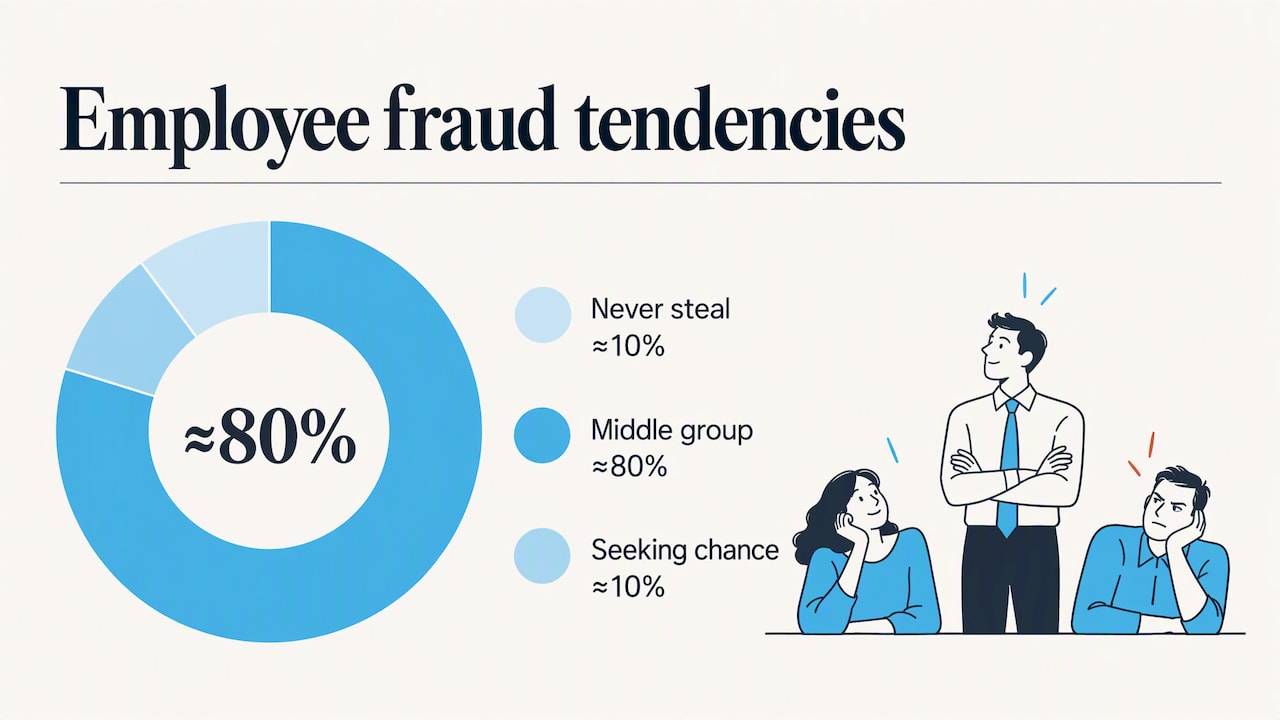
The often-quoted 10-80-10 rule makes the same point. About 10% of people will never steal, about 10% are actively looking for the chance, and the 80% in the middle might, if all three triangle elements line up. The practical reading: even a long-serving, well-liked employee deserves a system that does not depend on their goodwill.
Controls that cost little and work
You do not need a compliance department. You need a handful of habits.
- Separate duties. The person who approves a payment should not be the person who records it, and neither should reconcile the bank statement. In a three-person office, the owner can take the bank reconciliation: open the statement yourself and read it line by line each month.
- Verify on two channels. Fraud-prevention specialists advise that any change to vendor banking details, payroll direct deposit or a large wire be confirmed by calling a number you already hold, not one supplied in the email asking for the change. With voice cloning improving, a familiar voice on the phone is no longer proof.
- Set an anonymous reporting route. The hotline gap in the ACFE data is the easiest one to close. A third-party reporting line or even a dedicated email checked by someone outside the day-to-day team gives staff somewhere to go.
- Require vacations and rotate tasks. Schemes that depend on one person’s continuous attention tend to surface when someone else covers.
- Review exceptions monthly. Voided sales, refunds, new vendors, manual payroll changes and round-number invoices deserve a second look.
- Screen new hires. Run background checks consistent with the law where you operate, and get new employees to sign your policies.
Warning signs worth taking seriously
None of these proves anything alone. Several together justify a closer look.
- Cash receipts that fall short of what sales volume suggests
- A vendor you cannot verify, or one whose address matches an employee’s
- An employee who never takes leave, or guards records unusually
- Inventory shrinkage that outpaces ordinary loss
- A lifestyle that no longer fits a person’s pay
- Customers complaining about payments you have no record of
- Missing documents, or ledgers that were altered after the fact
When you notice a pattern, resist the urge to confront. A confrontation lets a guilty person delete files, move money and prepare a story. Quiet fact-finding comes first.
When to bring in a private investigator
An accountant or forensic accountant is the right first call for a paper trail: reconciling books, tracing transactions, quantifying a loss. A private investigator adds what documents cannot: observing behavior, verifying where someone actually is, interviewing witnesses, tracing assets and gathering evidence in a form a court or insurer can use.
Typical situations include:
- An employee claiming to work while doing something else, or running a competing business on your time
- Suspected theft where the books do not explain the loss
- A supplier or contractor whose existence or performance you doubt
- Fraudulent injury or compensation claims. We cover these in our guides to insurance fraud investigation and workers’ compensation fraud investigators
- Locating assets before or after a judgment against someone who owes you
A licensed investigator works within limits. As one US guide notes, an investigator cannot arrest anyone or wiretap a call they are not party to, and cannot obtain a target’s bank records. If someone promises otherwise, walk away.
For a closer look at the process, see our practical guide to employee theft investigation and our overview of how a private investigator works on a job.
How much does a private investigator cost?
The honest answer is a range, and what drives it is time. Investigators generally bill hours plus expenses, so the cost depends on how long the work takes, where, and with what equipment.
Hourly rates
In the US, a 2026 survey of 32 firms across the ten largest metros found an average of $132 an hour, with quotes up to $250. Averages by city in that survey ranged from $95 in Dallas to $153 in Chicago.
In Australia, where we are based, one 2026 cost guide reports surveillance rates between $90 and $175 an hour, with Victoria nearer the low end and Sydney at the top. The same guide notes that most investigations cost somewhere between $650 and $6,000 or more, depending on scope. Those are Australian dollars and Australian market figures. Do not apply them to a US engagement.
Retainers
Many firms ask for a retainer to open a case and then bill hours against it. The Australian guide cites retainers commonly between $1,500 and $5,000. Ask whether the unused balance is refundable and how you will be told when it is running down.
What a quote should include
A clear quote itemizes investigator time, report writing and basic evidence collection, and states what is extra. Common extras include rush reporting (the Australian guide cites about $225), specialist equipment such as GPS trackers, and travel beyond a set radius, often around 50 km.
Our published price
For surveillance, we publish a one-off price of $1,000 to $1,450 on our page about what a private investigator costs in Melbourne. Corporate, fraud and asset work depends on the matter, so we scope it with you first rather than quote a number blind.
A worked example
Take a hypothetical owner who suspects a salesperson is running a side business on company time. Say the quote is for two six-hour surveillance blocks at a rate of $130 an hour, plus a report. That is 12 hours, so $1,560 before expenses. If the subject does nothing relevant on the first day, you still pay for the hours. The numbers are illustrative, not a quote, but they show how quickly a modest-looking hourly rate becomes a four-figure bill.
Surveillance is time, not a guaranteed result
This point matters for expectations. You pay for the investigator’s time, and a six-hour block costs the full amount even if the subject never leaves home. A reputable firm tells you about this risk before taking payment. If a firm guarantees results, treat that as a warning.
Cost against loss
Weigh the spend against what you may recover. With a median small-business loss of $141,000 per case in the ACFE data, a few thousand dollars spent establishing facts is small. But if the suspected loss is $800, an investigation likely costs more than the problem. A first step may be an internal reconciliation, then a conversation with your accountant and attorney about whether outside help makes sense.
Protect the investigation before you start
The order of operations affects whether you can use what you find. An investigation conducted in contemplation of civil recovery against an employee can be protected by legal professional privilege, and the advice there is to engage external counsel early so that privileged work is clearly separated from internal operational reviews, which may be discoverable later. That analysis comes from an Australian law firm. Privilege rules differ in the US, so talk to your own attorney about how attorney-client and work-product protections would apply in your state.
A few practical rules apply anywhere:
- Preserve evidence: do not delete, edit or move files, and secure the relevant accounts and devices.
- Limit who knows. Fewer people informed means less chance of tipping off the suspect.
- Do not confront, accuse or dismiss until you have advice. Employment law, defamation risk and police reporting all come into play.
- Decide early whether you want a civil recovery, a police referral or both. Evidence gathered with that goal in mind is better.
Our perspective
We have been running investigations since 2006, and the pattern we see with business owners is consistent: the fraud itself is rarely what hurts most. The delay is. Owners spot something odd, tell themselves it is nothing, and ask questions months later, after the trail has gone cold.
Our view is that an investigation should be built around the decision you need to make: dismiss, recover, claim on insurance, or go to the police. That is why we tailor each matter rather than run a fixed package, and why our team of former police, ex-military and polygraph specialists focuses on evidence that holds up in legal proceedings.
We also think cost conversations should be frank. Surveillance is billed on time and cannot promise an outcome. We would rather tell you that before you pay than after, and tell you when a cheaper step, like a forensic accountant or a sharper internal control, should come first.
— Global
If you need evidence, start here
If you suspect an employee, supplier or claimant and need evidence you can act on, our team can scope the work with you. We handle corporate investigations, fraud investigations and asset searches, and our full list of services shows where each fits. Tell us what you have noticed and we will say honestly whether an investigation is the right next step.
FAQ
What are the most common frauds in small business?
Internally, the usual suspects are skimming cash, tampering with checks, expense padding and fake vendors. Externally, payment redirection through a spoofed email is among the costliest. Fake invoices and directory listings are the common nuisance scams.
What evidence is needed to prove fraud?
You generally need to show a false representation or concealment, that it was intentional, and that it caused a loss. In practice that means documents, bank and ledger records, witness accounts and, where appropriate, surveillance. The exact legal test depends on the jurisdiction, so ask an attorney how it applies to your case.
How much does a private investigator cost for a business fraud case?
Expect hourly billing plus expenses, often with a retainer. US averages in one 2026 survey were about $132 an hour, and Australian surveillance rates run roughly $90 to $175 an hour. Total cost depends on scope: a short targeted check can cost far less than a multi-week matter.
Should I confront an employee I suspect?
Not before you have preserved evidence and spoken to an attorney. Confronting too early can lead to destroyed records and weaken both a civil claim and a police referral.
Sources
- ACFE, Report to the Nations 2024
- AGA, The Fraud Triangle
- PayHQ, Payment redirection and scam statistics: Australia
- PayHQ
- Orbital Fire, 2025 FBI IC3 report for smaller businesses
- Zealous Advocate, How much does a private investigator cost in 2026
- Bark, How much does a private investigator cost in AU
- HireSecurityNow, Hiring a private investigator
- LK, Reporting employee theft or fraud