
If you think your spouse is hiding money in a divorce, the strongest move is to build a documented picture of the finances first, then trace what does not add up through lawful channels: formal disclosure, subpoenas and records analysis. A licensed investigator can run that trace, including overseas, and can produce findings your attorney can use. At Pi Melbourne, our asset search investigation is built for this, and we have worked since 2006 with former law enforcement, ex-military and polygraph specialists on sensitive personal matters.
This guide covers the warning signs, the records that matter, the digital and offshore places money goes, what the law lets you do yourself, and when to bring in professionals.
TL;DR
- No single red flag proves concealment. A pattern of unexplained transfers, vanishing statements and spending that does not match declared income is what justifies a deeper look.
- The records that expose hidden money are tax returns, bank and brokerage statements, business ledgers, loan applications and crypto exchange records, compared against each other.
- Do not log into your spouse’s accounts or devices. Use disclosure, subpoenas and professional tracing so that what you find can be used in court.
- Crypto, offshore companies and family transfers are common hiding places and need both paper-trail and blockchain tracing.
- Concealment can bring adverse inferences, costs and contempt, so the effort to find it is worth it.
Table of Contents
- Warning signs that a spouse may be hiding assets
- The records that reveal hidden money
- Where hidden assets actually go
- Know the legal limits before you act
- Where surveillance fits in an asset case
- Finding people and assets across borders
- Hiring ex-military and former FBI specialists for advice
- When to involve your attorney and a forensic accountant
- What happens when concealment is proven
- Our perspective
- How Pi Melbourne can help
- FAQ
- Sources
Warning signs that a spouse may be hiding assets
Start with behavior and numbers. Attorneys and financial professionals describe a recurring set of signals: unexplained withdrawals or transfers from joint accounts, new accounts or credit cards, missing statements, redirected mail, password changes and growing secrecy around financial records. Others add large or repeated cash withdrawals and purchases that cannot be explained or traced.
Income and lifestyle are the second layer:
- A lavish lifestyle on a supposedly smaller income. Continued expensive travel, purchases or hobbies alongside a claimed drop in earnings is a classic mismatch.
- Delayed bonuses. A change in the timing of performance-based pay can move income past the date of separation.
- Business irregularities. A sudden fall in reported business income, rising expenses, related-party payments, delayed invoices or revenue routed through a second entity can indicate that income is being diverted.
- Transfers to relatives or friends, and new overseas accounts or companies.
One caution applies to all of these. A single red flag may mean nothing; concern is stronger when several indicators form a pattern. High spending alone is not conclusive either. Treat the list as a map of where to look, not as a verdict.
If the secrecy also extends to your spouse’s private life, our guide to the signs of infidelity separates what is real from what is not, and the proof of cheating guide explains what courts accept.
The records that reveal hidden money
Most concealed assets leave a trail on paper. The American Bar Association’s guidance on financial experts in divorce lists the records to gather: tax returns and schedules, earnings statements, employment agreements, bank and investment statements, business records, virtual-currency records and lender financial statements. The value comes from comparing them against each other.
Cross-check everything
A practical sequence:
- Compare bank statements, tax returns and the financial disclosure. Income on one that is missing from another is a lead.
- Read loan and credit applications. People tend to list their assets generously when borrowing. A property, account or business interest that appears on a loan application but not in the divorce disclosure is exactly what to look for. A New Jersey guide recommends checking loan applications for assets omitted from disclosures.
- Trace unexplained deposits, withdrawals and transfers, and review credit-card transactions and large purchases.
- Ask for full accounting backups, not summaries. A forensic CPA guide recommends requesting complete accounting backups rather than only summaries.
Business owners and executives
When one spouse owns or runs a business, the review widens. Forensic accountants examine general ledgers, tax returns, bank and credit-card statements to detect personal expenses disguised as business deductions or unreported cash receipts. The same New Jersey guide points to underreported income, delayed contracts, inflated expenses, fictitious employees and fake vendors as patterns worth testing.
That last point overlaps with workplace fraud. Our guides on payroll fraud investigation and fraud in small business show how ghost employees and false vendors are uncovered, and the same methods apply when a spouse’s company is used as a hiding place.
Where hidden assets actually go
The Federal Bar Association’s course on forensic tracing in divorce covers closely held businesses, carried interests, trusts, executive compensation, cryptocurrency and commingled marital funds. Practitioners also reconstruct money moved through multiple accounts to determine whether funds were transferred, concealed, dissipated or converted into another asset, including stock options, restricted stock units and deferred compensation.
Typical hiding places include:
| Hiding place | What it looks like | Where the trail shows up |
|---|---|---|
| Cash and valuables | Art, jewelry, cars, large cash withdrawals | Withdrawal patterns, insurance schedules, purchase receipts |
| Relatives and friends | Loans or gifts that are never repaid | Transfer records, later reversals |
| Shell or second entities | Revenue routed through another company | Business bank records, related-party payments |
| Offshore accounts | New foreign accounts or companies | Wire records, tax filings, loan applications |
| Cryptocurrency | Exchange accounts, self-custody wallets | Fiat on-ramp records, exchange records, blockchain analysis |
| Deferred pay | Delayed bonuses, restricted stock | Employment agreements, compensation statements |
Cryptocurrency needs two kinds of tracing
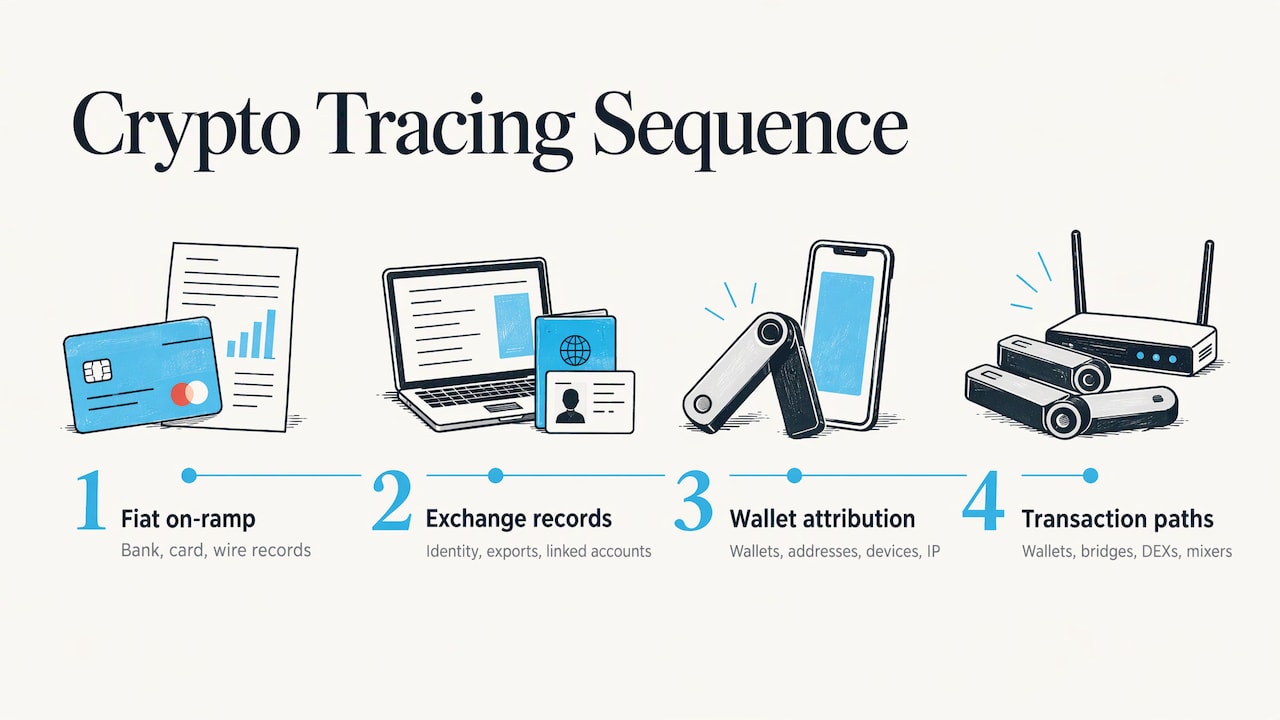
Crypto is the area where do-it-yourself efforts fail most. A 2026 American Bar Association article recommends starting with fiat on-ramp records such as bank, card and wire activity, then reconciling them with exchange identity records, exports and linked accounts. From there, investigators attribute wallets, addresses, devices and IP information, and follow transactions across self-custody wallets, bridges, decentralized exchanges and mixers. The conventional paper trail gives you the lead, and the on-chain analysis follows the movement afterward.
Know the legal limits before you act
The fastest way to damage your own case is to get evidence unlawfully. An Australian legal guide on hidden assets sets out the principle clearly: compile what you lawfully hold, obtain advice early, and use proportionate discovery such as requests, notices to produce, subpoenas, inspection, valuation and forensic accounting rather than accessing another person’s accounts, devices or communications without authority. Material produced under compulsion can also remain subject to privilege and confidentiality obligations.
In the United States, rules differ by state, so your divorce attorney decides which tools apply to your case. What you can do yourself is simple:
- Gather the documents you already have access to: joint statements, tax returns you signed, household bills.
- Write down dates, amounts and what you observed.
- Do not guess passwords, install spyware or read private messages.
- Keep everything in an organized file with its source noted.
That last habit matters more than most people expect. Our guide to chain of custody explains how evidence stays admissible, and the same discipline applies to financial documents and surveillance footage alike.
Where surveillance fits in an asset case
Financial records show where money went. They do not always show where a person goes, who they meet or what they control. That is the gap surveillance fills.
Lawful surveillance can establish facts a document review cannot:
- A spouse who claims no income but is seen working at a business day after day.
- Visits to a property, storage unit or second residence that was never disclosed.
- Regular meetings with the person who holds money on their behalf.
- Lifestyle that contradicts a sworn financial statement.
Our investigators produce court-ready photos and video, and we only work within the law. Published pricing for our surveillance service is $1,000 to $1,450 one-off, and the right scope depends on what has to be shown. Our guide to surveillance done the right way explains what lawful, usable surveillance looks like. If cohabitation or a new partner is relevant to support or property, the cohabitation investigation page shows how that evidence is built.
Finding people and assets across borders
Hidden money rarely stays in one country. Offshore accounts, foreign companies and relatives abroad are all common. Tracing across borders means combining public-record research, corporate registry work and, when needed, enquiries on the ground, always within the laws of the country concerned.
The same applies to people. A business partner who holds funds, a witness, or a spouse who has relocated may need to be located. We cover locating people as part of our work, and our write-up of a missing person located in the UK shows the kind of cross-border tracing involved. For more on how we work internationally, see our page on private investigators in Australia. Our wider guide on how to locate hidden assets sets out methods and limits in more detail.
Hiring ex-military and former FBI specialists for advice
Many readers ask whether it is worth hiring someone with a federal law-enforcement or special-forces background. The honest answer is that background matters when it translates into skills you need: planning an operation, reading a financial pattern, knowing how evidence is built and tested, and staying calm under pressure.
Our team includes experienced former police, ex-military personnel and polygraph specialists, and our former FBI agent page describes the missing-persons and child-recovery work that background supports. Their experience helps in an asset case in three ways:
- Structured fact-finding. They know how to turn a suspicion into a list of testable questions.
- Evidence discipline. They know that a photo, a transcript or a document is only as good as the way it was gathered and recorded.
- Discretion. Divorce is personal, and these cases need people who keep matters confidential.
If you want an initial conversation about your situation, that is a fair use of an expert’s time: describe what you have seen, and ask what is realistic to find and how. Our ex-military security page covers the wider range of military-trained support we can provide. Military and law-enforcement backgrounds are not a license to bend rules; the value is that they know where the lines are.
When to involve your attorney and a forensic accountant
Your divorce attorney leads. The American Bar Association’s guidance says to consider a forensic accountant when finances are complex, assets are substantial, income is not straightforward or disclosure may be incomplete or dishonest. These experts request documents, analyze what is produced, run forensic procedures and explain their opinions on income and cash flow.
Practitioners also draw a useful line between suspicion and proof: counsel establishes existence, classification and value, while the accountant supplies financial reconstruction and explanations that can withstand judicial scrutiny. An investigator supplies the facts on the ground that feed both. If cooperation stays inadequate, one guide notes you can ask counsel for a court order compelling disclosure.
Bring to your first meeting:
- Several years of joint tax returns and any schedules.
- Bank, brokerage and credit-card statements you can lawfully access.
- Business documents you have seen or signed.
- A timeline of changes you noticed: new accounts, missed statements, shifts in spending.
- Names of people or entities you believe are involved.
For how our work fits alongside legal teams, see our family law investigations page, and for the process in detail, asset search in divorce.
What happens when concealment is proven
The consequences are real, and that is why the effort is worth it. In one legal analysis, non-disclosure may lead to compelled disclosure, costs, adverse inferences, contempt and the setting aside of property orders, depending on the facts and the jurisdiction.
A decision of the Singapore Court of Appeal shows how far courts can go. The court applied a 40% uplift to the known asset value, awarded the wife a share of the increased value, and ultimately imposed an eight-month prison sentence for contempt after non-compliance continued. In the United States, one overview notes that destroying or altering financial records can be spoliation leading to sanctions or adverse rulings, and that fees, fines, contempt and criminal exposure are possible depending on the state.
Our perspective
Most people come to us after months of doubt. They have a feeling, a few odd bank entries and no idea what counts as proof. The first thing we tell them is to stop searching on their own and let us build the file properly.
Hidden-asset cases are won on detail: a dated photograph, a document traced to its source, a pattern that holds up when someone challenges it. Our team of former police, military and polygraph specialists works that way because evidence that cannot be defended is worth little.
We tailor each investigation to the person and the problem, since a business owner with a second company needs a different approach from a spouse with an unexplained cash habit. Since 2006 that has meant working discreetly, staying within the law and giving your attorney material they can use.
P.i Melbourne
How Pi Melbourne can help
If you suspect your spouse is hiding assets, our asset search investigation service is the place to start. We combine records-based tracing with lawful surveillance, and we tailor the scope to your situation, from a single undisclosed account to a multi-entity business. You can also read our six steps to an asset search that holds up in court or contact us through our main site to talk it through in confidence.

We work for individuals, business owners and legal clients who need evidence they can rely on, delivered with discretion.
FAQ
How do I find hidden assets in a divorce?
Gather the financial records you lawfully hold, compare tax returns, bank statements and loan applications, and note anything missing or inconsistent. Then work with your attorney to use formal discovery and subpoenas, and engage investigators and financial experts to trace what the paperwork does not reveal.
Can I look through my spouse’s accounts or phone myself?
No. Accessing another person’s accounts, devices or communications without authority can harm your case and expose you to legal risk. Use proportionate legal channels instead, and let professionals gather evidence in a way a court will accept.
Can cryptocurrency be traced in a divorce?
Often, yes. Tracing usually starts with bank, card and wire records showing money moving into exchanges, then follows wallets and transactions on the blockchain. It needs both conventional records analysis and specialist tracing, which is why early professional involvement helps.
What happens if my spouse is caught hiding assets?
Depending on the jurisdiction and facts, courts can order disclosure, award costs, draw adverse inferences, find contempt or set aside earlier orders. In serious cases, penalties can include fines or imprisonment.
Can an investigator find assets held overseas?
In many cases, yes, through registry research, record analysis and enquiries within the law of the country involved. The scope depends on the facts, so describe your situation to us and we will explain what is realistic.
Sources
- Signs your spouse is hiding money in a divorce
- 10 signs your spouse is likely hiding money in divorce
- Hidden Assets in Divorce: Signs, Examples and What to Do
- Hidden Assets in an Alberta Divorce: How They Get Caught
- The Use of Experts for Income Analysis and Opinions
- How to Trace Hidden Assets in Divorce | New Jersey 2025
- Hidden Assets in a Florida Divorce: Forensic CPA Guide
- Following the Money in Divorce: Forensic Income, Valuation
- Following the Money in Divorce: transcript
- Following the Coins: Digital Asset Tracing and Division in Divorce
- Financial Disclosure and Hidden Assets in Divorce
- What To Do If You Suspect Your Spouse Is Hiding Assets
- Singapore Court of Appeal decision [2016] SGCA 8
- Hidden Assets and Your Legal Rights in Divorce