
An investigation timeline has two meanings, and both matter. It is the schedule of how long an investigation will take, and it is the dated chronology of events and evidence that the investigation produces. A defined records search can finish quickly. Surveillance, locating someone who does not want to be found, or multi-county litigation support can take days or weeks, according to the Tennessee Independent Private Association. This guide covers both meanings: the phases and typical durations, what speeds a case up or slows it down, and how to record events so they hold up later.
TL;DR
- Private investigations usually move through four phases: intake and planning, research, field work, and analysis and reporting.
- Duration depends on urgency, access to information, the subject’s behavior, geography and complexity, not on a fixed calendar.
- Good starting details (full name, date of birth, last known address, routines) shorten timelines dramatically.
- Workplace and criminal investigations run on different clocks from private ones, with their own procedural rules.
- A dated, source-linked chronology is what turns raw observations into evidence you can use.
Table of Contents
- The four phases of a private investigation
- How long does it take? Ranges by type of work
- What makes an investigation faster or slower
- Finding people across borders
- Workplace and criminal investigations run on different clocks
- How to build the timeline itself
- Progress updates and milestones
- Hiring former FBI staff, ex-military and special forces experience
- Our perspective
- Talk to us about your case
- FAQ
- Sources
The four phases of a private investigation
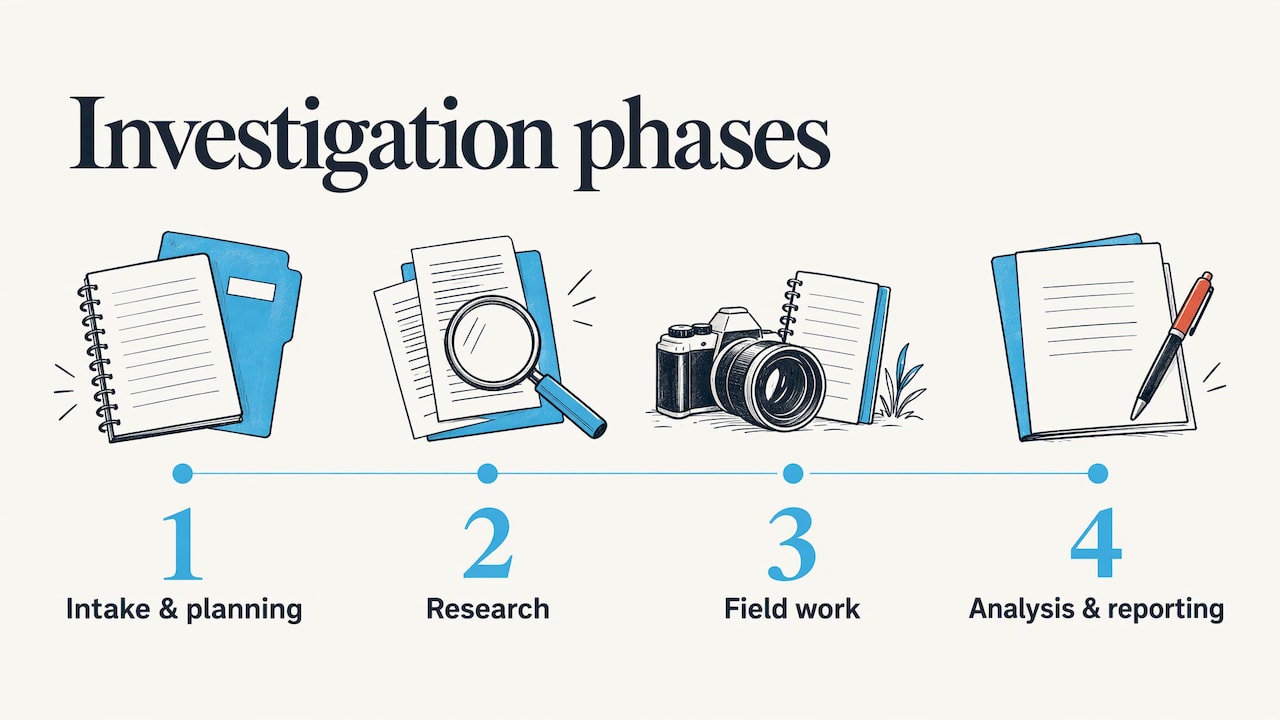
The TIPA guide describes four typical phases: intake and planning, research, field work, and analysis and reporting. Each has its own pace, and the total is the sum of all four, not just the time spent in the field.
Phase 1: Intake and planning
This is the conversation where the investigator learns what you need, what you already know, and what you intend to do with the result. A court matter needs a different standard of documentation than a private decision about a relationship. Planning also settles what is lawful, what the scope is, and how and when you will hear from the investigator.
In our experience, this phase is often the shortest and the most valuable. A few hours of clear briefing can save days of field work aimed at the wrong target.
Phase 2: Research
Before anyone watches a door, the investigator builds a picture from records and open sources: addresses, vehicles, business registrations, public filings, online footprint. For a defined records question, research may be nearly the whole job. For surveillance, it tells us where, when and how to watch.
Phase 3: Field work
Field work is the least predictable phase because it depends on another person’s behavior. Surveillance only produces useful footage when the subject does the thing you are worried about, and nobody controls that. Our surveillance service is published at $1,000 to $1,450 as a one-off fee, and the number of sessions needed is agreed with you based on the circumstances.
Phase 4: Analysis and reporting
Photos, video, notes and records are reviewed, sorted into time order and written up. A report that will be handed to a lawyer takes longer to prepare than a verbal briefing, because every statement needs to be tied to a time, a place and an exhibit.
How long does it take? Ranges by type of work
There is no single honest number, but there are patterns. The table below gives the shape of the work, using the factors the TIPA guide names: urgency, access to information, the subject’s behavior, geography and complexity.
| Type of work | What drives the timeline | Typical shape |
|---|---|---|
| Defined records search | Whether records are accessible and the identifiers are accurate | Can be completed quickly |
| Surveillance | Subject’s routine, how often the behavior occurs, how alert the subject is | Days to weeks |
| Locating a person who is avoiding contact | Quality of starting details, how often they move, how they use records | Days to weeks, longer if the trail is cold |
| Litigation support across several counties | Number of jurisdictions, court record access, witnesses | Days to weeks |
| Corporate or fraud matter | Volume of documents, number of people involved, access to systems | Weeks, sometimes longer |
We deliberately do not promise a fixed number of days for any category. Anyone who guarantees an exact finish date before seeing the facts is guessing.
What makes an investigation faster or slower
Starting information
TIPA notes that a full name and date of birth may make a locate straightforward, while a first name and an old city may not. The same logic applies everywhere: the more precise your starting point, the less time goes into narrowing down the target.
Before you call, gather:
- Full legal name and any known nicknames or alternate spellings.
- Date of birth or approximate age.
- Last known addresses, phone numbers, vehicles and workplaces.
- Photographs, recent if possible.
- A short written timeline of what you have already noticed, with dates.
The subject’s behavior
People who move often, stay out of records or are alert to being watched take longer to locate or document, per the same TIPA guide. A subject with a fixed daily routine can be documented in a few sessions. One who varies everything needs patience and sometimes a change of approach.
Urgency
Urgency can compress a timeline by putting more people on a case, but it cannot create evidence that does not exist yet. In a child welfare or recovery situation, speed matters most, and that is where early, accurate information from you counts the most.
Geography
Spread-out locations, multiple counties or several countries add travel, local rules and coordination. This is why international cases need more planning up front.
Finding people across borders
People are not always where the paperwork says. Locating someone overseas depends on the same factors as a domestic locate, plus the privacy and records rules of each country. Some countries open up a lot of public information, and others very little.
We work internationally, and you can see an example in our case page on how a private investigator found a missing person in the UK. Our team also covers private investigation across Australia. The practical advice for any cross-border search is to give the investigator every identifier you have, in the original spelling, including previous names and countries of residence.
Workplace and criminal investigations run on different clocks
People searching for an investigation timeline often mean an employer or government process. These differ from a private engagement because rules, rights and procedures set the pace.
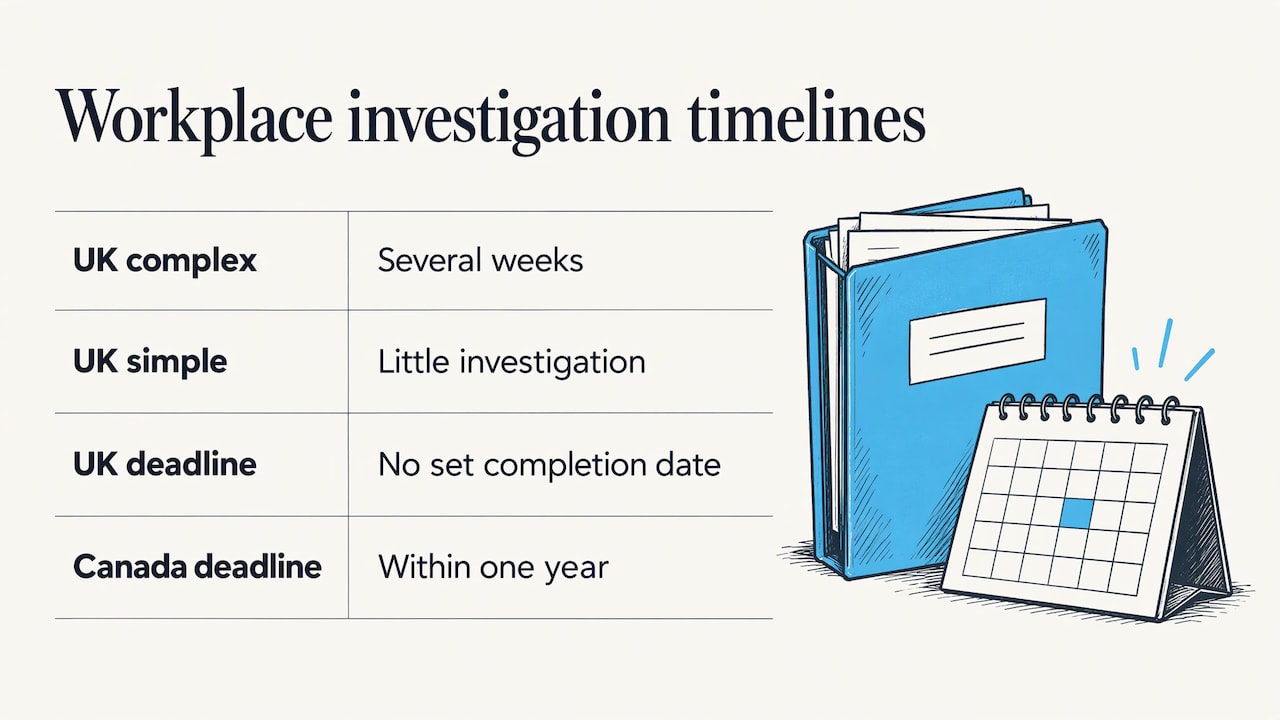
For workplace matters, the UK’s ACAS guidance says a complicated matter may take several weeks to conduct properly, while a simple one may need little investigation. It also says an investigator should not be bound by a set completion date, but should explain any delay to those involved and record it in the report. Canada is stricter: under the Canadian Human Rights Act Regulations, the investigation and its recommendations must be completed within one year of the complaint. That guidance also warns that long investigations can lead to lost evidence and vague memories.
These are rules of the United Kingdom and Canada, not universal ones. In the United States, requirements vary by state and by employer policy. If you run a business and need a neutral fact-finder, see our guides to workplace harassment investigations and terms of reference for misconduct matters, or the basics of corporate investigations.
How to build the timeline itself
The second meaning of the keyword is the chronology. An incident timeline converts scattered evidence into a structured sequence, and its goal is to establish what happened and in what order before anyone explains why. The same discipline applies to a private case.
- Start with a fixed anchor. Pick the first event you can prove with a document: a date-stamped message, a bank record, a booking.
- Log every entry with date, time, place, source and who recorded it. Use the same time zone throughout.
- Separate fact from inference. “Vehicle parked at the address at 7:42 p.m.” is a fact. “They were hiding something” is not.
- Link each entry to an exhibit. Photo, video file, receipt, record or statement, with its file name.
- Mark gaps. A gap is information. It tells you where to look next.
- Never alter earlier entries. Add corrections as new, dated lines so the history stays intact.
- Review at set points. Compare the timeline against new evidence and adjust the plan.
Our investigators use advanced technology to produce court-ready photos and video, and a clean chronology is what lets a lawyer or tribunal rely on them. If the matter is legal, our family law team can explain what documentation is needed.
Progress updates and milestones
Updates should be agreed at intake rather than improvised. A sensible arrangement sets the contact channel, how often you will hear from the investigator, and what triggers an immediate call, such as a significant sighting or a safety concern.
Milestones that show a case is moving forward:
- The subject is identified and confirmed.
- A routine, address or pattern is established.
- First usable documentation is captured.
- A scope decision: continue, widen, or stop.
- The draft report is ready for your review.
If a milestone slips, you should be told why and what changes. That mirrors the principle in the ACAS guidance that delays be explained to those involved.
Hiring former FBI staff, ex-military and special forces experience
Many clients ask us about hiring former FBI staff for advice, or former soldiers, including people with special forces backgrounds such as the British SAS. The reason is understandable: these careers train people in planning, information gathering and staying calm under pressure.
What that experience brings to an investigation timeline:
- Planning discipline. Former federal investigators and military personnel are used to working from a plan with defined phases and written records.
- Case documentation. Writing reports that others will rely on is a core habit of law enforcement careers.
- Cross-border and high-risk awareness. Time in operational roles helps with locating people abroad and judging risk in sensitive recovery cases.
Our team includes experienced former police, ex-military and polygraph specialists, and we have a page on our former FBI agent work in missing persons and child kidnapping. If you want advice on a plan, a timeline or a particular risk, a consultation with that kind of background is a good place to start. Our ex-military security page describes that side of what we do. Whatever the background, all work must stay within the law: an investigator’s role is lawful fact-finding, and our guide on what a private investigator can do sets out powers and limits.
Our perspective
We have been running investigations since 2006, and the pattern is consistent: cases go well when the plan is set before the field work starts. Clients often arrive wanting an answer by the end of the week. We would rather tell you honestly what is achievable and why.
Our investigators are experienced former police, ex-military and polygraph specialists, and each case is tailored to the person in front of us. A suspected infidelity, a staff fraud problem and a child welfare concern all need different schedules, different evidence standards and different levels of discretion.
We believe the timeline is part of the service. You should know what phase we are in, what we have documented, and what comes next. That is how evidence ends up suitable for legal proceedings and how clients stay in control of a stressful situation.
P.i Melbourne
Talk to us about your case
If you are weighing up a surveillance job, a locate, a workplace matter or a child welfare concern, we can map out the phases and likely time frame with you at the start. Our services include surveillance, cheating partner investigations, fraud, missing persons, family law, corporate investigations and asset searches. Browse the full private investigation services or contact us through Pi Melbourne.
Bring your list of known details and any dated notes. They are the fastest way to shorten the timeline.
FAQ
How long does a private investigation usually take?
It depends on the type of work. A defined records search can be done quickly, while surveillance and locating people who are avoiding contact can take days or weeks, according to TIPA. Urgency, available information, the subject’s behavior, geography and complexity all affect it.
What are the main steps of an investigation?
Four phases are typical: intake and planning, research, field work, and analysis and reporting. Each step feeds the next, and the timeline you keep records what was found at each stage.
How long should a workplace investigation take?
There is no universal deadline. ACAS in the UK says complicated matters may take several weeks and that delays should be explained and recorded. In Canada, federal human rights rules set a one-year limit for the process. Check the rules that apply to your employer and state.
What should I record in an investigation timeline?
Record each event with the date, time, location, source and the exhibit that supports it. Keep facts separate from your interpretations, mark gaps, and add corrections as new dated entries rather than editing old ones.
Sources
- How Long Does a Private Investigation Take? | TIPA
- Conducting workplace investigations | ACAS
- Human rights based approach to workplace investigations | Canadian Human Rights Commission
- Incident Timeline: Examples, Steps, and Template | Sologic