
You locate hidden assets by working in layers. Start with the paperwork you already hold. Add public records. Use the formal legal tools your lawyer can invoke. Then bring in an investigator for what documents never show: lifestyle, hidden business interests, and who really controls an account or company. No single search finds everything, and a blank result proves very little.
This guide covers each layer, what it can and cannot do, and where a private investigator earns the fee. It is written for people in divorce, business disputes, fraud recovery and judgment collection. The law differs by country and by state, so each legal point below is tied to the place it applies.
TL;DR
- Begin with what you hold: tax returns, joint statements, loan applications and credit reports. Gaps and unexplained transfers are your first leads.
- Formal discovery (document demands, interrogatories, depositions) is the main legal route in a US divorce. Investigators work alongside it, not instead of it.
- Time matters. Evidence is easily lost or destroyed, so plan early and move before the other side is alerted.
- A nil result from a database does not mean nothing exists. Shell companies, trusts and nominees hide the real owner.
- Cross-border cases are slower and need local legal counsel. Choose an investigator who works within the law of each country.
Table of Contents
- What counts as a hidden asset
- Step one: start with the documents you already have
- Step two: public records and unclaimed property
- Step three: the legal tools your lawyer controls
- Step four: what a private investigator adds
- Piercing the veil: shells, trusts and nominees
- Why a nil result is not an answer
- Crossing borders
- Build a plan before you spend
- Our perspective on hidden asset work
- When to hire a professional
- How we can help
- FAQ
- Sources
What counts as a hidden asset
A hidden asset is anything of value that one party conceals from a court, a creditor, a business partner or a tax authority. It can be money, property, a business stake, a vehicle, a brokerage account, crypto, or income that has been delayed or redirected.
In divorce, the common tactics include stashing physical cash, deferring bonuses or stock options until after the decree, undervaluing assets through a low appraisal, and inventing debts, such as a “loan” from a friend that gets quietly repaid later.
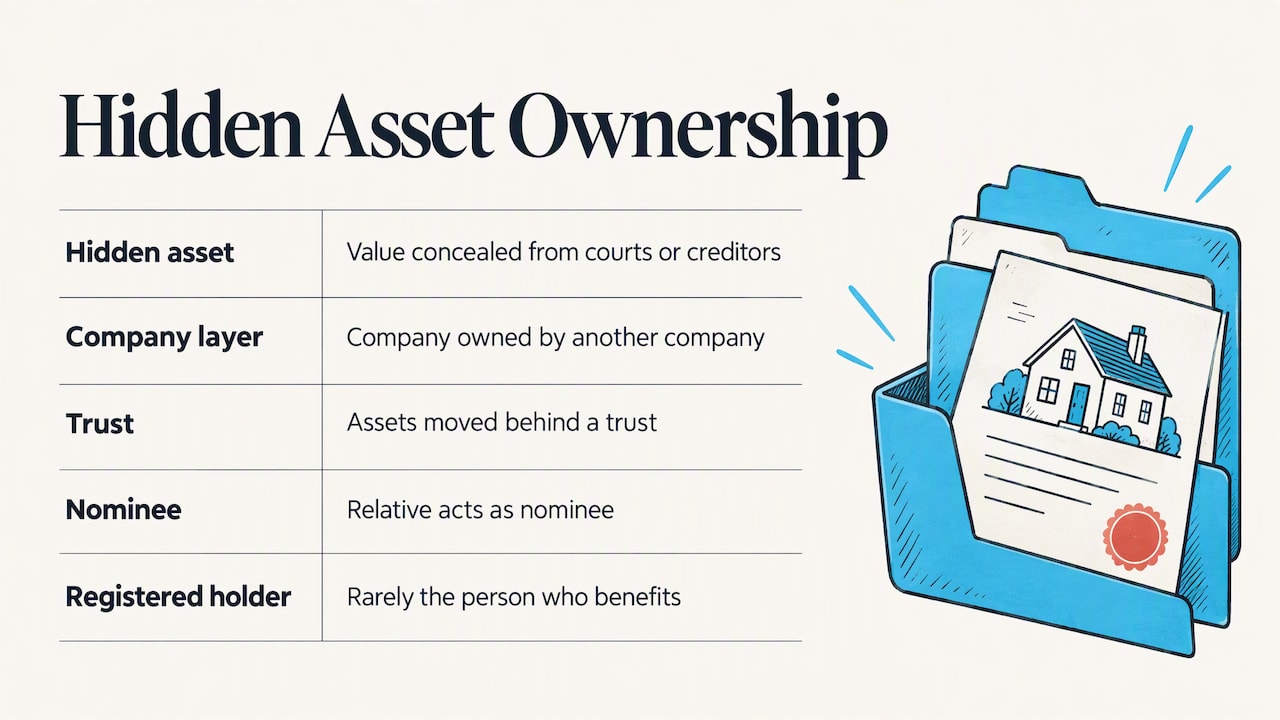
In fraud and business cases the pattern is different. The assets are usually moved behind layers: a company owned by another company, a trust, or a relative acting as a nominee. The registered holder is rarely the person who benefits.
Step one: start with the documents you already have
Before paying anyone, do the free work. Nolo’s guidance suggests examining every financial document you can legitimately access, including tax returns and joint bank statements.
Look for these signals:
- Tax returns. Interest or dividend income with no matching account on any statement you know of. A Schedule C or K-1 for a business you have never heard discussed.
- Bank statements and checks. Regular transfers to an unfamiliar account, round-number payments to the same person, or a sudden fall in a balance that was stable for years.
- Loan and credit applications. People often list their true assets when they want to borrow, then report less in a divorce or collection case. Old mortgage or car loan applications can be revealing.
- Business cash flow. Owners can understate revenue, run personal costs through the company, or pay themselves late.
- Lifestyle. Spending that does not fit declared income is a lead, not proof. Note dates, amounts and sources.
Keep copies of what you are entitled to see. Do not log into accounts that are not yours or take devices that belong to someone else. Evidence obtained unlawfully can damage your case and expose you to liability. Ask your attorney what is permitted in your state before you collect anything from a shared home.
Step two: public records and unclaimed property
Public records are slow to read but cheap, and they are the base of most professional work. Depending on legal authorization and jurisdiction, investigators search county recorders of deeds, tax offices and state corporation registries. A property deed, a UCC filing, a business registration or a professional license can each reveal an asset or a connection.
Some useful checks are open to anyone:
- Real estate: county recorder or assessor records show owners, purchase dates and recorded mortgages.
- Business interests: the Secretary of State registry in the relevant state lists officers and registered agents, although some states disclose little.
- Vehicles, boats and aircraft: registration databases vary by state and are restricted in some.
- Unclaimed money: USAGov explains that you can look for deposits from failed banks via the FDIC, matured savings bonds via the Treasury, and unpaid wages via the Department of Labor. This matters if you suspect an account has been forgotten, not hidden.
A warning from the Australian due diligence world applies everywhere. Registers only hold notified information. They do not independently prove beneficial ownership or confirm whether a registered asset is encumbered or disputed. Treat every record as a clue to verify, not a verdict.
Step three: the legal tools your lawyer controls
In a US divorce, the formal route is discovery. According to Justia’s divorce law guidance, this includes requests for production of documents, such as bank statements, tax returns, loan applications and business records, plus interrogatories answered under oath and depositions. Nolo adds that depositions can reach third parties such as accountants, and that discovery can extend to investment portfolios, business records and safe deposit boxes.
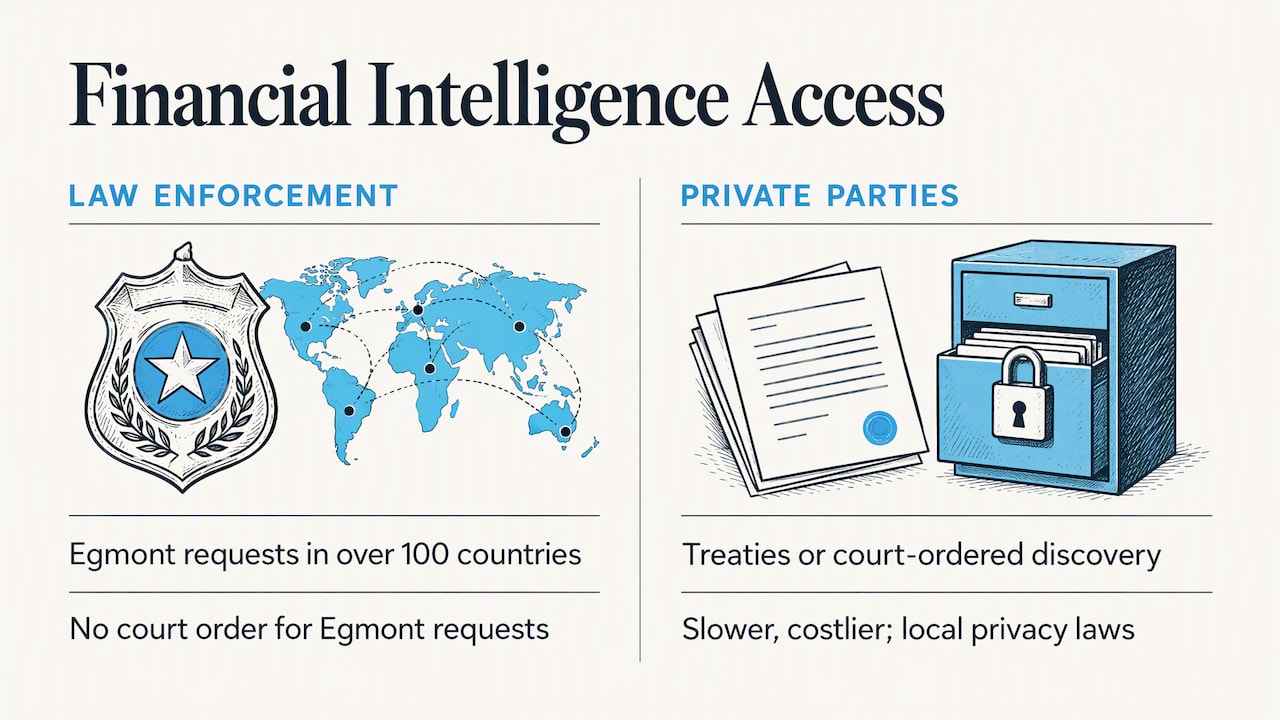
In bankruptcy, a creditor or trustee can use an examination under Rule 2004. Private parties generally cannot use the intelligence channels available to police. The FBI Law Enforcement Bulletin notes that law enforcement can use the Egmont network to request financial intelligence from over 100 countries without a court order. Private parties are limited to formal processes such as mutual legal assistance treaties or court-ordered discovery, which are slower, costlier and subject to local privacy laws.
That gap is the reason investigators matter. Discovery depends on the other side answering truthfully. A good investigator gives your attorney the questions to ask and the leads to test the answers against.
Step four: what a private investigator adds
An asset investigation is an evidence-gathering exercise, not a form-filling one. Professionals combine what one source describes as physical and human intelligence with digital forensics. In practice that means:
| Method | What it can show | Limit |
|---|---|---|
| Public record and registry searches | Property, companies, liens, filings | Only notified information; nominees hide owners |
| Financial record analysis | Odd patterns, unexplained transfers | Needs lawful access to records, often via discovery |
| Lifestyle and surveillance | Where the person spends time and money, undeclared businesses, storage units | Must be lawful and documented to a court standard |
| Interviews and human sources | Insider knowledge of deals and accounts | Reliability must be checked |
| Crypto tracing | Movement of funds on public blockchains | Linking a wallet to a person is the hard part |
Surveillance deserves a note. One guide describes it as discreet monitoring used to compare a person’s reported income against their actual spending patterns. A person who claims no income but visits a second property every weekend, or runs a cash business from a rented unit, has given you something no bank statement will.
The point of all of it is evidence that holds up. A lead you cannot prove is worth little. Photos, video, dated notes and a clear chain of custody are what let an attorney use the work in front of a judge.
Piercing the veil: shells, trusts and nominees
The hardest cases involve structures built to confuse. The Financial Action Task Force has stressed that transparency about beneficial ownership is essential to preventing illicit activity, because assets are so often parked behind shell companies, trusts and nominee arrangements.
The practical goal is to identify the person who actually controls or benefits, not just the name on the register. Typical questions an investigator works through:
- Who pays the company’s bills, and from which account?
- Who signs contracts, leases and loan guarantees?
- Which registered address or agent do several of the entities share?
- Does the person use the asset personally, such as a car, a house or a boat, while it sits in another name?
None of these answers come from one database. They come from correlating records with real-world observation.
Why a nil result is not an answer
A search that returns nothing is the most misread outcome in this field. It can mean the person has nothing. It can equally mean the structure is layered, or that the search used the wrong parameters. The Australian guide cited above warns against assuming that no hit means no asset and notes that each search type has limits to understand before drawing conclusions.
The same applies to your own checks. If the free searches find nothing, you have not proven the person is clean. You have only narrowed what you need to try next.
Crossing borders
Money that leaves the country is where most do-it-yourself efforts stall. Legal and investigative professionals point to jurisdiction as a primary obstacle: data that is accessible in one country, such as private bank records or beneficial ownership data, may be protected by privacy or secrecy laws in another. Effective cross-border work usually requires local legal counsel, and an investigator cannot simply demand information from a foreign institution.
If you suspect funds abroad, tell your attorney early. They can decide whether to seek court orders in the foreign jurisdiction, and an investigator with international experience can identify where those orders would need to land.
Build a plan before you spend
The Association of Certified Fraud Examiners lays out eight phases for finding assets, and the first is to develop an investigation plan. Its second is to consider legal issues and implications. Asset cases are time-sensitive, because information and evidence are easily lost or destroyed if not secured at the start. A plan sets objectives, a schedule and resources, and estimates the likelihood of success before significant money is committed.
Before you contact anyone, assemble:
- A one-page summary of the dispute and what you are trying to prove or recover.
- Full legal names, aliases, dates of birth and known addresses for everyone involved.
- Every account, property, company or vehicle you already know about.
- The names of your attorney and any court deadlines.
- A list of what has changed recently: new spending, transfers, a sudden business closure.
Then set a budget ceiling tied to the size of the prize. If the likely recoverable amount is small, a narrow engagement beats an open-ended hunt.
Our perspective on hidden asset work
We have been running investigations since 2006, and the pattern we see is consistent: clients arrive after weeks of guessing and often after the other party has been tipped off. The first thing we do is slow down and define what has to be proven, because asset work that is not aimed at a specific legal outcome produces a folder of interesting facts and nothing a court can use.
Our team includes former law enforcement, ex-military and polygraph specialists, and we tailor each investigation to the client’s situation rather than running a template. For asset cases that usually means combining record work with discreet observation, then delivering photos, video and notes in a form your attorney can rely on. We also tell clients plainly when a search has hit a wall, rather than padding the work to look busy.
Our advice: do not confront the person, do not move money yourself, and do not access accounts that are not yours. Each of those can ruin a case that might otherwise succeed.
— Global
When to hire a professional
Do-it-yourself is reasonable when the question is simple: a forgotten account, a property you suspect exists, or a missing tax return. Bring in a professional when any of these apply:
- The person controls a business and can shape the books.
- Assets appear to sit with relatives, companies or trusts.
- You need to show a pattern of lifestyle versus declared income.
- Funds may have moved abroad.
- Your attorney needs evidence that will be presented in court, not just a hunch.
- You fear the person will move assets once they sense you are looking.
When you choose an investigator, ask how they collect evidence lawfully, what the deliverable will look like, whether they will work directly with your attorney, and how they handle cross-border limits. A firm that promises to pull private bank records on demand is promising something it cannot lawfully do.
How we can help
Pi Melbourne runs asset search investigations built around the standard a court expects. Our page on an asset search investigation that holds up in court walks through the process we follow. If your matter also involves surveillance, family law issues or suspected fraud, see our full list of investigation services, or contact us from our home page to discuss your situation in confidence. For business disputes involving staff or directors, our guide to corporate investigations explains how those engagements work.
FAQ
How do I find my spouse’s hidden assets?
Start with tax returns, joint statements and old loan applications, looking for income or accounts you do not recognize. Your divorce attorney can then use discovery to demand documents and question your spouse and third parties under oath. If the trail goes cold or a business is involved, an investigator can add public record work and lifestyle evidence.
Can anyone look up what assets a person owns?
Not fully. Property, business registrations and some court filings are public, but bank and brokerage balances are not. Those usually surface only through legal processes such as discovery or court orders, which is why a blank database search never settles the question.
How do lawyers find hidden assets?
Mainly through discovery: document requests, written questions under oath and depositions of the spouse or third parties such as accountants. They often pair this with a forensic accountant or investigator who reviews the records and tests the answers against real-world evidence.
Can a private investigator get my ex’s bank records?
No lawful investigator can simply demand private bank records. Those generally come through the court, via subpoena or discovery. What an investigator can lawfully do is research public records, trace business and property links, and document lifestyle and activity.
How long does a hidden asset investigation take?
It depends on the structures involved and whether assets are abroad. Domestic record-based work can move quickly, while cross-border cases rely on slower legal channels. Starting early matters either way, since evidence can be lost.
Sources
- How to Find Hidden Assets During a Divorce, Nolo
- Hidden Assets and Your Legal Rights in Divorce, Justia
- How to Conduct a Hidden Asset Search, RecordsFinder
- How to find unclaimed money from the government, USAGov
- Business Due Diligence in Australia: A Complete Legal Guide
- Legal Digest: Money Laundering and Asset Forfeiture, FBI LEB
- FATF Plenary outcomes, June 2021
- How does a Forensic Accountant find hidden assets?, Gerald Edelman
- Making Crime Pay: How to Locate Hidden Assets, ACFE