There is no single US law that covers drone spying. Aviation safety is federal, but privacy is mostly decided by state law, and the details change a lot from one state to the next. Whether a drone flight is lawful usually depends on where the drone flies, what it records, who is being recorded, and whether that person had a reasonable expectation of privacy.
This guide explains how the rules fit together, where drone use turns into a crime, what limits apply to police and employers, and how rules abroad differ. It also covers when it makes sense to bring in professionals, including former law enforcement and ex-military investigators, before anyone collects evidence.
TL;DR
- The FAA regulates safe flying, not privacy. The FAA says it does not regulate privacy, so state and local laws fill the gap.
- At least 44 states had enacted drone laws since 2013, so the same flight can be legal in one state and a crime in another.
- Recording someone in a private space, secretly recording conversations, or repeatedly following a person can break privacy, wiretap or stalking laws.
- Police usually need a warrant for drone collection where people expect privacy, and employers face their own limits.
- Evidence collected unlawfully can hurt your case. Get advice before you act.
Table of Contents
- Who regulates drones in the US
- When drone use becomes illegal spying
- Limits on police drone surveillance
- Employers, businesses and drones
- How drone rules differ around the world
- Finding people across borders
- Hiring former FBI staff for advice
- Hiring ex-military specialists and former SAS soldiers for advice
- Surveillance that holds up
- Perspective
- Work with an investigator
- If you think a drone is spying on you
- FAQ
- Sources
Who regulates drones in the US
Two layers apply to every flight. The first is federal aviation law, which covers where and how a drone may fly. The second is a patchwork of state and local rules covering what a drone may see, record and share.
The FAA’s public guidance is clear on the split. If a drone is flying unsafely and poses an immediate threat, contact local law enforcement. The same page notes that the FAA does not regulate privacy, though local privacy laws may apply to drone operations. So an FAA-compliant pilot can still break state law by filming the wrong thing.
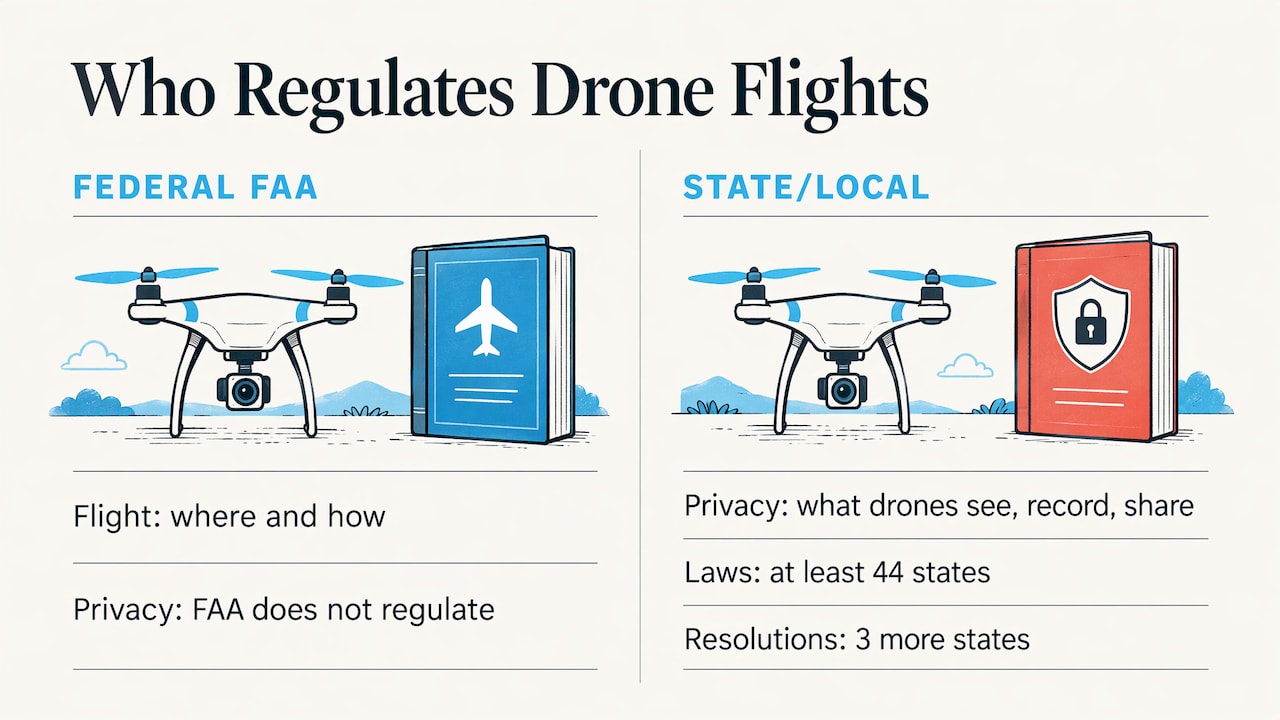
The National Conference of State Legislatures reported that at least 44 states had enacted laws addressing drones since 2013, and three more had adopted resolutions. Those laws cover police use, public use, and in many states private surveillance. Always check the law of the state where the flight happens, not the state where the operator lives.
When drone use becomes illegal spying
The core question in most states is the same: did the drone capture something a person reasonably expected to keep private? Several kinds of conduct commonly cross the line.
Watching people in private spaces
Oklahoma gives a clear example. Its statute prohibits intentionally using a drone to photograph, record or observe someone where they have a reasonable expectation of privacy. It also bars entering private property, or airspace within 400 feet of it, with intent to eavesdrop or conduct surveillance. The law lists exceptions for certain business, government and emergency uses. Other states word their rules differently, so treat Oklahoma as an illustration, not a national rule.
Recording conversations
Audio is often treated more strictly than video. California guidance explains that secretly recording private conversations by drone may violate Penal Code section 632, and that recording people in private spaces may violate section 647(j)(3). A drone with a microphone raises the risk, because the pilot may capture speech from a distance without the speakers knowing.
Following or tracking a person
The same California guidance notes that repeated tracking or following can amount to stalking under section 646.9. A drone that keeps returning to the same person or home can fit that pattern even if each single flight looks harmless. Courts look at the pattern, the purpose and the effect on the person watched.
Flying over a neighbor’s yard
People often ask whether a neighbor can fly over their garden. In the US the answer depends on state law, altitude, what is recorded and whether the behavior repeats. Hovering over a fenced backyard to film people is far riskier than a brief pass at altitude on the way to a photo location. Repeated flights after you have asked the neighbor to stop strengthen a harassment or privacy complaint.
Limits on police drone surveillance
Government drones face stricter rules because the Fourth Amendment applies. Many states require a warrant for drone surveillance in places where people expect privacy.
Illinois is a useful example. Its Attorney General’s guidance says a warrant is required for drone collection in a place where people have a reasonable expectation of privacy, subject to listed exceptions. It also says information gathered outside the statutory exceptions is presumed inadmissible. Warrant-based drone use is limited to 45 days, and information collected under a warrant must be destroyed within 30 days.
Those figures are Illinois specifics, not a national standard. They do show the typical structure: a warrant or a listed exception, limits on duration, and rules on deleting data. If you think police drone use against you was unlawful, a criminal defense attorney in your state is the right person to ask about suppressing the evidence.
Employers, businesses and drones
Businesses sometimes consider drones for site security, theft or monitoring staff. In the US, workplace monitoring is governed by a mix of state surveillance laws, notice requirements and common-law privacy claims. Our guide on what employers can legally monitor walks through the principles that carry over to any camera, drone or tracker. If your concern involves vehicles or equipment, see also whether a GPS tracker is legal.
Outside the US the rules can be stricter. For professional drone use in the EU, EASA says identifiable personal data triggers data-protection requirements: operators should inform people, have a lawful reason, minimize collection, limit use to the planned purpose, and secure the data. Employers with sites abroad need local advice before any aerial monitoring.
How drone rules differ around the world
Drone law is jurisdiction-specific. A comparative guide from Dentons covers Australia, Canada, the EU and selected member states, Japan, Korea, New Zealand, Singapore, the United Kingdom and the United States, and shows how regulation, sanctions and privacy treatment vary.
A few contrasts matter for anyone working across borders:
- Australia: the official drone privacy guidelines apply existing privacy and surveillance laws and say that recording a private conversation or activity without consent may be an offence under state or territory surveillance-device laws. Publishing captured information may add further liability.
- European Union: EASA says prolonged targeting or monitoring without a person’s knowledge and agreement raises privacy concerns.
- Germany: one state data-protection authority says the household exemption ends at the neighbor’s property boundary and does not cover observing public areas.
The lesson is simple. Never assume that a flight, recording or investigation method that is lawful at home is lawful abroad.
Finding people across borders
Many of the people who contact an investigator are not asking about drones at all. They want to locate a relative, a witness, a debtor or a parent who has taken a child overseas. Those searches cross jurisdictions, and each country has its own privacy, data and surveillance rules.
That is why a global search needs a lawful, documented method. Records research, open-source work, interviews and ethical field inquiries are lawful in many places, while covert recording or tracking can be a crime in the very country where the person is found. We have handled cross-border work before, including locating a missing person in the UK. If a child has been taken, read about our child recovery service and call early, because the first days matter most.
Hiring former FBI staff for advice
People search for “FBI for hire” expecting something that does not exist. Serving FBI agents cannot be hired privately. What you can hire is a private investigator with a federal law-enforcement background, who understands how cases are built, what prosecutors and courts expect, and how evidence is lost.
We have former FBI and military agents on our team, and clients often come to us for exactly this kind of advice before they spend money or take a risky step. Typical questions include:
- Whether a planned recording method is likely to be lawful in a given state or country.
- How to preserve messages, photos and financial records so they stay usable.
- Whether a missing-person or child-abduction situation should go to police first, and what a private team can add.
- How to document a suspected scam, including crypto fraud, so that a report is taken seriously.
You can read more about this background on our page about a former FBI agent working missing persons and child kidnapping cases.
Hiring ex-military specialists and former SAS soldiers for advice
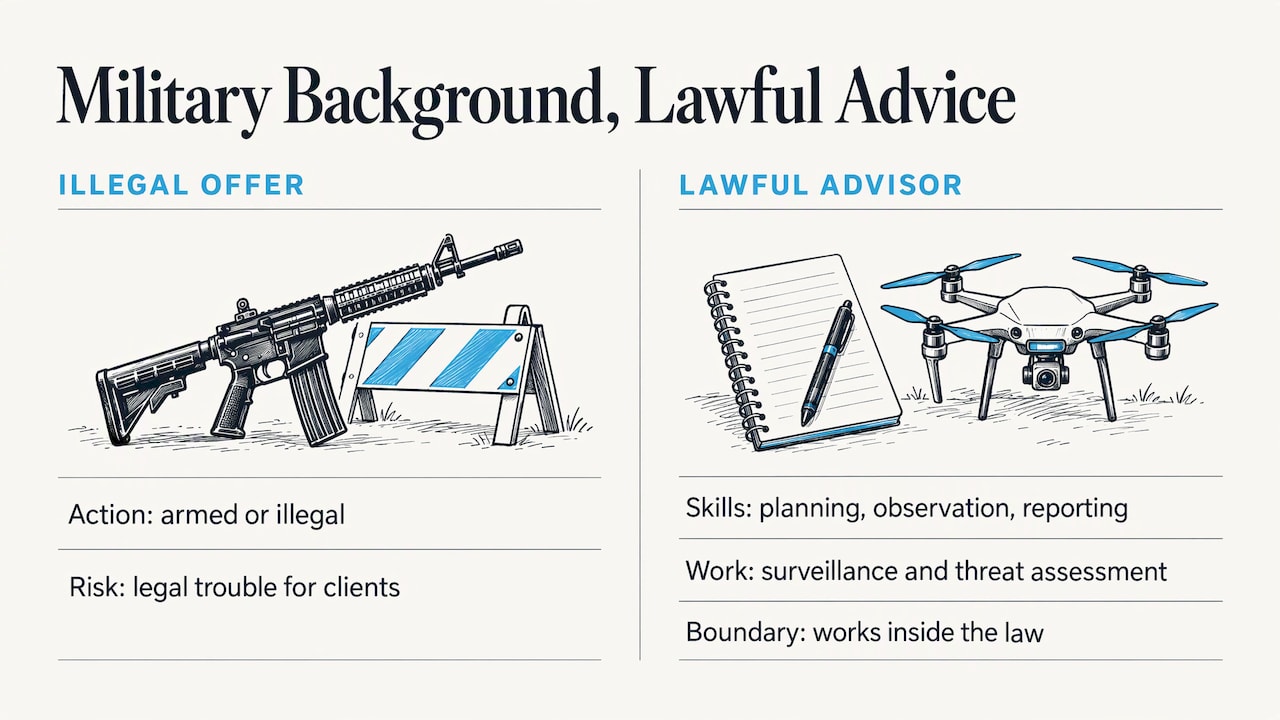
The other phrases we see are “ex-military hire” and “former SAS soldiers for hire”. Some people imagine private soldiers or mercenaries. That is not what a lawful investigation firm provides, and anyone offering armed or illegal action is a legal risk to you.
What ex-military professionals do offer is discipline: planning, observation, patience, reporting and calm under pressure. Those skills suit surveillance, threat assessment, locating people and advising on safety. Our investigators include ex-military specialists alongside former police and polygraph experts. If you want a view specifically from someone with special-forces experience, ask us about the experience of the people assigned to your matter, and we will tell you what is on the team for your case.
In every case, an advisor with a military background still works inside the law. They will tell you when a drone, a hidden recorder or a tracker is a bad idea.
Surveillance that holds up
If your goal is evidence for a divorce, custody case, workers’ compensation or a fraud claim, how the footage was collected matters as much as what it shows. Footage gathered unlawfully can be excluded and can expose you to civil claims or criminal charges.
Good surveillance follows a few principles:
- Observe from lawful positions. Work from public places and avoid trespass or filming into private spaces.
- Match the method to the purpose. Use the least intrusive approach that answers the question.
- Log everything. Keep times, locations and who handled the material. See our explainer on chain of custody for how evidence stays admissible.
- Report factually. A clear report of what was seen is more persuasive than speculation.
Our approach to this is laid out in surveillance services done the right way. Parents worried about a teenager can also read about our teenage monitoring approach, which starts with the child’s safety and the family’s legal position.
Perspective
In our work, the strongest evidence is rarely the most dramatic. A drone looks impressive, but if it records the wrong place or the wrong person, it can undo a case and create legal trouble for the client.
We build every investigation around the client’s situation and the rules where the work happens. Our team of former law enforcement, ex-military and polygraph specialists is trained to think about admissibility from the first day: what is lawful to capture, how it is logged, and how it will be presented.
Before anyone buys a drone or a hidden camera, we suggest a conversation. A short briefing can save a client months and a lot of money.
P.i Melbourne
Work with an investigator
Our surveillance service is published at $1,000 to $1,450 one-off, and other investigations are scoped to the individual matter. We handle cheating partner surveillance, fraud, missing persons, corporate misconduct, child recovery and court evidence, with court-ready photos and video. See our surveillance pricing and service page or all our investigation services, then tell us what you are facing.
Business owners can start with our overview of corporate investigations, and families can look at family law support.
If you think a drone is spying on you
Stay calm and document what you can without confronting the pilot.
- Write it down. Note date, time, duration, direction and the drone’s appearance. Take photos or video from your own property.
- Report safety threats. If the drone is flying dangerously, call local law enforcement.
- Check your state law. Privacy, stalking and trespass statutes vary. A local attorney can tell you which apply.
- Do not shoot it down or grab it. Damaging an aircraft can bring its own charges.
- Keep a log. A pattern of repeat flights is what turns an annoyance into a legal claim.
If you suspect a stalker, a partner or a business rival is behind it, an investigator can help establish who is responsible in a lawful way, so that your attorney has something to work with.
FAQ
Is it illegal to spy on someone with a drone?
Often yes, depending on state law. Many states prohibit using a drone to observe or record people where they have a reasonable expectation of privacy, and secret audio recording or repeated following can add wiretap or stalking exposure. Check the law of the state where the flight occurs.
Does the FAA protect my privacy from drones?
No. The FAA says it does not regulate privacy, although local privacy laws may apply to drone operations. Your protection comes from state and local statutes, and from civil claims such as trespass or invasion of privacy.
Can police use drones without a warrant?
It depends on the state and the situation. Illinois guidance, for example, requires a warrant for drone collection where people have a reasonable expectation of privacy, subject to listed exceptions. Other states set different rules, so ask a criminal defense attorney about your jurisdiction.
Can I hire a former FBI agent or ex-military investigator?
You cannot hire serving agents or soldiers, but you can hire private investigators with those backgrounds. They can advise on lawful evidence gathering, finding people and safety planning. We have former FBI and military agents on our team.
Are drone laws the same in other countries?
No. Drone rules are set country by country, and privacy treatment varies widely. Check local law, or ask a professional with international experience, before any flight or recording abroad.
Sources
- FAA: What To Know About Drones
- NCSL: Current Unmanned Aircraft State Law Landscape
- Oklahoma Statutes §21-1743: Unlawful use of drones
- Field Guide to Secret Audio and Video Recordings
- Illinois Attorney General: Guidance for Drone Usage by Law Enforcement
- EASA Privacy Handbook
- Dentons: Drone laws around the world
- Australia: Drone Privacy Guidelines
- Datenschutz Rheinland-Pfalz: Videoüberwachung mit Drohnen