
Police investigate crimes on behalf of the state, and they can arrest, search and charge. A private investigator works for you, on your timeline, and builds the evidence that police often have no time to build: proof of an affair, a staff member’s fraud, a missing relative’s whereabouts, a stalled family law matter. If a crime is in progress or a child is in danger, call the police first. For everything else, a private investigator is usually the faster and more focused route, and the two often work best together.
TL;DR
- Police hold legal powers (arrest, warrants, seizure) but must prioritize by public risk, so many personal, civil and financial matters get little attention.
- A private investigator has no arrest powers, but works only for you, with dedicated hours, surveillance and court-ready evidence.
- Use police for emergencies and active crimes. Use a PI for infidelity, staff misconduct, fraud trails, asset searches, family law evidence and locating people.
- Experience matters more than titles: ex-police, ex-military and polygraph specialists bring planning, patience and evidence discipline to a case.
- Our surveillance work is listed at $1,000–$1,450 one-off, and corporate, family law and recovery work is scoped to the case.
Table of Contents
- The core difference: public duty versus private client
- Powers: what police can do that a PI cannot
- Priorities: why your case may sit in a queue
- Side by side
- When to call the police first
- When a private investigator is the better call
- Finding people anywhere in the world
- Surveillance: where private investigators earn their keep
- Hiring former FBI agents, ex-military and special forces for advice
- Is it legal to hire a private investigator?
- Our perspective
- Talk to us about your case
- FAQ
- Sources
The core difference: public duty versus private client
The simplest way to separate the two is to ask who the investigator answers to.
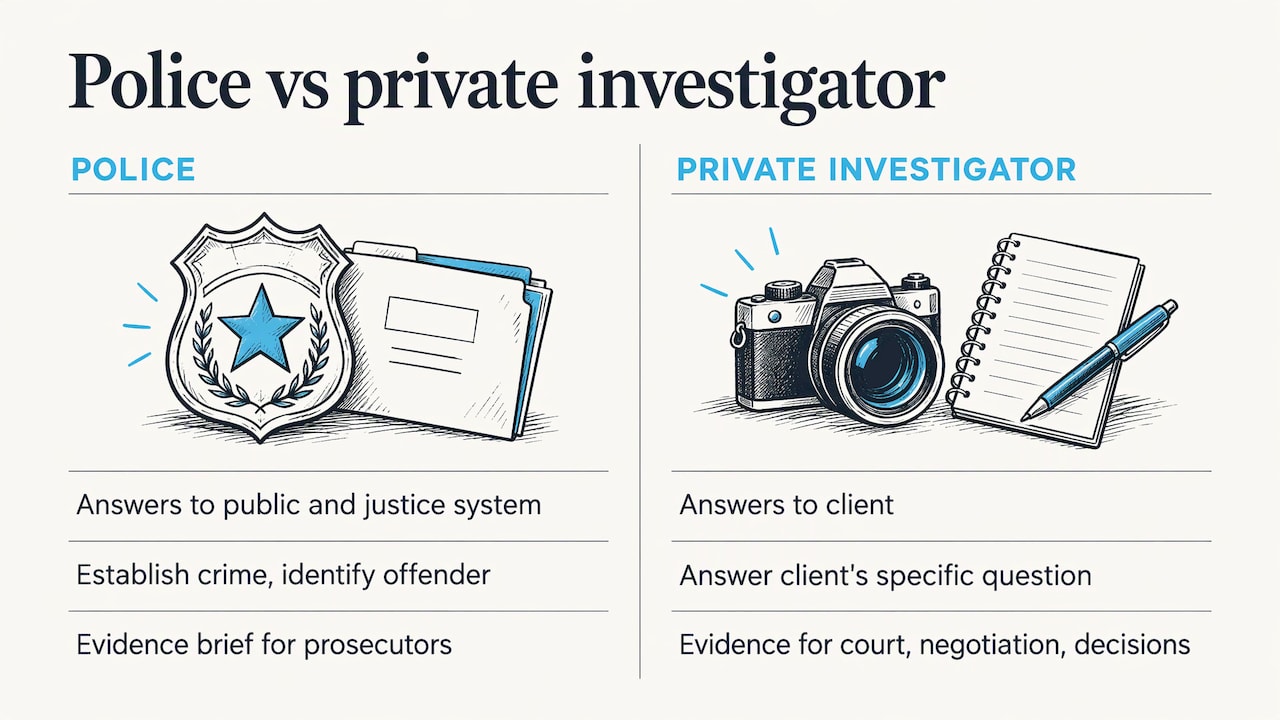
A police detective answers to the public and the justice system. Their job is to establish whether a crime has been committed, identify an offender and hand a brief of evidence to prosecutors. The FBI, for example, concentrates on federal crimes such as terrorism, cybercrime, public corruption and organized crime. A cheating spouse, a dishonest bookkeeper at a small firm or an adult who has cut off contact with relatives usually sits outside those priorities.
A private investigator answers to a client. The goal is not a prosecution. It is an answer to a specific question: Where is this person? Is my partner being honest? Who is taking money from the business? What does the other side in this custody dispute actually do each week? The deliverable is information and evidence, which you can then use in negotiation, in a tribunal, in court or simply to make a decision.
That difference in purpose explains almost every other difference below.
Powers: what police can do that a PI cannot
This is the part every ranking page agrees on, and it is worth stating plainly.
Police can:
- arrest and detain suspects
- obtain and execute search warrants
- compel witnesses and question suspects under legal caution
- seize evidence and access restricted government and crime databases
- cooperate with agencies in other jurisdictions through formal channels
A private investigator cannot do any of that. A PI is a civilian operating inside the same laws as everyone else, plus the licensing rules of the place they work. That means no trespassing, no illegal recording, no hacking, no pretending to be an officer. A good investigator knows exactly where those lines sit, because evidence collected unlawfully can be thrown out or damage your case.
If you want the full list of what is and is not allowed, we cover it in what a private investigator can do.
The practical consequence: when you need someone detained, a property searched or a suspect formally interviewed, only police can do it. When you need someone watched, found, documented or checked out, a private investigator can do it without waiting for a crime to be formally established.
Priorities: why your case may sit in a queue
Police work to a triage model. Violent crime, missing children, active threats and serious offenses come first, as they should. Resources are finite, so low-value fraud, domestic disputes without violence, and matters that look civil rather than criminal tend to be recorded and filed rather than actively worked.
That is not a failure of police. It is how public services are rationed. But it means you may report a crime, receive a reference number and hear nothing for months.
A private investigator has the opposite problem: capacity is bought, not rationed. When you engage one, the hours you pay for go to your question. You can set the scope, the budget and the reporting rhythm, and you can stop at any point. If you want to know how a job unfolds from the first call to the final report, see how a private investigator works on a job and the investigation timeline.
Side by side
| Police | Private investigator | |
|---|---|---|
| Who they work for | The public and the justice system | You, the client |
| Main goal | Prosecute an offender | Answer your question with evidence |
| Arrest and warrants | Yes | No |
| Cost to you | Funded by taxpayers | Fee for service |
| Speed on personal matters | Depends on priority; often slow | Starts when you engage, scoped to your budget |
| Surveillance of a person | Only with legal grounds and approval | Lawful observation in public, on your instruction |
| Civil, family and corporate matters | Rarely involved | Core work |
| Reporting to you | Limited, due to the investigation process | Full reporting to the client |
| Finding someone abroad | Formal agency channels, slow | Direct inquiries and contacts in other countries |
When to call the police first
Some situations are not a PI job at all.
- A child or adult is in immediate danger.
- A crime is happening now, or you have been threatened, stalked or assaulted.
- A child has been abducted. Police have the legal authority to issue alerts, check borders and act on warrants. Specialist recovery support can run alongside that, and we assist families with it through our child recovery service.
- You have been defrauded and need an official crime report, which banks, insurers and courts often require.
Report first, then bring in a private investigator to do what police cannot prioritize: trace the money, locate the person, document the pattern.
When a private investigator is the better call
Suspected infidelity
Police do not investigate affairs. If you are weighing up a relationship, the question is what evidence is real. Our guides on signs of infidelity and what counts as proof of cheating explain what holds up and what is only a feeling. Cheating partner surveillance produces dated, timed photo and video from public places, which is far more useful than screenshots or suspicion.
Staff misconduct and workplace fraud
If an employee is stealing, leaking information or claiming sick leave while working elsewhere, police will want a clear, documented case before they act. An investigator can build that case, interview witnesses and prepare a report your HR and legal advisers can use. Start with the basics of corporate investigations, then read about running an internal fraud investigation properly. Before you monitor staff, check the rules in workplace surveillance laws. Our corporate investigations and staff monitoring work follow those limits.
Family law and child welfare
In parenting and property disputes, a court wants facts: who is supervising the children, where the other party lives, what assets exist. Police rarely gather that. A private investigator can produce observation notes, photos and video suitable for a legal proceeding. Parents worried about a teenager’s safety can also use teenage monitoring, which documents where a teen goes and who they meet without confrontation.
Crypto scams and other fraud
Police take reports, but a crypto theft can cross several countries within hours. A private investigator can trace the people and businesses behind a scam, identify where assets sit and prepare a file for a lawyer or a formal complaint. See fraud in small business and insurance fraud investigation for how fraud files are assembled. For a business with a compensation claim to test, our WorkCover investigations and asset search work cover the common cases.
Finding people anywhere in the world
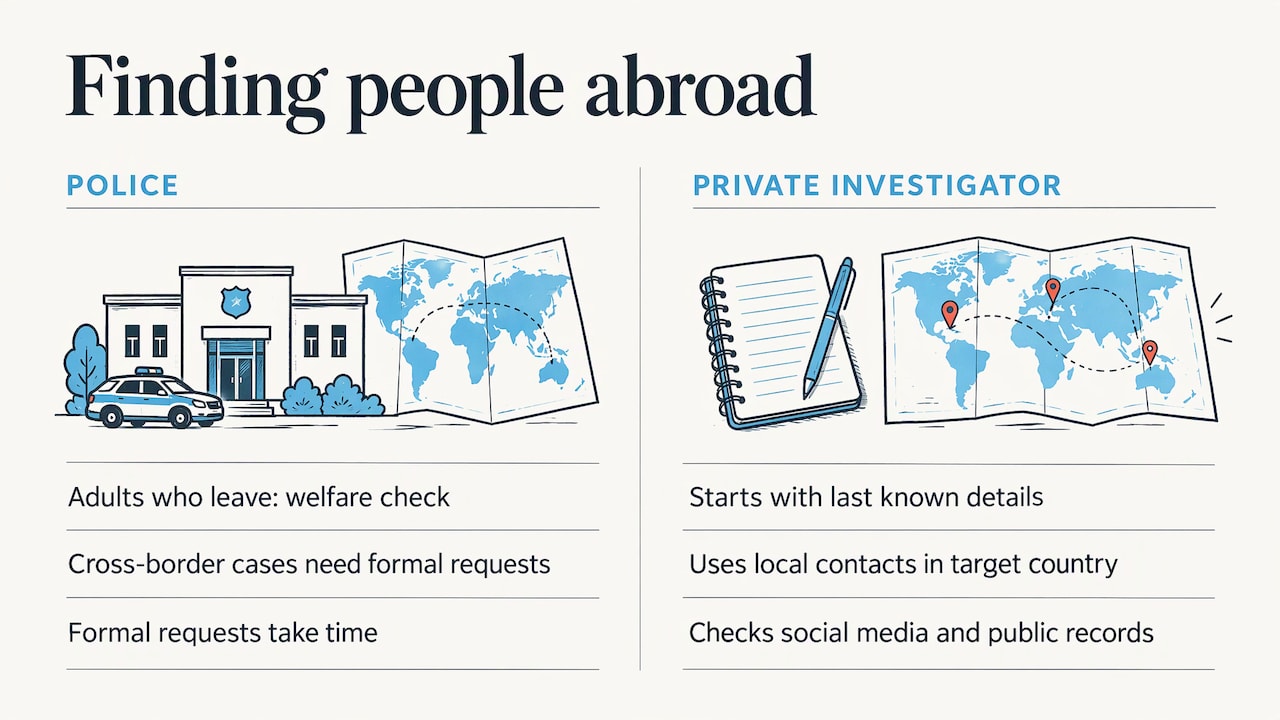
Police generally treat an adult who has chosen to leave as a welfare check, not an investigation. They also work within their own borders unless a formal request is made to another country, which takes time.
A private investigator tends to start from the person: last known addresses, employers, social media, relatives, public records, and local contacts in the country where the trail leads. Our social media investigation page explains how open-source research fits in. The earliest steps are laid out in how to locate a missing person, and we have located a missing person in the UK. We also take on missing persons work more broadly and describe our reach on private investigators in Australia.
Two practical points. Give the investigator everything you have, even details that seem trivial, such as a nickname, a former employer or a hobby. And agree early on what you will do once the person is found, because a lawful investigator will pass on a location or a message but will not help anyone approach a person who does not want to be contacted in a way that puts them at risk.
Surveillance: where private investigators earn their keep
Surveillance is the clearest example of the gap between the two. Police use it for serious crime and need approvals to do so. A private investigator uses it for the questions people actually have: Is the injured claimant really housebound? Where does my spouse go on Thursday evenings? Who collects my child from the other parent’s home?
Good surveillance is mostly preparation. The investigator confirms the subject’s routine, plans vehicle positions and entry and exit points, and uses more than one operative where a single one would be noticed. The output is a timed log, photos and video that show who, where and when, without trespassing or intruding on private spaces.
What that costs: our surveillance work is listed at $1,000–$1,450 one-off, and the cost page explains what moves the figure. For how we approach the work, see surveillance services done the right way.
Hiring former FBI agents, ex-military and special forces for advice
People search for “FBI for hire” or “former SAS soldier for hire” because they want someone who has seen serious cases and will not panic. That instinct is sound, with one correction: a former agent or soldier has no more legal power than any other private citizen once they leave the service. What they bring is training and judgment.
What transfers well:
- Planning. Military and law enforcement work are built on preparation, contingencies and clear objectives.
- Patience and observation. Long surveillance is dull and demanding. Discipline matters more than gadgets.
- Evidence handling. Former police and federal investigators know what a court will and will not accept.
- Composure. Sensitive cases, such as a missing child or a controlling partner, call for calm and discretion.
Our team includes former FBI and military personnel, former police and polygraph specialists. If you want to talk through a kidnapping or missing-person concern with that background, read about our former FBI agent expertise. Ex-military hires for private security or armed “mercenary” work are a different industry entirely. They are not investigation, and we do not present them as such. If your problem is that someone is missing, deceiving you or taking money, an investigator is the right person to ask.
Is it legal to hire a private investigator?
Yes, in general. Hiring a licensed investigator to find information, observe in public or gather evidence is lawful in most places. The investigator must hold the right licence where they work and stay inside privacy, surveillance and trespass law. The things you should never ask for are illegal: tracking a phone you do not own, accessing someone’s accounts, recording private conversations you are not part of, or entering a home. A competent investigator will refuse, and that refusal protects you.
Laws differ by country and state, so ask any investigator which licence they hold and which rules govern your case before you commit.
Our perspective
We are asked this question often, usually by someone who has already spoken to police and been told, kindly, that there is little they can do. That is rarely a failure. It is a sign the matter is personal, civil or financial, and needs someone whose only job is your case.
Our team is made up of experienced former police, former military and polygraph specialists, plus former FBI personnel, and we tailor each investigation to the individual client rather than running every case the same way. We use advanced technology to produce photos and video suited to legal proceedings, because evidence is only worth what a lawyer or tribunal will accept.
Our advice is simple. Call police for danger and crime. Call us when you need facts, found people, documented behavior or a file that stands up in a legal matter. The two work well side by side.
P.i Melbourne
Talk to us about your case
If your situation fits a personal, family, corporate or fraud matter, we scope the investigation to your question and your budget. Our services include surveillance, cheating partner surveillance, fraud investigation, missing persons, staff monitoring, family law support, evidence collection for court and child recovery. You can see the full range on our private investigation services page, or contact us through Pi Melbourne.

FAQ
What is the difference between a police investigator and a private investigator?
A police investigator is a sworn officer who works for the state, can arrest and obtain warrants, and aims to prosecute offenders. A private investigator works for a client, has no arrest powers, and gathers information and evidence to answer the client’s question.
Why do police not like private investigators?
Friction usually comes from a private investigator interfering with an active case, mishandling evidence or acting beyond the law. When an investigator shares findings early and stays within the law, the relationship is generally cooperative. Reporting a crime before you hire one avoids most problems.
Is it illegal to hire a private detective?
No. Hiring a licensed investigator is lawful in general. What is illegal is asking them, or anyone, to break the law on your behalf, for example by hacking accounts, trespassing or recording private conversations. Rules vary by country and state, so confirm the investigator’s licence for the place the work is done.
Can I use both police and a private investigator?
Yes, and in serious matters it is often the best approach. Report the crime to police so there is an official record, then use a private investigator to trace people, document behavior or gather evidence for your lawyer. Share anything relevant with police through your lawyer or the investigating officer.