
Whether you can legally record a conversation depends on where each person is standing, not only on where you are. Federal US law lets you record a call you take part in. Roughly a dozen states require everyone’s consent, and other countries set their own rules. If a recording may end up in court, in a custody dispute or in an HR file, the safest route is to have it gathered by investigators who work within these rules every day. That is what our team does.
TL;DR
- US federal law generally requires the consent of at least one party, and you can be that party. Many states are stricter and require all parties to agree.
- Calls that cross state or national lines can fall under more than one law, so the strictest rule is the one to plan around.
- Making a recording and using it as evidence are separate legal questions. A lawful recording can still be excluded, and an unlawful one can create liability for you.
- Outside the US the rules differ sharply: some countries treat secretly recording a private conversation as a criminal offense even when you take part.
- For infidelity, workplace, family law or fraud matters, court-ready evidence is best collected by licensed investigators, not by a hidden phone in a pocket.
Table of Contents
- One-party and all-party consent: what the terms mean
- The US picture: federal law and the states
- Recording laws around the world
- When secret recording becomes a problem
- Legal to record is not the same as usable in court
- Recording in specific situations
- How to approach recording lawfully
- Who to hire: former agents and military investigators
- Surveillance without the legal risk
- Our perspective
- Talk to us before you record
- FAQ
- Sources
One-party and all-party consent: what the terms mean
Under a one-party consent rule, a person who takes part in a conversation can authorize its recording without telling the others. Under an all-party rule, everyone in the conversation must agree. The Digital Media Law Project notes that “all-party” is the more accurate label than “two-party”, because a call can have three or more people on it. The same guide points out that exceptions, notice rules and privacy conditions vary from one jurisdiction to another.
Three ideas sit underneath every rule you will read:
- Participant versus eavesdropper. Recording a conversation you are in is treated very differently from planting a device to capture a conversation you are not part of. Third-party eavesdropping is unlawful almost everywhere without a warrant or consent.
- Expectation of privacy. Laws usually protect conversations where people reasonably expect privacy. The Texas State Law Library explains that courts have generally found little expectation of privacy in public places, but that whether a specific recording is legal depends on the facts.
- Recording versus sharing. Even where the recording itself is lawful, posting it, forwarding it or handing it to a third party can trigger separate rules.
The US picture: federal law and the states
The federal wiretap statute, 18 U.S.C. §§ 2510 and 2511, requires the consent of at least one party before in-person, telephone or electronic conversations are recorded. If you are in the conversation, you are a party. The Federal Communications Commission says it has no rules on individuals recording their own phone calls and points consumers to state authorities, because some states prohibit the practice.
That is where most of the risk sits. According to the Reporters Committee for Freedom of the Press, about 11 states mainly require all-party consent: California, Delaware, Florida, Illinois, Maryland, Massachusetts, Michigan, Montana, New Hampshire, Pennsylvania and Washington. Michigan’s rule applies at least to recordings by someone outside the conversation. The same guide adds some split rules:
| Situation | Rule |
|---|---|
| Missouri and Oregon | All parties must consent to record in-person conversations, but only one party for phone calls |
| Connecticut and Nevada | All parties must consent to record phone calls, but only one party for in-person conversations |
| Hawaii and Maine | All parties must consent in particularly private places, otherwise one party |
| Texas | One-party consent, with protections for conversations where people have a reasonable expectation of privacy (Texas State Law Library) |
California shows how strict an all-party state can be. Its eavesdropping law requires every party to a confidential communication to consent, and for calls on cellular or cordless phones, consent is needed regardless of confidentiality. Laws change, so treat any summary, including this one, as a starting point and confirm the statute in your state before you press record.
What about calls between states?
This is the question that catches people out. You are in a one-party state, the person you call is in an all-party state, and nobody is sure which law applies. The Digital Media Law Project says the answer for interstate calls can be uncertain and recommends getting every party’s consent. The practical rule: plan around the strictest law that could touch the call.
Recording laws around the world
Because we investigate for clients in many countries, including people trying to locate relatives or witnesses abroad, we see how much the rules change at a border. A worldwide overview reports that there is no international treaty setting consent rules for private recordings. It lists the US federal approach, Japan, South Korea, Brazil, India, South Africa and Spain as generally permitting participant recording, and Germany, France, Greece, Portugal, the Philippines and Malaysia as examples of all-party approaches. It describes the United Kingdom as depending on context and Australia as varying by state and territory.
Two official examples show how seriously some countries take it:
- Switzerland. The Federal Data Protection and Information Commissioner states that recording a private, non-telephone conversation without the consent of everyone involved is an offense, even if the recorder is a participant. Narrow exceptions exist, for example emergency and rescue calls and certain high-volume business calls about orders, contracts or reservations.
- Canada. The Office of the Privacy Commissioner says businesses subject to PIPEDA must tell customers a call is being recorded, state the purpose and obtain consent. In most cases, continuing the call after that notice implies consent.
If your conversation involves someone abroad, whether a business contact, a relative or a person you are trying to find, assume that their country’s law may apply as well as yours.
When secret recording becomes a problem
Covert recording is not automatically illegal in the US. In a one-party state you can usually record a call you are on. The trouble starts in four situations:
- You are in an all-party state, or the other person is.
- You are not part of the conversation. Leaving a recorder running in a room, a car or a phone line you do not take part in is the classic eavesdropping offense.
- The conversation is in a place where privacy is expected, such as a home, a private office or a bedroom.
- You share it. Posting a recording online or sending it to the other person’s employer can create separate claims.
Consequences vary widely. Abroad, penalties can be heavy: Germany’s criminal code can punish unauthorized recording of another person’s non-public words with up to three years in prison or a fine, and a South Australia guide reports a maximum of AUD 15,000 or three years for an individual. Australia also introduced a statutory tort for serious invasions of privacy, which that guide says began on 10 June 2025.
Legal to record is not the same as usable in court
A clean recording and an admissible recording are two separate things. Courts ask whether the recording was lawfully made, whether it is authentic, whether it is relevant, and whether someone can explain where it came from and who handled it. In England and Wales, for example, a guide to covert recordings says admission is discretionary and turns on relevance, fairness, authenticity and proportionality. It also reports guidance from the Family Justice Council in May 2025 that strongly discourages covert recording of children.
US courts have their own tests, and a recording that a judge excludes does a client no good. Our pages on video evidence in court and chain of custody explain what makes material stand up. For relationship matters, see what proof of cheating actually counts for.
Recording in specific situations
Suspected infidelity
It is tempting to hide a recorder in a partner’s car or bag, or to tap their calls. In most places that puts you on the wrong side of the law, especially when you are not part of the conversation. Observation of a person’s movements in public, with photos and video taken lawfully, is a different matter and is what our cheating partner surveillance is built around. Our signs of infidelity guide helps you decide whether surveillance is warranted.
Workplace and employees
Employers face layered rules: federal and state recording laws, notice requirements, and limits on monitoring private spaces. Our guide to workplace surveillance laws sets out what employers can legally monitor. Where theft, fraud or misconduct is suspected, our corporate investigations team handles the evidence side so the HR process is not undermined later.
Family and child welfare
Recording a child, or recording a former partner during a custody dispute, can backfire badly in court even where the recording is technically legal. Family courts look at the child’s welfare and privacy. Our family law services are designed for exactly these sensitive matters, and our restraining order evidence guide shows what to gather.
Fraud and scams
If you are chasing money lost to a scam or a fraudster, including a cryptocurrency scam, the call you want to record may involve someone in another state or country. That is exactly the cross-border situation where the law is hardest to predict. Preserve what you already have, such as messages, emails and transaction records, and speak to an investigator before you start recording calls with the other side.
How to approach recording lawfully
These are safe-use steps, not legal advice. For a particular dispute, a lawyer licensed in your state is the person to confirm your position.
- Identify every location. Note the state or country each person is in during the conversation.
- Apply the strictest rule. If any location requires all-party consent, get it.
- Announce the recording. A clear statement at the start of the call, such as “this call is being recorded”, creates consent when the other person carries on. Keep the recording of that statement.
- Stay a participant. Never record a conversation you are not part of.
- Keep the original file. Store it unedited, with the date, device and who was present, because a judge will want to know where it came from.
- Limit sharing. Give it only to your lawyer, the court or the investigator working on the matter.
The weak point in this routine is usually the evidence trail. A recording you made yourself can be challenged on how it was captured and stored. Our investigators collect photos, video and other material in a way designed to be suitable for legal proceedings, so you are not relying on a phone file whose history you cannot prove.
Who to hire: former agents and military investigators
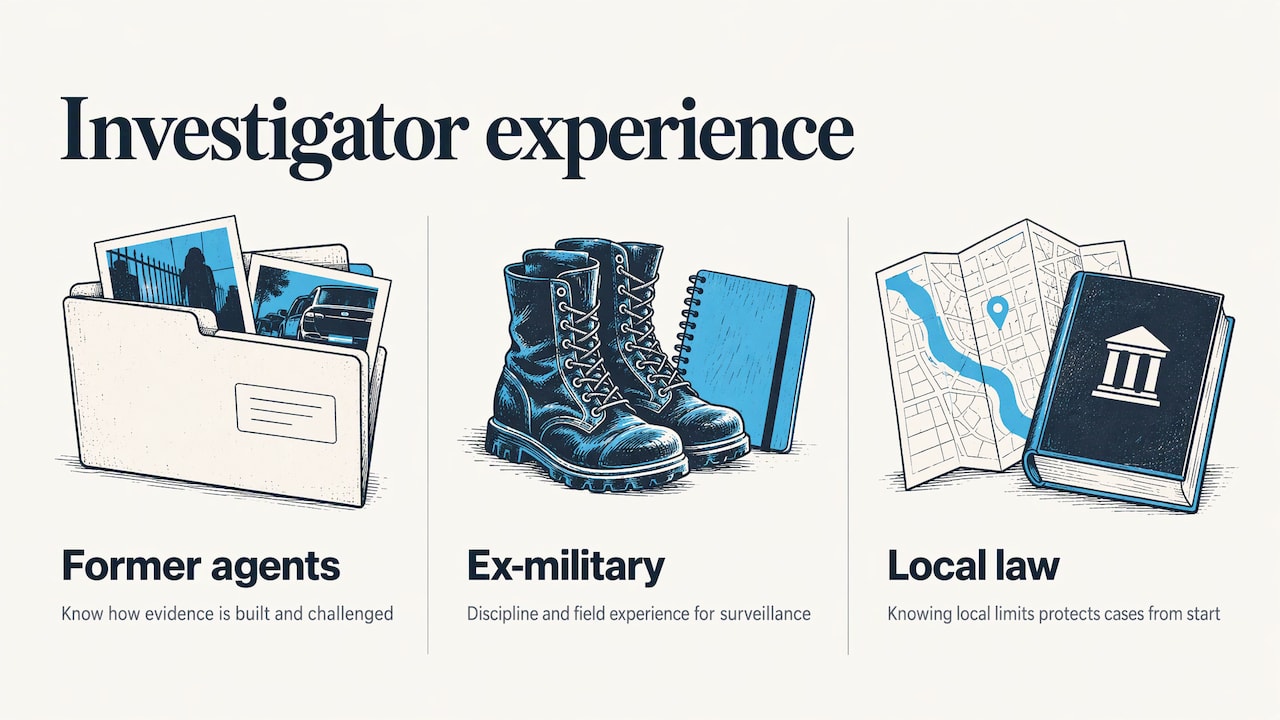
People often ask us whether they can hire former FBI staff, ex-military personnel or even “mercenaries” to resolve a situation. The realistic version of that request is hiring experienced investigators, and our team includes former law enforcement, ex-military and polygraph specialists. They are hired for advice, surveillance, locating people and collecting evidence, not for force or for breaking recording laws. A former federal agent brings an understanding of how evidence is built and challenged, and our former FBI agent page covers missing persons and child abduction work. Our ex-military team offers the discipline and field experience that surveillance demands.
Finding people overseas is a good example of why that background matters. Our guide to locating a missing person covers the first steps, and we have worked cases abroad, including locating a missing person in the UK. Because laws on recording, data and surveillance differ by country, an investigator who knows the local limits protects your case from the start.
Surveillance without the legal risk
Surveillance is often the lawful alternative to covert audio. Observing and photographing a person’s movements in public places, within the rules, does not raise the eavesdropping problem that a hidden microphone does. Our surveillance services page explains how we do it, and we also keep client details protected, as described in our note on private investigator confidentiality.
Our perspective
Most of the people who contact us have already made a recording, or are about to. They are worried, they want proof, and the phone in their hand feels like the quickest answer. Often it is the riskiest one.
The rules on consent differ from state to state and country to country, and a recording that breaks them can hurt the person who made it more than the person it targets. Our approach is to tailor each investigation to the client’s situation and to deliver evidence suitable for legal proceedings.
That is why our team is built from experienced ex-police, ex-military and polygraph specialists. They know how evidence is challenged, and they use advanced technology to produce court-ready photos and video. We would rather help you build a case that holds up than watch a good one collapse over how it was gathered.
P.i Melbourne
Talk to us before you record
If you are weighing a recording, a surveillance job or a search for someone, we can tell you what evidence your matter needs and how to gather it properly. Our surveillance work is published at $1,000-$1,450 one-off, and other services, from family law to fraud and asset searches, are quoted to the matter. Since 2006 we have worked on infidelity, corporate fraud, child recovery and legal evidence cases.
Start with our private investigation services or read about surveillance pricing. If you are overseas, our page on private investigators in Australia explains how we work with international clients.
FAQ
Is it legal to record a conversation in the US?
Usually yes, if you are part of it and your state follows one-party consent, as federal law does. In states like California, Florida and Pennsylvania, everyone must consent. Because rules differ, check the law for every location involved.
Can I record a phone call without telling the other person?
In a one-party consent state, generally yes, if you are on the call. If the other person is in an all-party state, the safest course is to get their consent, since interstate calls create legal uncertainty.
What happens if I record someone illegally?
You can face criminal charges and civil claims, and a court may refuse to admit the recording. Penalties depend on the jurisdiction and range from fines to prison abroad. Sharing the recording can add further liability.
Can a secret recording be used as evidence?
Sometimes. Admissibility is a separate question from legality, and judges look at relevance, authenticity and how the file was handled. A lawyer in your state can tell you how your court treats it.
Do recording laws apply if the other person is in another country?
Potentially both countries’ laws can matter. Some countries, such as Switzerland, treat secret recording of private conversations as an offense even for participants, so get consent for any cross-border call.
Sources
- Digital Media Law Project: Recording Phone Calls and Conversations
- Reporters Committee: Introduction to the Reporter’s Recording Guide
- Reporters Committee: California recording guide
- Federal Communications Commission: Recording Telephone Conversations
- Texas State Law Library: Audio Recording
- Swiss FDPIC: When the recording of conversations is allowed
- Office of the Privacy Commissioner of Canada: Recording of Customer Telephone Calls
- World Recording Laws overview
- South Australia Recording Laws
- Covert Recordings as Evidence in UK Courts