
A background check confirms what the records say about a person. An investigation answers a question the records cannot: where someone is, what they are doing, whether money has moved, or whether a story holds up. If you need a standard yes-or-no screen for a hire or a tenant, you need a check. If you suspect a cheating partner, staff fraud, a hidden asset, a missing relative or a crypto scam, you need an investigation, and the evidence it produces has to survive scrutiny. At Pi Melbourne, our investigators are former police, ex-military and polygraph specialists, and we build each case around the question you actually have.
TL;DR
- A background check is a defined search of databases and selected records. An investigation is customized and can add interviews, fieldwork, cross-referencing and surveillance.
- Checks are predictable and fast. Investigations take longer and vary with how many places, sources and people are involved.
- The legal rules depend on the purpose of the report (employment, housing, credit, a court case), not on what a provider calls it.
- Finding a person abroad, tracing assets or documenting conduct for court is investigation work, not a database lookup.
- Kidnapping in progress is a police matter first. Investigators are not mercenaries and cannot use force or pose as officers.
Table of Contents
- What a background check actually is
- What an investigation adds
- Side by side
- Which one fits your situation
- Finding people anywhere in the world
- Surveillance: what it is and what it produces
- Hiring former FBI staff, ex-military and former special forces
- The legal side: purpose decides the rules
- Questions to settle before you start
- Promo
- Perspective
- FAQ
- Sources
What a background check actually is
A background check is a research process. Someone runs a set of searches against databases and selected records, then reports what came back. The PI Institute’s 2026 comparison describes checks as built on defined searches, which is why results come out standardized and the turnaround is fairly predictable.
Typical contents are criminal records, identity verification, employment and education confirmation, and sometimes driving or credit history. In the United States, the Office of Personnel Management describes background evaluations as reviews of an applicant’s employment, criminal and personal history, used to assess reliability, integrity and personal adjustment.
A check tells you whether a record exists. It does not tell you why, whether the record is the right person’s, or what is missing from it.
What an investigation adds
An investigation starts with a question rather than a list of databases. The Virginia Department of Criminal Justice Services separates a background investigation from a criminal-record check: the investigation includes further inquiries such as references, employment and school records, and an in-depth interview.
The same logic applies in private work. According to the PI Institute, investigations are customized and may add primary-record research, interviews, cross-referencing, identity resolution and follow-up. They tend to take longer and become less predictable as the number of jurisdictions, the depth of sources, the interviews and the verification needs increase. Neither approach is automatically better. They answer different problems.
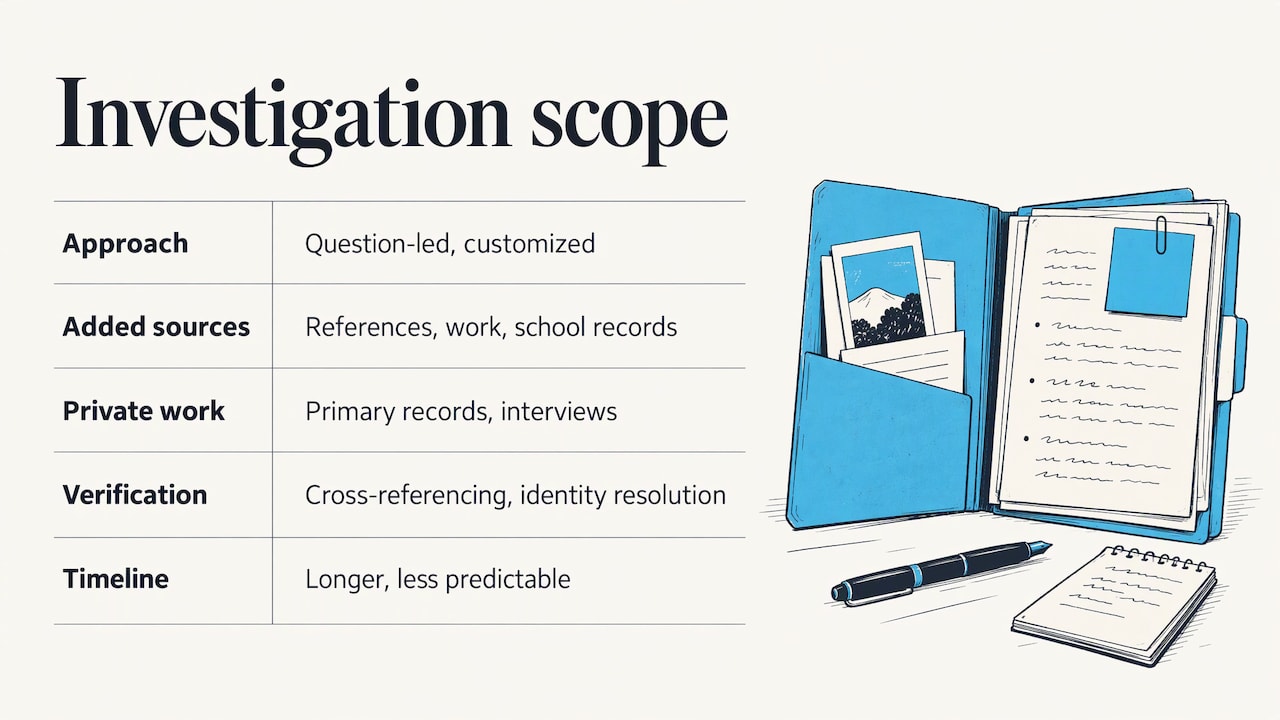
Government vetting shows the same pattern. The OPM notes that background evaluations may draw on former employers, coworkers, friends and neighbors, particularly for positions of trust, law enforcement, private security and security clearances. In that setting, investigators document concerns alongside mitigating information, which RAND’s personnel vetting toolkit frames as holistic verification rather than automatic disqualification.
Side by side
| Background check | Investigation | |
|---|---|---|
| Starting point | A name and a standard list of searches | A specific question or concern |
| Sources | Databases and selected records | Records, people, fieldwork, documents, sometimes surveillance |
| Output | Standardized report | Tailored findings with a record of what was and was not established |
| Time | Usually predictable | Varies with scope and jurisdictions |
| Best for | Routine screening | Suspected infidelity, fraud, missing persons, asset tracing, evidence for legal matters |
Which one fits your situation
Suspecting a cheating partner
No database shows whether your partner is seeing someone. A check will return a clean record and tell you nothing. What helps is documented observation over time: where they go, who they meet, how often. Our cheating partner surveillance produces court-ready photos and video, which matters if the relationship ends in a family law dispute. You can see how this work is organized on our private investigation services page.
Employee conduct and fraud
A pre-hire check screens the person before they join. It does not tell you why stock is disappearing or whether a manager is diverting payments. That takes an investigation: terms of reference, interviews, document review and, where appropriate, staff monitoring. Our guides on internal fraud investigation and the basics of corporate investigations set out how it runs. Workplace monitoring has legal limits, so read about what employers can legally monitor before you start. Our corporate investigations service covers misconduct and fraud for business owners, and we also handle Victorian WorkCover investigations.
Child welfare and family law
Parents worried about a teenager, or about a child’s safety during a custody dispute, need observation and documentation, not a records search. See our pages on teenage monitoring, child custody investigation and family law support.
Hidden money and crypto scams
A check on a name rarely shows where money went. Tracing assets means following documents, corporate structures and transfers. Australia’s Law Society Journal reports that investigators may assist lawyers with asset tracing, corporate structures, fraud and documentary evidence, depending on the case. For divorce, read how hidden assets are found; for wider tracing, see our asset search investigation. If you have lost money in a crypto scam, gather every transaction record, wallet address and message before you contact us, and report it to the police in your country as well.
Finding people anywhere in the world
A people-search site can return an old address. It cannot tell you whether the person still lives there, whether the match is correct, or who they are living with. Locating someone is an investigation problem: you resolve identity, cross-reference sources and follow leads, often in more than one country.
The more jurisdictions involved, the longer and less predictable the work becomes, because each country has its own records, access rules and privacy laws. That is why international cases need an investigator who can say plainly what can be found lawfully in each place. We have written up a case where our team found a missing person in the UK, and our guide on locating a missing person lists the first steps. Our reach across the country is described on our page on private investigators in Australia.
If a child is missing or has been taken, call the police first. After that, our child recovery service can work alongside you on locating and recovering the child.
Surveillance: what it is and what it produces
Surveillance is the clearest example of why an investigation differs from a check. It is lawful observation, recorded so that it can be used later. The aim is a clean, dated, time-stamped record of what happened.
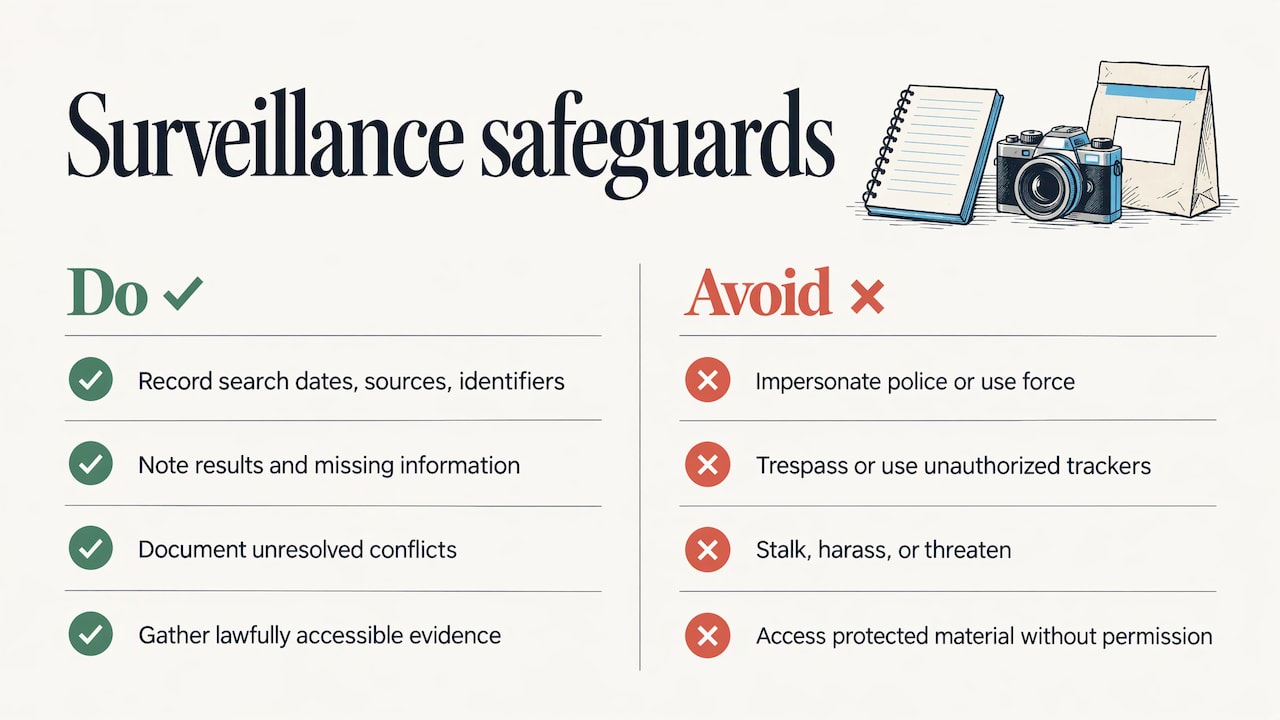
The discipline is in the documentation. The PI Institute recommends recording search dates, sources, identifiers, responsive results, missing information and unresolved conflicts, so that a report conveys both findings and their limits. The same habit applies to surveillance logs and footage.
Boundaries matter as much as technique. According to the Law Society Journal, investigators in Australia must not impersonate police, use force, or breach laws on stalking, harassment, threats or unauthorized tracking devices, and an investigator who uses unlawful methods can harm a client’s case. The Texas explainer makes the same point for the US: investigators may document observations and gather lawfully accessible evidence, but cannot trespass, compel testimony or access protected material without authorization.
Our surveillance work is priced from a published range of $1,000 to $1,450 one-off, set out on our cost page. For how the job unfolds day to day, read how a private investigator works on a job and surveillance done the right way.
Hiring former FBI staff, ex-military and former special forces
People often search for “FBI for hire” or ex-military help because they want experience, not a title. That is a sound instinct, with two conditions.
Match the experience to the task. A former federal agent brings training in interviews, case building and evidence handling. A former soldier brings fieldwork discipline, patience and planning under pressure. Former special forces backgrounds, such as the SAS, add surveillance and observation skills. None of that replaces the specific task: tracing assets needs document skills, while a missing child case needs locating experience.
Licensing is local. A badge or service record from abroad does not give anyone the right to work as an investigator where you live. In Connecticut, for example, Chapter 534 defines licensed private-detective work to include background investigations, surveillance and securing evidence, with experience routes such as five years of full-time investigative work or ten years as a police officer. Ohio’s Revised Code requires qualifying experience, an exam and liability coverage, and New Mexico sets a route requiring at least 6,000 hours of qualifying investigative work. In New South Wales, the Law Society Journal notes investigators must be licensed under the Security Industry Act 1997 (NSW). Rules differ everywhere, so ask any investigator which license covers the work in the place it will happen.
Our team includes former FBI and military agents, ex-police and polygraph specialists. If you want advice on whether your situation needs an investigation, our page on a former FBI agent for missing persons and child kidnapping shows the kind of experience we bring.
What about “mercenaries for hire”?
This is not investigation work. An investigator cannot use force, take the law into their own hands or act as police. If someone is in immediate danger, call the emergency services. If you need facts, locations or evidence gathered lawfully, that is where an investigator helps. Our page on private investigators versus police explains who to call and when, and our guide to what a private investigator can do sets out the limits.
The legal side: purpose decides the rules
The PI Institute makes a point many people miss: legal treatment depends on the purpose of the report, such as employment, housing, credit or insurance, not on whether a provider calls it a check or an investigation.
For US employment screening, that means obligations under the Fair Credit Reporting Act (FCRA). A compliance overview summarizes them as a standalone written disclosure, written consent, and pre-adverse-action steps. It adds that California’s Fair Chance Act generally covers employers with five or more employees and bars criminal-history inquiries before a conditional offer. State and local rules differ, so an employer should confirm requirements for its own location before screening.
If you want the findings to be used in a legal matter, the way they are gathered counts. Investigators can locate witnesses, trace assets and develop documentary evidence, and the Law Society Journal describes written witness statements and stresses lawful evidence handling. Before you hire anyone, the Texas explainer’s advice is a good template: define the question, disclose court orders and safety concerns, agree scope and terms in writing, and be wary of anyone who guarantees findings or court outcomes.
Questions to settle before you start
- What decision will this inform? A hire, a divorce, a dismissal, a lawsuit, a recovery of funds.
- Who will see the result? A lawyer or court needs a different standard of documentation than a private decision.
- What is the lawful route? Employment checks, workplace monitoring and surveillance each have their own rules.
- What do you already hold? Messages, statements, receipts and dates save time and money.
- Is anyone at risk now? If so, contact the police before anyone else.
Promo
If your question cannot be answered by a database, we build the investigation around it. Pi Melbourne has operated since 2006, and our investigators include former FBI and military agents, ex-police and polygraph specialists, using advanced technology to produce court-ready photos and video. Services include surveillance, cheating partner surveillance, fraud and corporate investigations, family law support, missing persons, child recovery, asset searches and evidence collection for court.
Start on our private investigation services page or visit Pi Melbourne to describe your situation.
Perspective
Most people who come to us have already tried the easy route. They ran a name through a search site, or they bought a report, and it told them nothing about what was keeping them awake.
We believe the right question comes first. A check is the right tool when you need to confirm a record. When the issue is a partner’s behavior, a staff member’s conduct, a child’s safety or money that has vanished, you need people who know how to observe, document and follow a trail.
That is why our team is built on experience: former police, ex-military, former FBI and military agents, and polygraph specialists. Each case is tailored to the client’s circumstances, and our evidence is gathered so it can be used in legal proceedings.
P.i Melbourne
FAQ
Is a security clearance the same as a background check?
No. A clearance involves a background investigation, which is wider than a standard check. The OPM says these evaluations draw on former employers, coworkers, friends and neighbors, and are used for positions of trust, law enforcement, private security and security clearances.
What is involved in a background investigation?
It begins with records, such as criminal history and employment or education confirmation. It then adds references, interviews and cross-referencing of sources. The Virginia Department of Criminal Justice Services lists references, school and employment records and an in-depth interview among the extra steps.
Can an investigator find someone in another country?
Often, yes, though the time and certainty depend on the countries, the records available and what you already know. Each jurisdiction has its own access and privacy rules, so a lawful approach matters. Give us every detail you hold, including old addresses, employers and contacts.
Can I use investigation findings in court?
They can support a case when gathered lawfully and documented properly. A lawyer decides how evidence is used, so involve yours early. Our work on evidence for court is built around dated, well-documented photos, video and reports.
Sources
- Background Evaluation/Investigation, U.S. Office of Personnel Management
- What is a background investigation? Virginia Department of Criminal Justice Services
- Background Investigation vs. Background Check, PI Institute
- Personnel Vetting 101 Applicant Toolkit, RAND
- How and when should law firms work with private investigators, Law Society Journal
- What Can a Private Investigator Do in Texas?
- Chapter 534, Private Detectives and Security Services, Connecticut General Assembly
- Chapter 4749, Ohio Revised Code
- 16.48.2 NMAC, New Mexico
- Background Check Compliance overview