
The most reliable sign of infidelity is not one behavior. It is a pattern: secrecy, changed routines and emotional distance that appear together, last for weeks and have no other explanation. A single late night or a passcode change proves nothing. This guide covers the signs people most often report in a husband or a wife, the innocent explanations that look identical, and how to move from suspicion to certainty without making things worse.
TL;DR
- Secrecy is the strongest cue. Research published in 2024 found it weighed far more in people’s judgments of betrayal than how often two people interacted or how well they knew each other.
- One changed behavior is not evidence. Stress, depression and work pressure produce the same changes, so look for clusters over time.
- Do not confront in the first shock-filled hours, and do not install spyware or track a phone. Both can backfire legally and emotionally.
- If you may need proof for a divorce or custody matter, how it is collected decides whether it is usable. A licensed professional is the safer route.
Table of Contents
- What counts as infidelity today
- The signs people report most
- Signs of a cheating husband or wife: is there a difference?
- Why signs alone are not proof
- How to tell if your spouse is cheating: a measured approach
- Why DIY detective work can hurt you
- What proof of infidelity actually looks like
- Our perspective: what we see when people come to us
- When to hire a private investigator
- If you are weighing next steps with us
- FAQ
- Sources
What counts as infidelity today
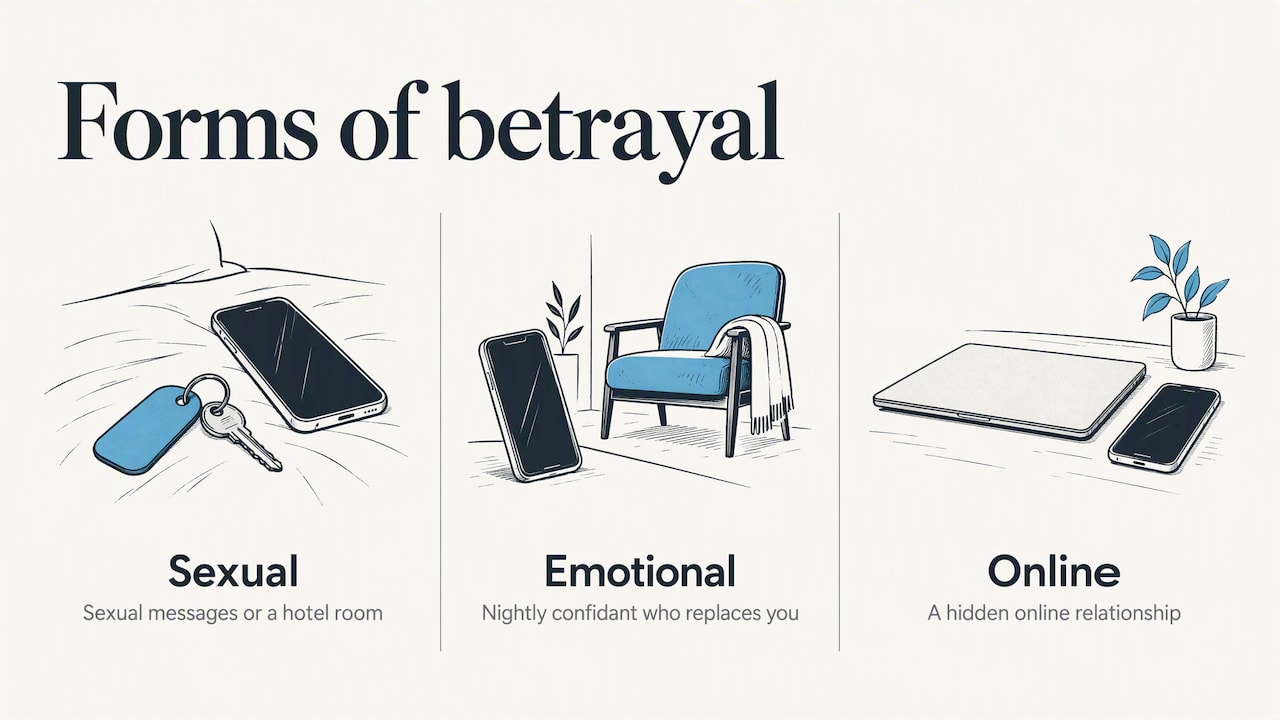
Infidelity is usually split into sexual and emotional. The line has blurred online. Studies on cyber-cheating found that people mostly regard it as a real form of betrayal, and work on cues to infidelity shows that people suspect emotional involvement from different cues than they do sexual involvement.
That matters because your partner may never have met the other person in private. Sexual messages, a nightly confidant who replaces you, or a hidden online relationship can hurt as much as a hotel room. The signs below apply to all of these.
The signs people report most
No list is a verdict. Treat each item as a question to keep in mind, not an answer.
Secrecy around devices and communication
This is the category with the best research behind it. Warning signs include:
- The phone is now always face down, taken into the bathroom or kept on silent.
- Passcodes change, or notifications are hidden.
- Your partner deletes message threads or browser history, when they used to leave things open.
- Calls end or the tone shifts when you walk in.
- A new second account, app or email address appears.
The point is the change from your partner’s own baseline. Someone who has always been private is not showing you anything new.
Changes in schedule and availability
- Unexplained gaps or vague answers about where they were.
- New work trips, or sudden “late meetings” that nobody can confirm.
- Psychology Today’s clinical writer lists flat tires, dead batteries, traffic jams and extra time at the gym among the excuses that can signal an affair.
- Forgetting the kids’ pickups, birthdays or anniversaries that they used to keep.
- Plans changed at the last minute, which AARP’s coverage also quotes a licensed clinical social worker as a possible behavioral change.
Emotional and physical distance
- Less interest in intimacy, or a sudden change in what they want.
- Picking fights, or going unusually passive, so that time together is avoided.
- Less curiosity about your day, your plans or your future.
- New attention to appearance, clothes or fitness with no stated reason.
- Changes in eating and sleeping patterns.
Money and logistics
- Unfamiliar charges, cash withdrawals, gift purchases you did not receive.
- New subscriptions, a second card, or statements that are suddenly paperless.
- Mileage on the car that does not match the stated routine.
Social signals
Psychology Today also notes that friends may seem uncomfortable around you, because the people close to a cheating partner often know first. This one is soft evidence. Friends may simply sense tension at home.
Signs of a cheating husband or wife: is there a difference?
The searches “signs of a cheating husband” and “signs of a cheating wife” are common, and the articles that rank often split the lists by gender. In practice the cues overlap almost completely. Secrecy, schedule changes and emotional withdrawal show up regardless of who is doing it. Gender stereotypes (“he buys new cologne,” “she suddenly loves the gym”) are weak predictors and can send you after the wrong thing.
What differs more is the individual. Compare against how your partner normally behaves, not against a generic list.
Why signs alone are not proof
Here is the honest part most listicles skip. Increased secrecy, an altered schedule and mood shifts are also common indicators of personal stress, depression or outside pressure. That source is blunt: a single changed behavior is just a changed behavior, and what clinicians look for is the pattern.
Some innocent explanations that look like cheating:
| What you notice | Possible innocent explanation |
|---|---|
| Phone guarded, new passcode | Planning a surprise, a work confidentiality rule, a privacy habit after a data breach |
| Late nights | Job pressure, a layoff fear they have not shared, caring for a relative |
| Emotional distance | Depression, burnout, grief, health worries |
| Less sex | Medication side effects, stress, resentment about something unrelated |
| New gym routine | A health scare, a doctor’s advice, a personal goal |
| Spending changes | Hidden debt, gambling, or a gift being planned |
There is also evidence that people can be fairly good at spotting a cheater. A study on thin slices of infidelity found that observers could identify people cheating on their partners from a short video clip. So your gut may be picking up on something real. But a gut feeling is not documentation, and acting on raw suspicion can do damage that is harder to repair than the suspected affair itself.
How to tell if your spouse is cheating: a measured approach
A 2024 analysis of detection strategies found that almost 58% of people use three or more methods, most often watching behavioral changes, asking questions while reading reactions, and tracking the partner’s location. The first two are fine. The third is where people get into trouble. Here is a sequence that protects you.
- Write down what you see. Dates, times, what was said. Keep it private and factual. A log separates a pattern from a bad week.
- Rule out the innocent causes. Ask yourself whether there is a new stressor at work, in their health, or in the family.
- Wait before confronting. The hours after a suspicion or discovery are often marked by shock and emotional flooding. Betrayal-trauma specialists advise against reactive confrontations, which rarely give clarity and often lead to blame-shifting or deleted evidence.
- Try an honest conversation. Describe what you have noticed without accusing: “I feel distance between us and I want to understand it.” How your partner reacts is information too.
- Consider a counselor. Clinicians argue that asking about affairs should be a standard part of assessment, and that couples who enter therapy while an affair is hidden do significantly worse than those where it comes out early.
- Decide whether you need proof. If the answer is for your own peace of mind, a conversation or counseling may be enough. If it could affect a divorce, custody, or property split, the next section matters.
Why DIY detective work can hurt you
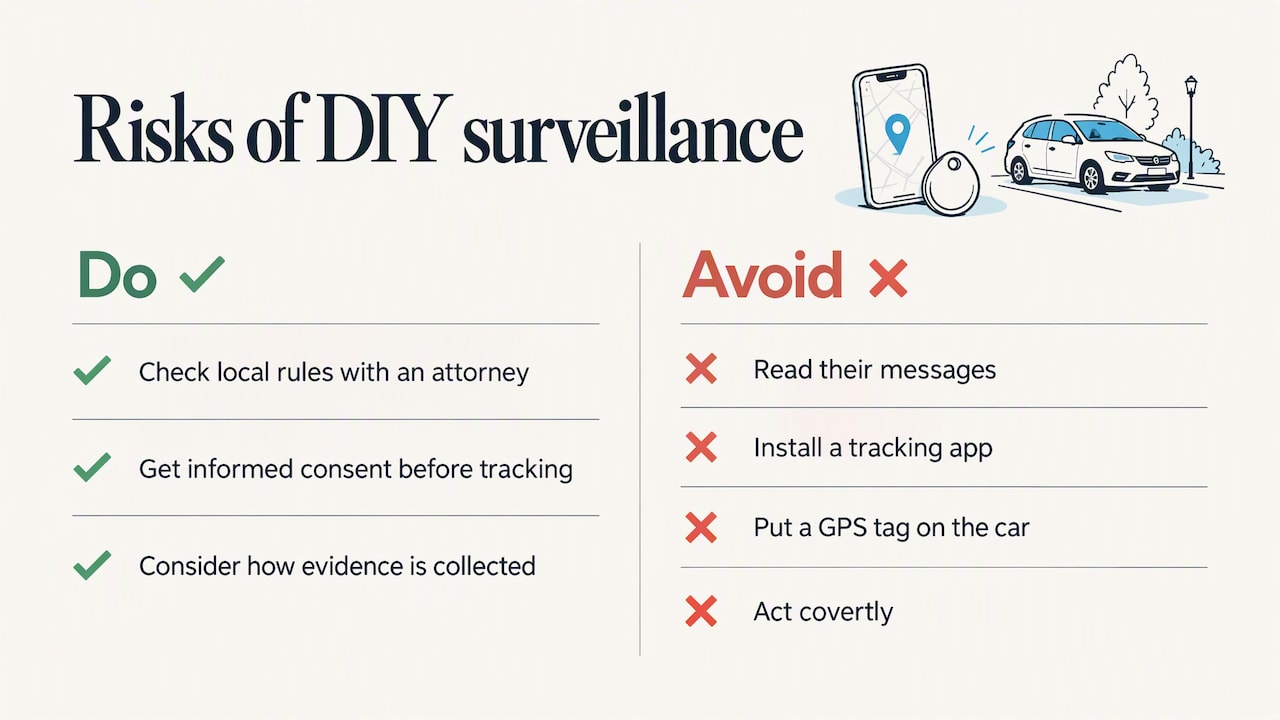
The temptation is to read their messages, install a tracking app or put a GPS tag on the car. Think twice. Tracking another adult can cross legal lines: a legal overview of tracking a spouse explains that informed consent makes it legal, while marriage, paying the phone bill or owning the device does not by itself grant permission, and that some states have criminal statutes aimed at tracking another adult. The rules vary by state and by country, so check yours with a family law attorney before you do anything covert.
There is a second cost. Researchers and practitioners warn that personal detective work can compromise legal standing: evidence gathered the wrong way may be inadmissible, and the process can trigger destructive emotional cycles. If you ever need the material in a family law proceeding, how it was collected matters as much as what it shows.
What proof of infidelity actually looks like
An argument or a suspicion is not proof. What carries weight depends on where you are and what the matter is, but generally speaking it is dated, time-stamped, lawfully gathered documentation: photographs or video of the people together, verified over several days, with a clear record of who collected it and how.
That is the work of surveillance by a licensed investigator. A professional can:
- Observe over agreed days and times, so that one coincidence is not mistaken for a pattern.
- Record photos and video in a form suitable for legal proceedings.
- Stay within the law on privacy and trespass, which you may not know in detail.
- Report facts only, without drawing emotional conclusions.
If you are in the U.S., ask any investigator you consider about state licensing and what the report would include. Questions to ask before hiring anyone:
- Are you licensed in the place where the surveillance will happen?
- What will the final report and footage look like?
- How do you handle discretion if the subject notices?
- What does it cost, and what is not included?
Our perspective: what we see when people come to us
We have run private investigations since 2006, and most people who contact us about a partner arrive with a list of signs and a knot in their stomach. Our honest view:
- Most people ask us the wrong question. “Is he cheating?” is a feeling. The workable question is: “What do I need to know, and what will I do with the answer?” If you would end the marriage either way, you need evidence that stands up. If you want to repair it, you may be better served by a counselor first.
- Patterns beat moments. Our investigators, who include former law enforcement, ex-military and polygraph specialists, are trained to separate an isolated event from repeated behavior. That discipline is why we plan surveillance around the days and times that matter, rather than watching blindly.
- Every case is different. A suspicion about a spouse, a concern about a teenager, and a family law dispute call for different plans. We tailor the investigation to the situation, and we do not run the same script each time.
- Evidence quality is everything. Footage that is clear, dated and lawfully obtained can be used in legal proceedings. Footage from a hidden app on a partner’s phone may not be, and it may expose you to risk.
- Discretion is part of the job. Your partner should not learn about it from us.
If you have decided that you need to know, we would rather you do it properly than do it quickly.
— Global
When to hire a private investigator
Consider professional help when:
- You have a documented pattern, not a single incident.
- The result could affect divorce, custody, spousal support or asset division.
- You have already tried a direct conversation and received evasive answers.
- You are tempted to track or hack your partner’s devices, which is the moment to stop and hand it to someone who knows the limits.
It is not the right step when you are still at the first hunch. In that case, keep your log, talk to someone you trust, and think about counseling.
What it costs
Our published surveillance pricing runs from $1,000 to $1,450, one-off. Our page on what a private investigator costs in Melbourne explains what drives the figure. For a broader view of how an engagement runs, see how a private investigator works on a job.
If you are weighing next steps with us
We handle cheating partner surveillance, family law support and court-ready evidence collection, and we serve clients worldwide. If you want to talk through what you have noticed and whether an investigation makes sense, start with our private investigation services page. If the situation involves custody or a teenager, our family law services cover that too. Our team will tell you plainly if an investigation is not what you need yet.
FAQ
What are the most common signs of infidelity?
The most common are secrecy around phones and accounts, unexplained changes in schedule, emotional withdrawal, and altered spending. Of these, secrecy carries the most weight in the 2024 research. Look for several signs together over time, not one in isolation.
Can stress cause the same behavior as cheating?
Yes. Distance, mood swings, odd hours and secrecy are also typical of stress, depression or outside pressure. That is why a pattern and a calm conversation come before any accusation.
What are the types of infidelity?
Researchers usually describe two main types, sexual and emotional. Online behavior such as cybersex or intense emotional disclosure is often perceived as real betrayal, so many people now treat the boundary as fluid.
Is it legal to track my spouse’s phone or car?
Not necessarily. Informed consent makes tracking lawful, but marriage or ownership of the device does not, and some states criminalize tracking another adult. Speak to a family law attorney in your state before you try it.
Does evidence I collect myself count in court?
It may not. Practitioners warn that evidence gathered improperly can lose its value in family law proceedings. If a legal outcome is at stake, ask an attorney and a licensed investigator how evidence should be gathered.
Sources
- Strategies for Detecting Infidelity: An Explorative Analysis
- The relative importance of contextual factors in judging infidelity, Personal Relationships
- Cues to Infidelity
- The realness of cyber-cheating, University of Warwick
- Signs of infidelity: how to really tell if your partner is cheating
- Thin slices of infidelity, Personal Relationships
- Assessing relationship betrayals
- Turning Pain into Power: Overcoming Betrayal Trauma
- How to Tell If Your Partner is Cheating on You, AARP
- 10 Signs Your Spouse Is Cheating, Psychology Today
- Can You Track a Spouse or Partner? Laws, Consent, and Penalties Explained