
A skip tracing investigation is the structured search for a person whose address, phone number or whereabouts you no longer know. Database lookups are only the first layer. When a person is hiding, has crossed a border or has a reason to disappear, the result comes from verified leads, field work and surveillance, run by investigators who know where each method stops and the law starts. At Pi Melbourne, our team of former law enforcement, ex-military and polygraph specialists works missing persons and recovery cases for clients in Australia and abroad.
TL;DR
- Skip tracing locates a person by building a profile, searching records and contacts, then verifying every lead until one current address or contact point survives.
- Databases go stale quickly. Verification in the field, by speaking to people and confirming with surveillance, is what turns a lead into a location.
- Several US laws limit who may pull credit, bank and motor vehicle data, so the purpose of your search decides which methods are legal.
- Cases involving a child, a cheating partner, a fraud or a person abroad are better handled by investigators with former FBI or military backgrounds.
- Our Surveillance service is published at $1,000 to $1,450 one-off, and other work is quoted to the case.
Table of Contents
- What a skip tracing investigation actually is
- How skip tracing methods work, step by step
- What skip tracing can and cannot find
- The legal limits: why the purpose decides the method
- Finding people all over the world
- Hiring former FBI staff for advice
- Hiring ex-military investigators and former special forces soldiers
- Surveillance: where the lead becomes proof
- How skip tracing results should be documented
- What a skip tracing investigation costs
- Where we come in
- Our view on skip tracing
- FAQ
- Sources
What a skip tracing investigation actually is
The term “skip” comes from someone who has skipped town: a debtor, a witness, a relative who stopped answering, a business partner who vanished with funds. A skip trace is the process of finding where that person is now.
People order one for very different reasons:
- A family member has cut contact, or a parent needs to find a child who was taken or is not returned.
- A lawyer needs to serve court papers or reach a witness.
- A business needs to find a former employee, a supplier or a debtor.
- A person wants to locate a spouse or partner who is concealing assets or a second life.
- Someone who lost money in a cryptocurrency scam wants to know who is behind the account and where they are.
The method is the same in each case. What changes is how much the target wants to be found, and that changes everything about how hard the work becomes.
How skip tracing methods work, step by step
A good trace follows stages. Skipping one is the usual reason a search ends on the wrong person.
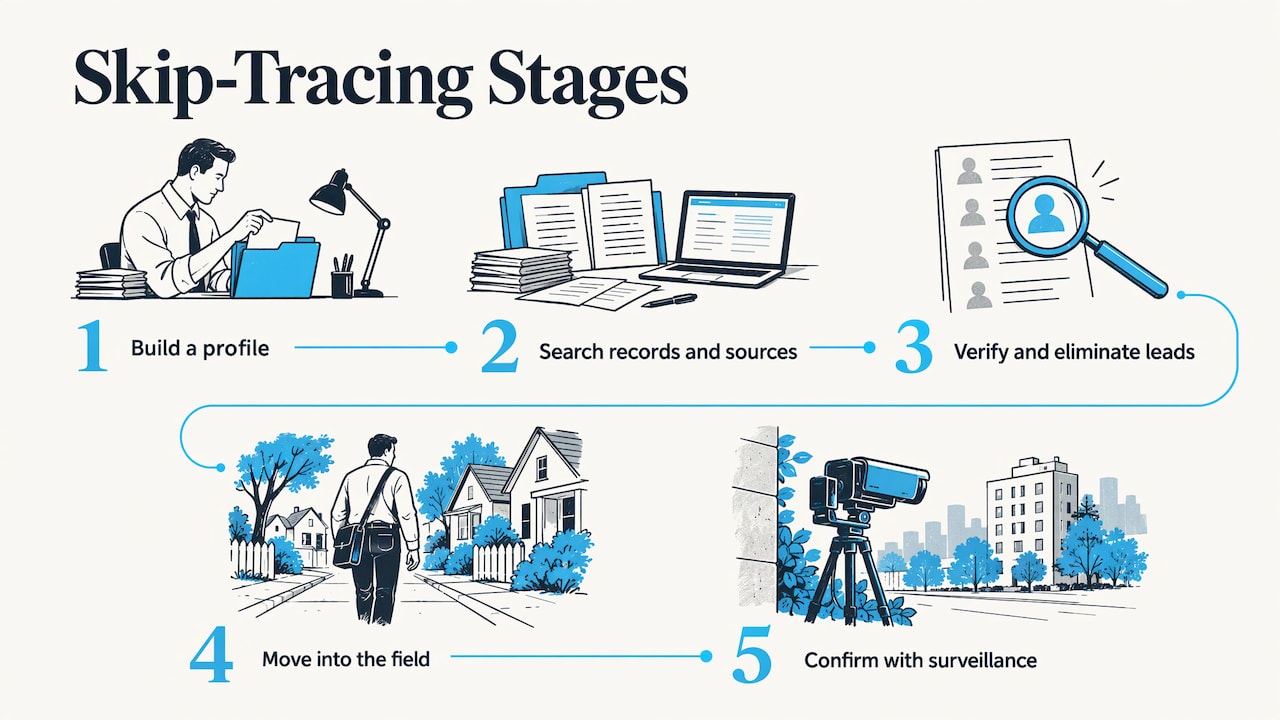
1. Build the profile
The search starts with everything you already know: full legal name, spelling variants, nicknames, date of birth, last known addresses, phone numbers, email addresses, social media accounts, schools, former employers, and the names of friends, relatives and business associates. The more identifiers you have, the fewer wrong people you will chase. A common name with no date of birth can return dozens of candidates.
Where it goes wrong: people hand over a half-remembered name or an old nickname, and the trace proceeds on the wrong identity. We ask for everything you hold, including screenshots and old messages, because a small detail such as a gym or a hometown often separates two people with the same name.
2. Search records and open sources
Next come public records, property and business filings, court records, professional registrations, social media, and online footprints such as forum handles and marketplace listings. A professional search can return candidate addresses, phone numbers, emails, employers, relatives and associates, vehicle and property records. Each result is a lead, not a fact.
3. Verify and eliminate
This is the stage that separates a database printout from an investigation. Records lag behind real life. Industry guidance on verification notes that searches are most effective when ordered within three months of the subject’s last known address, and that a full name and Social Security number are the identifiers they rely on, according to the Association of Internet Research Specialists’ verification methods paper. Past that window, or without those identifiers, you are guessing, and the guess gets worse every month.
Verification means cross-checking each lead against others: does the phone number connect to the same address, does the employer match, does a neighbor or relative confirm it. Outdated leads and people who only share a name are removed.
4. Move into the field
When records do not produce a current location, the work goes physical. Investigators visit the last known address, speak to neighbors, approach former employers and coworkers, and follow relationships that the person has not been able to cut. This is slow, human work and it is where experience counts. A poorly handled approach to a neighbor alerts the target within the hour, and the trail goes cold.
5. Confirm with surveillance
An address is not a location until someone has seen the person there. Surveillance confirms that the subject actually lives or works at the address, shows their routine, and captures photos and video you can use afterward. Our Surveillance service uses advanced technology to produce court-ready photos and video, and it is the step that turns “probably there” into evidence. See how our surveillance is priced and how we do it the right way.
What skip tracing can and cannot find
A thorough trace can produce current and recent addresses, phone numbers, email accounts, employer details, relatives and known associates, vehicles, property ownership and social media profiles. That is usually enough to start the real work.
It cannot reliably tell you:
- Whether the person is living at an address today, rather than appearing in a record from last year.
- Whether a name match is the right person.
- What a person intends to do, or whether they are dangerous.
- Where money has gone, unless the trace is paired with a separate asset investigation.
That last point matters in divorces and fraud cases. If the person you are looking for is also hiding funds, the location is one piece. Our asset search investigation covers the money side.
The legal limits: why the purpose decides the method
In the United States, a skip trace is only as legal as the way the information was obtained. Three rules shape most of it.
- Credit reports. The Fair Credit Reporting Act lets a consumer reporting agency furnish a report only to someone with a permissible purpose, and the Consumer Financial Protection Bureau has confirmed that disclaimers do not cure a missing one. Wanting to find an ex-partner is not a permissible purpose.
- Pretexting. The Gramm-Leach-Bliley Act prohibits obtaining customer information from a financial institution by false pretenses, such as calling a bank and posing as the account holder.
- Motor vehicle records. The Driver’s Privacy Protection Act restricts who may access records held by state motor vehicle departments, and only for listed purposes.
Outside the US, the rules differ by country. The EU’s GDPR, Canada’s PIPEDA and the Australian Privacy Act all limit how personal data may be collected and moved, so a trace that crosses borders has to respect each system.
The practical lesson is simple. Methods that look easy online, such as buying a report or phoning an institution, can expose you to liability, and anything gathered unlawfully may be unusable in court. If your result will be used in a custody case, a divorce or a civil claim, how it was gathered matters as much as what it says.
Finding people all over the world
People move across borders, and so do the people who hide. A trace that starts in Melbourne can end in London, Dubai or Los Angeles. International locates run on the same stages, but each one gets harder.
- Records differ. Some countries publish property and company registries openly. Others restrict them or hold them only in a local language, so leads have to be read and confirmed locally.
- Privacy law differs. What a US searcher may lawfully pull is not what an Australian, German or Canadian investigator may collect. Cross-border transfers of personal data carry their own conditions.
- Field work needs people on the ground. Speaking to neighbors, former employers and relatives cannot be done from a screen.
- Time zones and languages slow every verification step.
We have handled this kind of search before: our team traced a missing person in the UK, which you can read about in our case on finding a missing person in the UK. For an overview of the territory we cover, see private investigators in Australia.
If you are chasing someone behind a cryptocurrency scam, start by saving every wallet address, transaction ID, chat log and website you have, and report the scam to the police or your national fraud reporting body. Those records are the profile an investigator needs to move from a wallet to a person.
Hiring former FBI staff for advice
Many readers ask us for FBI-trained investigators. The reason is sound: former federal agents spent years on kidnapping, fraud and fugitive cases, where locating someone who does not want to be found was the job.
What that background brings to a skip tracing investigation:
- Case structure. Knowing which leads to run first and how to document them so they hold up later.
- Interview skill. Getting a straight answer from a relative or former employer without revealing why you are asking.
- Fraud and financial trails. Following money and identities across accounts, which matters for scams and hidden assets.
- Child and missing person cases. Understanding how abductions and runaways tend to unfold, and where families make costly early mistakes.
We use former FBI and military investigators for exactly these matters. You can read about this part of the team on our page for a former FBI agent on missing persons and child kidnapping.
If a child is in immediate danger or has just been taken, call the police or emergency services first. That step belongs to the authorities. Our Child Recovery service works alongside it, and you can see how child recovery works.
Hiring ex-military investigators and former special forces soldiers
Former military personnel are the other profile clients ask for, sometimes in language such as “ex-military for hire” or “former SAS soldiers”. Whatever the label, what you are buying is a skill set rather than a uniform:
- Patience in surveillance. Hours of observation without being noticed, in a car, on foot or from a fixed point.
- Planning and discipline. Routes, timings, contingencies and clean notes.
- Composure under pressure. Calm decisions when a subject changes direction or a situation turns tense.
- Reading terrain and people. Working out where a person would go and who they would turn to.
Our team includes experienced ex-military investigators, alongside former police and polygraph specialists. We use these skills for lawful investigation work: locating people, observing them and documenting what we find. If you are looking for someone to use force, break the law or act as a “mercenary”, that is not what we do. What we offer is professional investigation that produces evidence you can use.
Surveillance: where the lead becomes proof
Surveillance is the part of a skip trace that most clients underestimate and that most DIY attempts get wrong. Following someone without being spotted takes training. Being spotted does more than ruin one day: the subject changes routine, moves, or becomes hostile.
Professional surveillance does three jobs in a locate:
- Confirms identity. The person at the address is the person you are looking for.
- Maps the pattern. Where they sleep, work and travel, which matters for serving papers or a child handover.
- Creates evidence. Dated photos and video, handled so they can be used in a legal matter.
The same discipline applies when a client suspects a cheating partner, or an employer suspects staff misconduct. The tools differ, but the principle holds: the observation has to be lawful, careful and recorded. If you are an employer, read what employers can legally monitor before you start.
How skip tracing results should be documented
What you find is only useful if it can be explained later. Whether the result is for a lawyer, a court or your own safety, keep a record of:
- The date, time and source of every lead.
- Which leads were confirmed, which were rejected and why.
- Original photos and video, unedited, with their timestamps.
- Who handled the material and when.
Share the address with your lawyer or the authorities rather than turning up yourself, especially where there has been violence, threats or a protection order. A located person is not always a safe one to approach. We prepare our findings so a lawyer can use them, and our family law work follows the same approach.
What a skip tracing investigation costs
Costs depend on what you are buying. Automated data platforms price per record, and an analysis of 2026 pricing puts that at roughly cents per record, with subscriptions for high-volume users. That is the price of raw data, and it does not include checking whether any of it is right.
An investigation is priced for the work. Our published Surveillance price is $1,000 to $1,450 one-off, and you can read what drives that in our private investigator cost guide. Locates, missing persons, fraud and asset work are quoted to the case, since distance, number of leads and how hard the person is hiding all change the hours involved.
Where we come in
If you know the person’s name and have a last known address, a trace might look simple. If the person is hiding, abroad, or tied to a child, a fraud or a court matter, it rarely is. Our investigations are tailored to each client’s situation and carried out by former police, ex-military and polygraph specialists, using advanced technology to produce evidence suitable for legal proceedings.
Start with our private investigation services, which cover missing persons, cheating partner surveillance, fraud, child recovery and evidence for court, or contact us through Pi Melbourne.
If you want to understand the process before you call, read how a private investigator works on a job.
Our view on skip tracing
Most people come to us after a search has already failed. They have a name from a database, an address that turned out to be two years old, and a growing fear that the person has gone for good.
We believe a locate is won on verification. A record is a lead. A neighbor, a former employer and a few hours of careful observation turn it into an answer. That is why our team is built from experienced former police, ex-military and polygraph specialists, people who have done this under pressure.
We tailor every investigation to the client’s situation, because a missing teenager, a debtor, a cheating partner and a fraudster do not call for the same plan. And we work toward evidence that is usable, because most clients need the result for a lawyer, a court or a safety decision.
If you are searching for someone, the best thing you can do is gather what you already have and speak to us before you start approaching people yourself.
P.i Melbourne
FAQ
Is skip tracing legal?
Yes, locating a person is lawful when it is done with lawful methods and a legitimate purpose. The line is crossed by how information is obtained: pulling credit data without a permissible purpose, pretexting a bank or misusing motor vehicle records can all create liability. A specialist plans the search around those limits.
How long does a skip tracing investigation take?
It depends on how much you can tell us and how hard the person is hiding. A cooperative target with a recent address can be located quickly. A person who has deliberately cut ties, moved abroad or uses a false identity takes longer, because every lead has to be confirmed in the field.
Can you find someone in another country?
Yes. International locates follow the same stages but depend on local records, local privacy law and people on the ground. We handle searches that cross borders, including a case that ended in the UK, and we tell you at the start what the country involved allows.
Do you hire out former FBI or military staff for advice only?
Our investigators include former FBI, police and military specialists, and they work on investigations rather than acting as consultants for hire in the abstract. If you want advice on how to approach a missing person, child or fraud case, tell us the situation and we will tell you which service fits it.
Sources
- Consumer Financial Protection Bureau advisory opinion on FCRA permissible purposes, Federal Register
- Verification Methods in Private and Public Information, Association of Internet Research Specialists