
To locate a missing person, call police first, hand them a complete information file, and bring in a specialist investigator alongside the official search, not after it stalls. Police hold the legal power to search, ping phones and enter a person into national databases. A private investigator adds time, manpower and tracing skills for the leads that police caseloads leave unworked. At Pi Melbourne, our investigators include former police, former military and former FBI personnel, and we trace people in Australia and overseas.
TL;DR
- Report the disappearance to police right away. In the U.S. there is no legal 24-hour waiting period, and anyone concerned can make the report.
- Build one file before you call: recent photo, clothing, medications, phone, vehicle, routines, a last-seen timeline and the names of people who know them.
- Keep every volunteer search, social media post and media appeal coordinated with police, and never disturb the last-known location.
- A private investigator works in parallel with police, using lawful tracing, surveillance and interviews, and can follow leads across borders.
- Pi Melbourne’s investigators are ex-police, ex-military and polygraph specialists, and our team includes former FBI personnel.
Table of Contents
- What to do in the first hours
- Build the information file police and investigators need
- Search safely and lawfully
- Use the official databases
- When a private investigator makes the difference
- Surveillance in a missing person search
- Hiring former FBI personnel and ex-military investigators
- Finding people anywhere in the world
- Work with us
- Our perspective
- FAQ
- Sources
What to do in the first hours
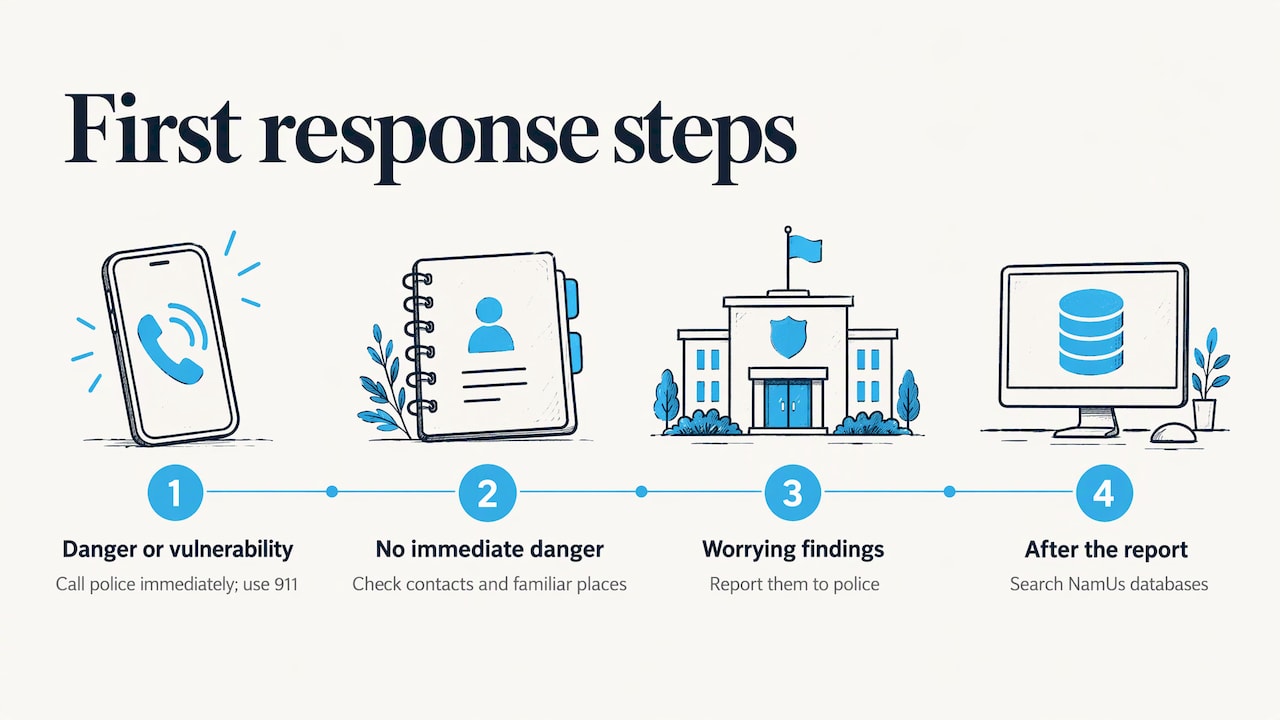
The first call is to police, and the call is made immediately. If the person is in danger, is a child or is vulnerable, use 911. North Carolina’s emergency management office tells families to call 911 as soon as possible when safety is a concern instead of contacting search-and-rescue teams directly. Trained search resources are requested through law enforcement, and your job is to supply a timeline, the facts and one reliable point of contact.
The idea that you must wait a day is a myth. Alberta’s government, for example, states that there is no 24-hour waiting period and that anyone can report a person missing, even if unrelated or living elsewhere. The case stays open until the person is found. Australia’s National Missing Persons Coordination Centre makes the same point in its SOS Guide: the first 24 hours matter because CCTV footage and other leads can disappear, and families should give police every fact, including private or sensitive information.
If there is no sign of immediate danger, a few quick checks are reasonable before or while you call. Alberta suggests contacting friends and family, hospitals, the school or employer, places the person frequents and their social media. If any check turns up something worrying, stop and call police.
The report itself must go through local law enforcement. Maryland State Police, for instance, says initial reports must be taken by local law enforcement, by calling 911 or going to a local station. After that, families can use NamUs to search databases and find support.
Build the information file police and investigators need
Whoever searches, the quality of the information decides how fast they can move. North Carolina’s guidance lists what to prepare: a recent photo, a clothing description, medical needs or medications, vehicle details, phone or possible-location information, routes, destinations, habits and planned activities, plus a clear last-seen timeline. New Zealand Police goes further and asks for identifying marks, social-media use, phone and banking details, transport, reasons for concern and any previous disappearances, along with the names of people who know the person well.
A practical way to organize it:
| What to gather | Why it matters |
|---|---|
| Two or three recent, clear photos | Used for alerts, databases and canvassing |
| Clothing, marks, tattoos, glasses, medications | Lets hospitals and officers recognize the person |
| Phone number, carrier, accounts, devices | Gives police a starting point for lawful records requests |
| Vehicle make, plate, color | Allows plate-reader and camera checks |
| Bank and card details | Shows where the person last spent money |
| Routine, hangouts, workplace, past disappearances | Narrows likely destinations |
| Timeline of the last 48 hours | Anchors every other lead |
Preserve the person’s room and belongings as they are. The U.S. Office of Juvenile Justice and Delinquency Prevention advises families not to disturb items that may hold fingerprints, DNA or scent, and to give investigators the personal items and records they ask for.
Write down names, dates and what was said as soon as you learn it. Memory blurs quickly, and an investigator who takes over later can only work as well as your notes.
Search safely and lawfully
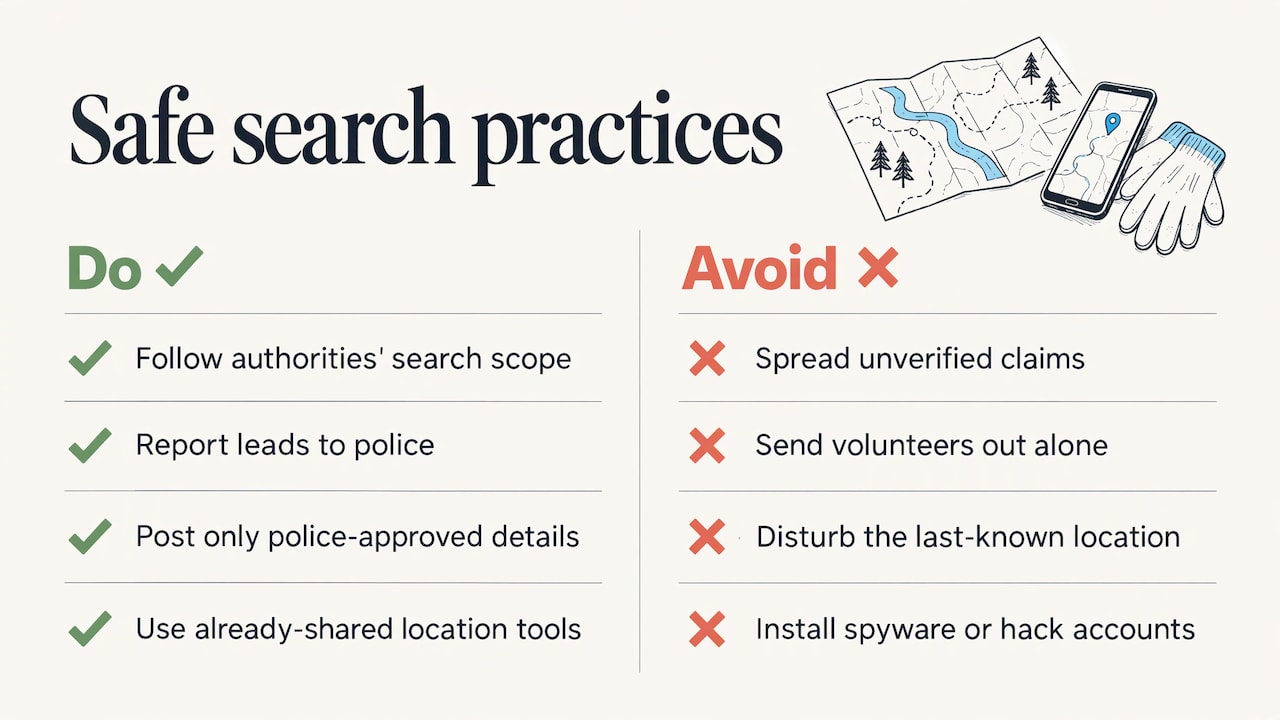
A search that feels productive can damage the case. North Carolina advises families not to spread unverified information, send out volunteers on their own or disturb the last-known location without direction from authorities, because that can create confusion, delay rescue and destroy evidence.
The Police Service of Northern Ireland’s missing persons investigation guidance describes how a professional search is scoped: the last known position, the surrounding area, likely routes, the last known address and other relevant places. Your own checks should follow the same logic, and any lead should be reported to police instead of acted on by confronting people.
Social media is double-edged. Toronto Police’s community guide treats public appeals as useful for leads but notes that exposing a location, passing on unverified claims and uncontrolled disclosure can endanger people or contaminate an investigation. Post only what police have agreed to, with a photo, a description and the police contact, and keep sensitive details out of public posts.
Location sharing needs care too. Use only tools the person already shared with you, such as a family location-sharing account, and never install spyware on their phone, hack accounts or enter property without permission. Those acts are illegal in most places, can taint evidence and can leave the person you love less willing to come back.
An adult has the right to go missing. The UK police’s guidance notes that going missing is not itself illegal and that the priority is the person’s wellbeing. If you do find them, that is often the point where an investigator’s discretion matters: the aim is to confirm they are safe, not to force contact.
Use the official databases
In the U.S., the central tool is NamUs, the National Missing and Unidentified Persons System. According to the National Institute of Justice, it allows advanced searching and cross-matching of missing and unidentified persons, and it tracks biometric information until the case is resolved. The same article cautions that only 16 states require law enforcement to enter cases into NamUs, so ask the officer handling your case whether yours has been entered and get the case number in writing.
Procedures differ by country. Switzerland’s federal police tells people to report to the nearest police station or 117, not to fedpol. Mexico’s July 2025 national protocol requires authorities to register a disappearance without delay and circulate a search form. Chile’s Law 21,500 lets anyone report a disappearance by any means without a minimum waiting period. The common thread is that the official report opens the door to every other resource, so it comes first wherever the person disappeared.
When a private investigator makes the difference
Police are responsible for the official search, but they handle many cases at once, and a case with no sign of danger can move slowly. A private investigator does not replace that work. We add dedicated time and manpower to the parts of a search that rely on persistence: tracing, interviews, surveillance and following a lead that sits in another country.
Here is where an investigator typically earns their fee:
- Adults who left on their own. Police may confirm someone is safe without telling the family where they are. Families, executors and lawyers often still need a lawful way to make contact.
- Estranged relatives and lost contact. A parent, sibling or child who has not been heard from in years.
- Legal matters. Serving documents, locating a witness or a debtor, or finding a person connected to an estate or asset search.
- Cross-border searches. A person last known to be abroad, where a local family has no contacts or language skills. Our team has worked on a missing person case in the UK, and we also take on searches in the U.S. and the rest of the world.
- Child recovery. Cases involving a child taken by a parent or another person, where speed, planning and discretion matter.
What a legitimate investigator can do is limited by law. Licensed investigators work with public records, lawful records research, interviews, open-source research and observation in public places. They do not hack, impersonate officials or obtain private records by deception. If an investigator promises you a phone’s location data or someone’s bank statements on request, treat that as a red flag: those records are released to police or by court process. We explain the boundaries in more detail in our guide to what a private investigator can do.
Surveillance in a missing person search
Surveillance is often what turns a located address into a confirmed one. Once we have a probable location, discreet observation in public places can show whether the person actually lives or works there, who they are with, and what their routine looks like, without alerting them or anyone around them. It also produces dated, time-stamped photos and video, which matter if the case later involves a court, a custody dispute or a protection order.
Our surveillance work uses court-ready photos and video and advanced technology. Surveillance is published on our site at $1,000 to $1,450, one-off. Larger searches are scoped to the case, so we ask for the information file first and then agree the plan. For the principles we work by, see surveillance services the right way.
Surveillance also changes what happens next. If the person is found and is an adult who does not want contact, the investigator can report back to you that they are safe and, where the law and the circumstances allow, pass on a message. If the person is at risk or a child is involved, the finding goes to you and to the authorities.
Hiring former FBI personnel and ex-military investigators
Many readers arrive asking for an FBI agent for hire, or for ex-military operators. Those are fair instincts, and the useful question is what the experience actually brings.
Former FBI personnel. Agents spend years on kidnapping, fugitive and missing person cases and learn how a case is built from the first report to the last interview. Our team includes former FBI personnel, and our former FBI agent page covers missing persons and child kidnapping. A former agent is most useful as an adviser at the start: reading your information file, spotting what is missing, ranking the leads and telling you which questions police need answered. A former agent is a private citizen, not a federal officer, and works within the same lawful limits as any other investigator.
Ex-military investigators. Military backgrounds bring discipline in planning, patient observation, working in unfamiliar terrain and staying calm and discreet under pressure. These are the skills that matter on a long surveillance and on overseas searches. We use ex-military personnel alongside former police and polygraph specialists. They investigate, observe and report within the law; we do not offer armed or mercenary services.
Ex-police and polygraph specialists. Former police investigators know how to take a statement, test an account and document evidence so it stands up. Polygraph specialists support interviews where a person’s account needs to be tested.
This mix is the reason our investigations are tailored to each client’s situation instead of following a template. Our guide to how an investigator works on a job explains the stages from briefing to final report.
Finding people anywhere in the world
A disappearance rarely stays in one country. A person may have moved abroad, may hold two passports, or may have been taken across a border. The practical difficulty is that every country has its own rules for what records are public, who can ask for them and how a missing person report works. That is why the first step is always the local police report where the person was last seen, and why the second is someone who can work in that place.
We work on cases across Australia and internationally, and our pages on private investigators in Australia set out how we operate. For an overseas search we start from your file, identify the country and the most likely cities, and plan how the trace will be carried out lawfully there.
Give us everything you know, including old addresses, past employers, friends, online handles, languages spoken and any plans the person mentioned. In an international search, the small details are usually what narrow the country down.
Work with us
If police are already involved and you want more done, or if the person is an adult who left, we can start with a confidential discussion about your file. Our services include missing persons, surveillance, child recovery, family law support and evidence collection for court. The full list is on our private investigation services page. We work from your information file and agree a plan with you before anything starts.

Bring the file you have built from the section above: the photo, the timeline, the phone and vehicle details and the names of everyone who knows the person. That is the fastest way to a realistic plan.
Our perspective
Families who call us are usually a few days or a few weeks into the worst stretch of their lives, and most have the right instinct: they want every available person working the case. The lesson from our work is that a missing person search is won by organization, not by drama. A complete file, one point of contact with police, and one investigator who can pursue the leads that nobody else has time to chase.
We built our team around that. Former police know how to document and test information. Ex-military personnel know how to plan and stay patient. Former FBI personnel know how large missing person and kidnapping cases are structured. Polygraph specialists help when an account needs checking. Together they let us tailor each search to the person, the place and the legal situation, instead of running a standard package.
Our rule is simple: lawful methods, discretion, and evidence that holds up if a court ever needs it. Whether the search is in Melbourne or on another continent, that does not change.
P.i Melbourne
FAQ
How do I find a missing person fast?
Report to police immediately and give them a complete file with photos, a timeline and phone, vehicle and bank details. Then check NamUs for your case and ask the officer how it is being circulated. If you want more resources working, a private investigator can run a parallel trace.
Do I have to wait 24 hours to report someone missing?
No. Official guidance in Alberta and other jurisdictions confirms there is no waiting period, and U.S. police departments take reports at any time. If you are worried, call right away.
Can a private investigator find a missing person?
Yes, using lawful methods: records research, interviews, open-source research and surveillance in public places. An investigator works alongside police, who keep the legal powers over phone records and formal searches. We can also search overseas where the person has moved abroad.
Can I hire a former FBI agent or ex-military investigator?
Yes. Our team includes former FBI personnel as well as ex-police, ex-military and polygraph specialists. They bring case-building and surveillance experience and work within the law like any licensed investigator, so we do not offer armed or mercenary work.
What if the missing person is an adult who left on purpose?
An adult is free to go, and the UK police note that going missing is not illegal. Police will focus on confirming they are safe. An investigator can help families, lawyers and executors with lawful contact when that is needed.
Sources
- Wilderness Search & Rescue, North Carolina Department of Public Safety
- Report a missing person, Alberta.ca
- The SOS Guide: Missing Persons, National Missing Persons Coordination Centre
- Report a Missing or Unidentified Person, Maryland State Police
- How to report a missing person, New Zealand Police
- When Your Child Is Missing: A Family Survival Guide, OJJDP
- Missing Persons Investigations, PSNI
- Community Guide to Report a Person Missing, Toronto Police Service
- What to do when someone goes missing, Police.uk
- Advancing Justice for the Missing and Unidentified Through Research, National Institute of Justice
- Search for missing persons, fedpol Switzerland
- Protocolo Nacional para la Activación de la Alerta Nacional, Mexico
- Ley 21500, Chile