
Social media can be used in court, but a post is not automatically admitted. A judge needs to see that it is relevant, that it is authentic, and that it was gathered lawfully. A screenshot on your phone shows the content. It does not show who wrote it, when, or whether it was altered. This guide explains what counts as social media evidence, how U.S. courts test it, and how to capture it so it survives an objection.
TL;DR
- Posts, photos, videos, comments, direct messages and their metadata can all be evidence, but each must be shown to be relevant and authentic before a court will consider it.
- Under Federal Rule of Evidence 901(a), the question is whether there is enough proof that the item is what you say it is. Witnesses and distinctive details usually supply it.
- Hearsay objections and the federal Stored Communications Act are the two most common legal barriers.
- Preserve early and document everything: who captured it, when, how, and who handled it afterward.
- When the stakes are high, such as divorce, custody, fraud or a workplace case, a professional investigator can capture and document the material so it can be tested in court.
Table of Contents
- What counts as social media evidence
- Can social media be used in court?
- Authentication: proving it is what you say it is
- Hearsay and privacy: the two common objections
- How to collect and preserve social media evidence
- Where social media evidence shows up
- Social media evidence and surveillance work together
- Why hire an investigator with a law enforcement or military background
- Finding people anywhere in the world
- Perspective
- Work with our investigators
- FAQ
- Sources
What counts as social media evidence
Social media evidence is any content or data from a platform that helps prove or disprove a fact in a dispute. The most common examples:
- Public posts and captions: status updates, tweets, Stories, reels.
- Photos and videos: a claimant lifting boxes despite a back injury, a parent at a party on a day they said they were working.
- Comments, replies, likes and shares: they show who engaged with what, and when.
- Direct messages: often the most revealing material, and the hardest to obtain lawfully.
- Profile information: names, employers, relationship status, listed locations.
- Metadata: timestamps, geolocation tags, device information and account identifiers that help tie a post to a person and a moment.
In practice, the same categories appear across criminal prosecutions, civil suits, employment disputes and family law matters. The abundance of images, interaction and metadata gives lawyers and investigators a record that did not exist twenty years ago. Academic work has noted that social media factors into most cases in some respect, and affects government investigations and criminal litigation in particular.
Can social media be used in court?
Yes. Courts treat it like any other evidence, with the same gatekeeping. Legal commentary summarizes the test: the content must be relevant, authentic and reliable under the governing rules of evidence. Fail any one and the judge can keep it out.
Relevance. The content must make a fact that matters to the case more or less probable. Maryland’s People’s Law Library lists relevance as the first step: you have to show the content bears on the issues being decided. A vacation photo is irrelevant to most contract disputes and highly relevant to a disability claim.
Authenticity. This is where most social media evidence fails. Anyone can create a fake account, edit a screenshot or post under another name.
Admissibility rules. Hearsay, privacy law and in some cases the best-evidence rules apply on top. The next sections take each in turn.
Authentication: proving it is what you say it is
In federal court, the standard comes from Rule 901(a). The American Bar Association’s guidance on using social media evidence at trial describes it as evidence sufficient to support a finding that the item is what its proponent claims. That is a lower bar than proof beyond doubt. The judge decides whether a reasonable jury could find the item genuine, and the jury then weighs it.
There are two broad routes:
- Direct proof. A witness who saw the post being created, or who exchanged the messages, testifies that the screenshot matches what they saw.
- Circumstantial proof. Distinctive characteristics point to the purported author. The People’s Law Library explains that authentication can rest on either direct testimony or circumstantial details. Texas lawyers describe how courts there look at personal photos, writing style and account connections when the alleged author denies writing the post.
What does this mean for you? The more context you capture, the easier authentication becomes. A screenshot of one comment is weak. A capture showing the full URL, the account handle, the profile page, the date, and surrounding posts in the same voice is much stronger.
Hearsay and privacy: the two common objections
Hearsay. Under Federal Rule of Evidence 801, hearsay is an out-of-court statement offered to prove what it asserts. A post saying “I was at the bar all night” is an out-of-court statement. Whether it comes in depends on how you use it and whether an exception applies. Statements by an opposing party, for example, are treated differently from statements by a stranger. Catalyst Legal’s overview describes the rule and notes that exceptions may apply. Your attorney decides the theory under which the item is offered.
Privacy law. The federal Stored Communications Act limits how private account content can be obtained from providers. Kryder Law notes that content may be inadmissible if it was gathered in violation of federal privacy law, including the provisions at 18 U.S. Code § 2703. Two practical points follow:
- Public content that anyone can view is the safest category to collect.
- Logging into someone else’s account, guessing passwords or pretending to be a friend to get access is where people create legal problems for themselves. It can taint the evidence and expose you to liability.
If private content is essential, it is typically obtained through the legal process, such as a subpoena, a court order, or discovery between the parties, and your lawyer should lead that.
How to collect and preserve social media evidence
Platforms delete things. Users delete things faster. Speed and documentation matter.
Step 1: Capture quickly
Capture the content as soon as you find it. The U.S. Department of Justice has told its prosecution teams to preserve potentially discoverable electronic communications in native format when possible, and otherwise to print and preserve them as soon as possible, no later than 10 days after sending or receipt. Private parties are not bound by that memo, but the principle is sound: do not wait.
Step 2: Capture context, not just the item
Record the full URL, the account name and handle, the date and time of capture, and the device used. Capture the profile page and the thread around the post. Expand comments and replies before you capture, because collapsed threads hide the context an opposing lawyer will ask about.
Step 3: Keep a log
Write down who captured what, when, and with which tool. International prosecutors’ guidance stresses secure, auditable logs of every transfer, handling and access, including timestamps, locations and the people involved. The same discipline applies in a private case. Our guide to chain of custody explains how a documented trail keeps evidence admissible.
Step 4: Keep originals, work on copies
Store the original capture files unchanged. Do any annotation or highlighting on copies, and say so.
Step 5: Use legal channels for what you cannot see
If the content may be deleted or sits behind a private account, ask your attorney about preservation requests and formal process. Meta, for example, takes steps to preserve account records for 90 days while formal legal process is pending, according to a Department of Justice document for law enforcement. It does not retain data for law enforcement unless a valid preservation request arrives before the user deletes the content. Ordinary individuals cannot send such requests alone. This is a reason to involve counsel early.
Where social media evidence shows up
Family law and custody
Posts about drinking, travel, spending or new relationships can bear on parenting or financial disclosure. Courts want the specific post tied to the specific person. If you are building a case, our page on family law investigations describes how we support it, and our guide to restraining order evidence covers what to gather and how to present harassing messages and contact.
Infidelity and divorce
A flirtatious message does not prove much on its own, and courts differ on what a marital misconduct claim needs. We explain what carries weight in proof of cheating. Social posts often work best as leads that point to where a person was and with whom, which a licensed investigator can then confirm through lawful surveillance.
Insurance, injury and workers’ compensation
Photos and videos that contradict reported limitations are among the most common uses. A claimant posting from a gym or a ladder is a standard example. Our overview of insurance fraud investigation shows how these leads are verified. In Victoria, Australia, we also handle WorkCover investigations.
Employment and workplace cases
An employee’s public post can support a misconduct or harassment finding, but employers need to follow a fair process and respect monitoring laws. See our guides on workplace misconduct investigations, harassment investigations and workplace surveillance laws.
Fraud and hidden assets
Lifestyle posts, such as a new car or property, can hint at assets that do not appear in a financial disclosure. They are starting points. Confirming ownership takes records work, as described in our asset search investigation guide and our explanation of asset recovery.
Social media evidence and surveillance work together
Online content tells you what a person says. Surveillance tells you what a person does. The strongest cases use both. A post claims a person is home sick, and a surveillance record with time-stamped photos and video shows otherwise. Or a geotagged photo suggests a location and an investigator confirms who was there.
Our investigators are experienced former law enforcement, ex-military and polygraph specialists, and we use advanced technology to produce court-ready photos and video. Surveillance by us is billed as a one-off engagement, and our published range for surveillance is $1,000 to $1,450. Details are on our page about what a private investigator costs in Melbourne. For the online side, see social media investigation, and for how a job runs from brief to report, see how a private investigator works on a job.
Why hire an investigator with a law enforcement or military background
Many readers come to us asking for former FBI personnel, ex-military operators or elite-unit veterans, sometimes in strong language. The practical reason is sound: people trained in evidence handling, surveillance discipline and report writing tend to produce better case files.
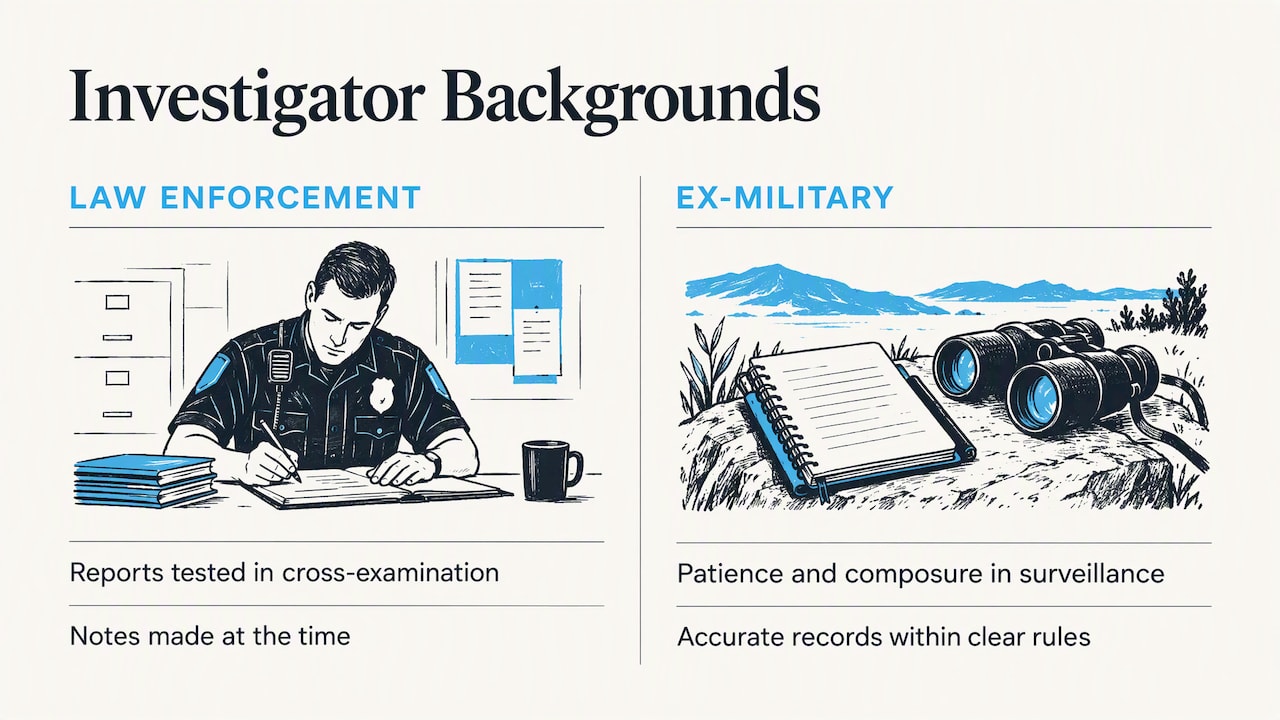
Former law enforcement. Investigators from policing and federal backgrounds are used to writing reports that will be read by a lawyer and tested in cross-examination. They know that a note made at the time carries more weight than one reconstructed later. If you want to speak with someone about a missing person or child abduction, see our page on our former FBI agent.
Ex-military. Military service builds patience, composure and fieldcraft: staying unnoticed for hours, recording accurately, and acting within clear rules. Those habits matter in surveillance, where one careless moment can end an operation. Our team includes ex-military investigators, and the person on your case is matched to what the job requires.
What to expect from advice. A consultation with an experienced investigator should give you a realistic view of what can be captured lawfully, what a court is likely to accept, and what to do now to avoid damaging your own case. It should not involve anything illegal. We work within the law, and we do not offer anything resembling mercenary or vigilante work. The value of a former agent or soldier is in method, not muscle.
Finding people anywhere in the world
Social media is often the first thread when you are trying to find someone: a former business partner who vanished with funds, a relative who cut contact, a parent who took a child abroad. Profiles, tagged photos, mutual contacts and posting patterns narrow down countries and cities. But a lead online is not a location, and evidence gathered across borders raises its own problems.
Government bodies recognize this. A UNODC submission from Angola points out that traditional tools such as letters rogatory are slow, and proposes a global 24/7 network for cooperation on electronic evidence because digital data is volatile. Private clients face the same pressure: the sooner the trail is worked, the better the chance of finding the person.
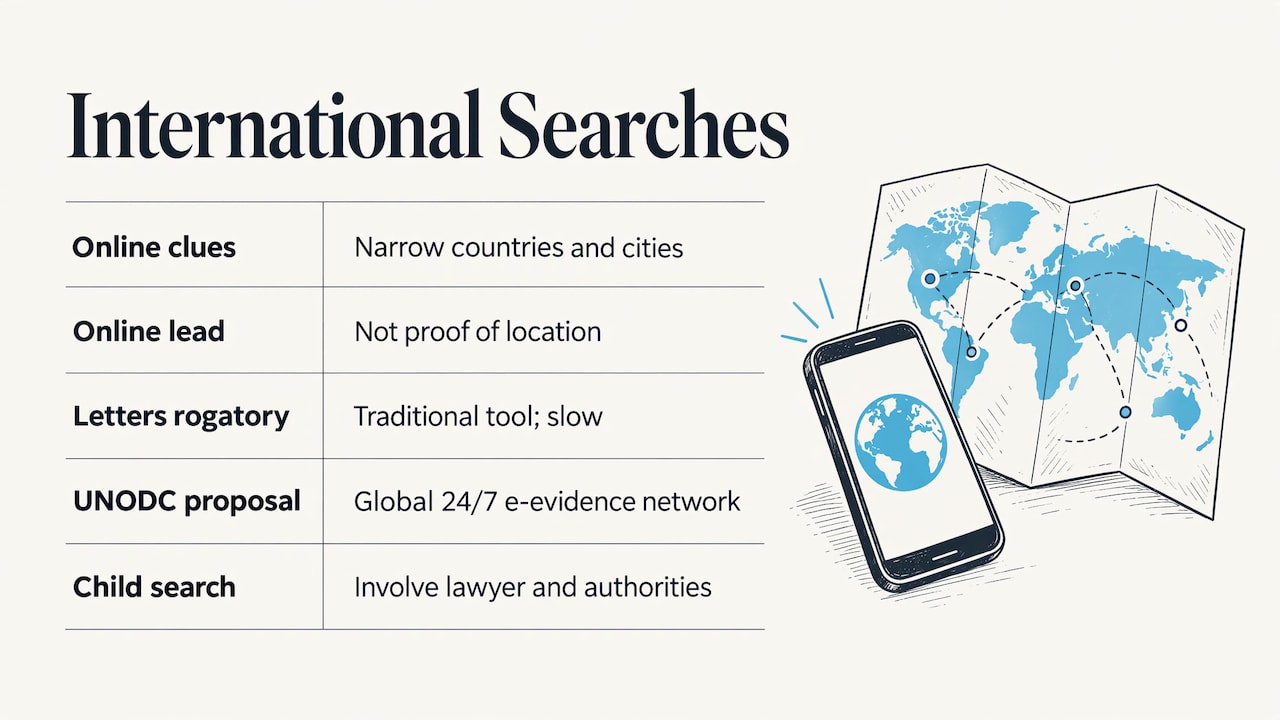
We take on missing person and child recovery matters, and we have worked internationally, including a case where we found a missing person in the UK. If a child has been taken, see our child recovery service. Anyone searching for a person abroad should also involve a lawyer and, where a child is involved, the relevant authorities, because rules on custody and removal differ by country.
Perspective
We see the same mistake every month. Someone finds a damaging post, takes a quick screenshot, and confronts the other person. The post is deleted within the hour, the account goes private, and what remains is a cropped image that nobody can authenticate.
Our approach is to treat online content as the starting point of an investigation, not the end. We capture it with context, record who did it and when, and then corroborate it in the real world. That is why we pair social media work with lawful surveillance and put the whole file in a form a lawyer can use.
Because our team includes former law enforcement, ex-military and polygraph specialists, we write each file expecting that it will be challenged. Each engagement is tailored to the client’s situation, whether that is a family matter, a corporate problem or a claim that does not add up.
P.i Melbourne
Work with our investigators
If you need social media content captured properly, confirmed by surveillance, or tied to a person who is hard to find, we can scope it with you. We handle infidelity, family law, corporate, fraud, missing person and child recovery matters, and we tailor each investigation to your situation.

See our full list of investigation services or start at pimelbourne.com.au to talk to us about your case.
FAQ
Can screenshots be used as evidence?
Yes, but they are weak alone. A screenshot must still be authenticated, usually by a witness who saw the original or by distinctive details that link it to the author. Capture the URL, handle, date and surrounding context, and keep the original file.
Is it legal to collect someone’s social media posts?
Public content that anyone can view is generally the safest to collect. Accessing a private account without permission, such as using someone’s password, can violate federal privacy law and may make the evidence inadmissible. For private content, ask your attorney about formal legal process.
Does deleting a post destroy the evidence?
Not always, but it makes things harder. Platforms may keep some records for a limited period, and a preservation request through legal channels can help. Meta, for instance, will preserve account records for 90 days once it receives a request from law enforcement. If you have a copy, preserve it now and log how you obtained it.
Do the rules differ outside the U.S.?
Yes. Prosecutor guidance from UNESCO notes that civil law systems give judges wider discretion over digital evidence, while common law systems lean on documented chain of custody. Ask a lawyer in the country where the case will be heard.
Sources
- Social Media Evidence at Trial, Maryland People’s Law Library
- Using Social Media Evidence at Trial, American Bar Association
- State Bar of Texas articles
- Can Social Media Be Used as Evidence in Court?, Catalyst Legal
- Can Social Media Posts Be Used in Court?, Kryder Law
- Social Media Evidence in Government Investigations and Criminal Litigation, University of Richmond
- Guidelines for prosecutors on digital evidence collection, UNESCO
- Deputy Attorney General Memorandum on electronic communications, U.S. Department of Justice
- Information for Law Enforcement Authorities, U.S. Department of Justice
- Angola submission on international cooperation, UNODC