
A workplace harassment investigation is a prompt, impartial fact-finding process that starts when an employer learns of a complaint. It means securing evidence, interviewing the complainant, the accused and witnesses separately, deciding what more likely happened, and acting on the result. In the US, how well an employer does this can decide whether it is held liable. This guide walks through the process step by step, covers evidence, bullying and third-party cases, and explains when an outside investigator is the safer choice.
TL;DR
- Start fast: look at interim protection within the first 24 to 48 hours, then open a documented, impartial investigation.
- Interview the complainant, the accused and witnesses separately, and give each side the chance to respond to the evidence against them.
- Preserve emails, messages, records and footage early, and stay inside privacy and surveillance law.
- Use an independent investigator when neutrality is in doubt, when senior people are involved, or when the case is complex.
- Findings lead to action and follow-up, including checks for retaliation.
Table of Contents
- What a harassment investigation is meant to achieve
- The harassment investigation process, step by step
- Harassment evidence: what to collect and keep
- Bullying, third-party harassment and other special cases
- If you are the one being accused
- When to bring in an independent investigator
- Hiring former FBI, military and police investigators for advice
- Finding people anywhere in the world
- After the findings: outcomes and follow-up
- Perspective: what we see in these cases
- How Pi Melbourne can help
- FAQ
- Sources
What a harassment investigation is meant to achieve
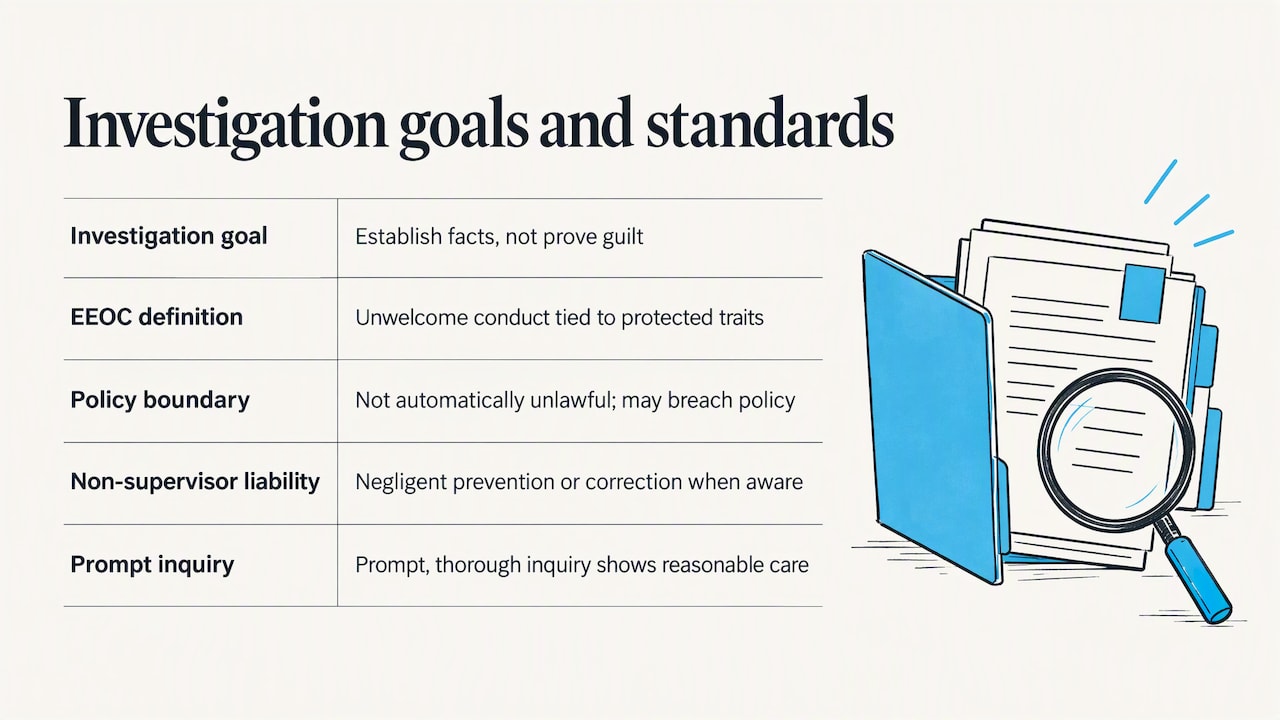
The goal is not to prove someone guilty. It is to establish facts and decide whether the conduct happened and whether it breaches policy or the law. Acas, the UK’s workplace relations body, tells investigators to get the information they reasonably can and need for the case, and to establish the facts from both sides rather than aiming to prove guilt.
In the US, the EEOC defines workplace harassment as unwelcome conduct based on protected characteristics such as race, sex, religion, national origin, age, disability or genetic information. General rudeness is not automatically unlawful, but the same behavior can still breach company policy, which is why many employers investigate bullying with the same process.
The legal stakes are real. According to a law firm summary of the EEOC’s updated guidance, an employer is liable for harassment by a non-supervisory person only if it was negligent in preventing it or in taking reasonable corrective action once it knew or should have known. A prompt, thorough investigation is the clearest way to show reasonable care. This is general information, not legal advice: your employment lawyer should confirm what applies in your state.
The harassment investigation process, step by step
There is no single correct method. The Canadian Human Rights Commission notes that the approach may vary with the allegations, the parties and the information available. Still, sound investigations share the same backbone.
1. Receive the complaint and protect people
Write down exactly what was reported, by whom, and when. Then consider interim measures. The Oregon State Government’s investigations toolkit recommends that within 24 to 48 hours an employer consider whether administrative leave or reassignment is needed to reduce risk. Choose measures that do not punish the complainant, since moving the person who complained can look like retaliation.
2. Set the scope and choose the investigator
Define the allegations in writing, the policies in question and the question the investigator must answer. Pick someone with no stake in the outcome. If the accused is a manager, a friend of the investigator, or an executive, internal neutrality is already compromised (more on that below).
3. Gather documents and preserve evidence
The investigation begins by gathering information relevant to its mandate, including workplace policies and written complaints or responses. Issue a preservation notice early so emails, chat threads and files are not deleted.
4. Interview everyone, separately
Investigators should meet separately with both parties and with anyone who witnessed events, share relevant information and let each person respond. Start with the complainant, then the accused, then witnesses, and return to earlier interviewees if new facts emerge. Take notes, ask open questions, and avoid promising total confidentiality you cannot deliver. Employment New Zealand points out that workers are entitled to a support person at interviews; in the US, check your policy, any union agreement and state law on whether a support person may attend.
5. Weigh the evidence and make credibility findings
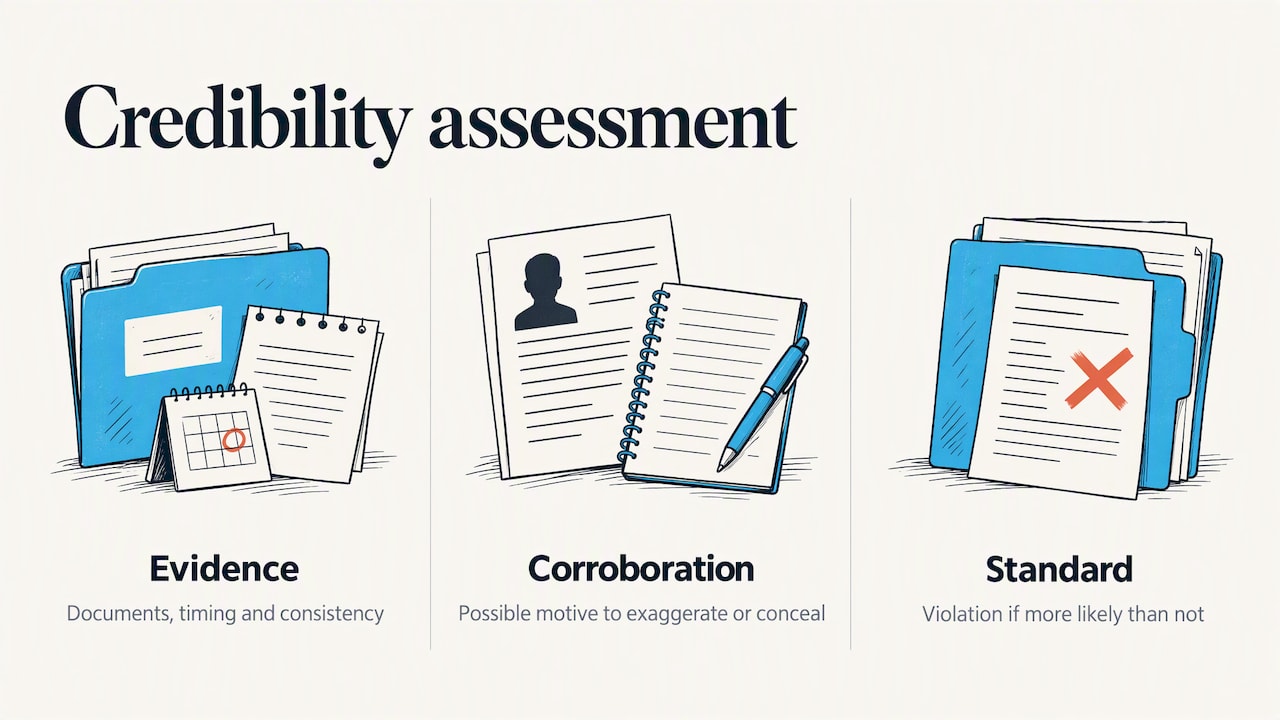
Most harassment cases have no neutral eyewitness, so credibility matters. Compare accounts against documents, timing, consistency, corroboration and any motive to exaggerate or conceal. Many institutions apply the preponderance standard, under which a violation is found if it is more likely than not that it occurred.
6. Write the report
A final report should describe the scope, allegations, facts, witnesses, documents reviewed, credibility determinations and conclusions, according to the Oregon toolkit. Some processes also share a draft for comment: Northwestern University gives parties a preliminary report to review before findings are finalized. Keep witness identities out of any version that goes to the parties, as the Canadian Human Rights Commission says final reports must not disclose them.
7. Decide, act and follow up
A separate decision-maker should read the findings and choose the response. See the section on outcomes below.
Harassment evidence: what to collect and keep
Strong evidence is usually ordinary and dull: timestamps, messages, records. Acas lists emails, paperwork, receipts, computer and phone records, CCTV, attendance records and vehicle tracker data as typical sources, with the condition that collection must follow the law and respect workers’ privacy.
For a harassment claim, that translates into:
- Written communication: emails, text messages, chat apps, social media messages and shared documents.
- The complainant’s own record: a dated diary, screenshots, notes made at the time, and anything sent to friends or family soon after the event.
- Access and schedule records: badge swipes, rosters, meeting invites and travel logs that show who was where.
- Video and audio: CCTV where it exists and was lawfully recorded. Check state recording laws before anyone secretly records a conversation, because rules on consent differ.
- Prior complaints and personnel files: earlier reports against the same person, which can show a pattern.
- Witness statements: signed or confirmed by the witness as accurate.
If you are the person reporting harassment, begin keeping your own record now: dates, times, places, exact words, who saw it, and what you did next. Store copies somewhere that is not a work device.
Where surveillance fits, and where it does not
Most harassment cases are solved with interviews and documents, not covert watching. Surveillance has a narrow place: for example, when a person alleges harassment continues outside work hours, or when conduct is being denied and a lawful, documented observation can corroborate what is alleged. It must be proportionate, lawful where it takes place, and authorized by the right people. Employer monitoring rules differ widely between jurisdictions, and our guide to workplace surveillance laws explains what employers can legally monitor. If you are weighing surveillance, get legal advice first and use a licensed professional who knows how evidence must be recorded to be useful later.
Bullying, third-party harassment and other special cases
Workplace bullying investigations
Bullying often lacks a protected characteristic, so it may not trigger federal anti-discrimination law, yet it damages morale, health and retention. Employers commonly investigate it under conduct policies using the same steps: interim protection, separate interviews, documents, findings. Safe Work Australia’s guide states that investigators must be unbiased, objective and suitably qualified. Bullying cases usually turn on patterns over time, so ask each witness for specific examples and dates rather than general impressions.
Third-party harassment
Harassment is not only a coworker problem. Customers, clients, vendors and contractors can create a hostile environment too. A law firm analysis of federal appeals court decisions says an employer is liable for third-party harassment if it unreasonably fails to take corrective action likely to stop the misconduct, and that a prompt investigation is the hallmark of that action. In practice: take the complaint as seriously as one about a coworker, document the contact, adjust assignments to protect the employee without penalizing them, and tell the third party that the behavior must stop.
When the complaint involves a supervisor or executive
These are the cases where an internal investigator is most likely to face pressure, real or perceived. They are also where outside investigators earn their fee.
If you are the one being accused
Searchers often ask how to defend against a false accusation. The honest answer is to cooperate, avoid contacting the complainant or witnesses about the case, preserve your own messages rather than deleting anything, and ask for the allegations in writing so you can respond to specifics. Give the investigator any documents and names that support your account. Do not retaliate: the EEOC says the law protects employees from retaliation for complaining, participating in an investigation or opposing harassment. A short consultation with an employment lawyer is wise before any interview.
When to bring in an independent investigator
Use an outsider when you cannot guarantee neutrality inside the company. Safe Work Australia recommends an external investigator if internal neutrality cannot be ensured or when the case is complex. The task is to determine objectively whether the allegations are substantiated or whether there is insufficient information.
Good reasons to go external:
- The accused is a senior leader, an owner, or someone close to HR.
- HR itself is implicated or has handled earlier complaints badly.
- Several complainants, locations or countries are involved.
- The matter may reach a regulator or court, and the file must stand up to scrutiny.
- Evidence needs specialist handling, such as digital records, interviews with former staff or checks on outside conduct.
What to ask a candidate: their background, how they document interviews, how they handle confidentiality, whether they hold the licenses your state requires, and what the written report will contain. Our own approach to this kind of work is set out in the basics of corporate investigations, and our guide on terms of reference for workplace misconduct shows how to scope the job so the findings are fair.
Hiring former FBI, military and police investigators for advice
Many employers and individuals want the judgment of someone who has run serious inquiries. People who worked in federal law enforcement, the police or the armed forces have typically spent years interviewing reluctant witnesses, building a file that must survive challenge, and keeping sensitive information tight. That experience is useful in a harassment matter even when you do not need anyone followed.
A short advisory engagement can help you:
- Decide whether the matter needs a full investigation or a lighter inquiry.
- Draft the allegations and the questions to put to each person.
- Review an internal report for gaps before it is relied upon.
- Judge whether there is a safety risk, such as stalking or threats, that goes beyond HR.
At Pi Melbourne, our team includes former police, military and polygraph specialists, and we have worked with former FBI personnel, including on missing persons and child kidnapping matters. If you want advice from a specific background, such as former special forces, tell us what the situation needs and we will say honestly who on our team fits and who does not. A professional should never be hired for their résumé alone: what matters is whether they can run an impartial, documented process.
Finding people anywhere in the world
Harassment cases sometimes depend on people who are no longer around: a former employee who witnessed events, a complainant who left the country, or a respondent who has moved. Locating them is a legitimate part of fair fact-finding, provided it is done lawfully and with a clear purpose. Methods include public record and social media research (see our explainer on social media investigation), address verification, contact through lawful channels, and, where needed, local partners in the other country. Privacy law varies sharply between countries, so an investigator must know what is allowed where the person lives. We have done this across borders, as in this case of a missing person found in the UK.
After the findings: outcomes and follow-up
Once findings are reached, a decision-maker should evaluate them and choose corrective action. Safe Work Australia says that if a complaint is substantiated, actions range from counseling and training to warnings, transfers or dismissal, depending on severity. Match the response to the conduct and apply it consistently, whoever the person is.
Then do three things many employers skip:
- Tell both parties the outcome in appropriate terms, without revealing witness identities.
- Check for retaliation. The Oregon toolkit suggests checking back within six months to confirm none has occurred.
- Look for patterns. The same toolkit advises reviewing complaints for patterns that show whether more training is needed.
If a case spills into protective orders or court, the way evidence was gathered becomes critical. Our guide to restraining order evidence explains what to gather and how to present it.
Perspective: what we see in these cases
Most harassment investigations go wrong at the start, not the end. The complaint is handled by someone too close to the people involved, evidence is not secured, and the accused hears about it before the facts are fixed.
Our investigations are tailored to each client’s scenario, and we are led by experienced ex-police, ex-military and polygraph specialists who know how to interview carefully and document precisely. That matters because the people involved are often still working side by side, and the report may later be read by a lawyer, a regulator or a judge.
We believe the strongest results come from independence and discretion. An outside investigator has no career to protect inside the company, so employees speak more freely and the findings carry more weight. Where lawful surveillance or locating a witness is needed, we bring those skills under the same standard: proportionate, documented and court-ready.
P.i Melbourne
How Pi Melbourne can help
If you need an independent view on a harassment or bullying complaint, we can scope the matter, advise on the process, gather evidence lawfully and report findings you can rely on. Our corporate investigations service covers workplace misconduct, staff monitoring and fraud, and our surveillance services page lists the published surveillance price of $1000 to $1450 one-off. Corporate investigations carry no published price, so contact us to discuss your matter.
To talk through a confidential situation, start at pimelbourne.com.au.
FAQ
What should I do if my boss is harassing me?
If you feel safe, tell the person the behavior must stop. Otherwise, follow your employer’s anti-harassment policy or go to a supervisor or HR. The EEOC says you may also file a charge. Keep a dated record of what happens, and speak to an employment lawyer if the harasser controls your pay or schedule.
How long should a harassment investigation take?
There is no fixed legal deadline, but it must be prompt. The EEOC guidance, as summarized by a law firm, treats an investigation as prompt if it happens reasonably soon after the employer learns of the alleged conduct. Simple matters may close in weeks. Complex cases with many witnesses take longer, so keep the parties updated.
Can an employer use a private investigator for a harassment complaint?
Yes. An independent investigator is a sound choice when internal neutrality is in doubt or the case is complex. The investigator must act impartially, respect privacy and surveillance laws, and produce a written report covering the allegations, evidence and conclusions.
Is workplace bullying investigated the same way as harassment?
The steps are largely the same: interim protection, separate interviews, evidence, findings and follow-up. The difference is the legal test. Harassment tied to a protected characteristic can create liability under federal law, while general bullying is usually handled under company policy and state or local rules.
Sources
- EEOC: What You Should Know, What to Do if You Believe You Have Been Harassed at Work
- Acas: Step 3, Carrying out an investigation
- Canadian Human Rights Commission: Human rights-based approach to workplace investigations
- Canadian Human Rights Commission: Human rights based approach to workplace investigations (PDF)
- Oregon State Government Investigations Toolkit
- Safe Work Australia: Guide for preventing and responding to workplace bullying
- Northwestern University: Formal Investigation, Discrimination and Harassment
- Employment New Zealand: If you feel bullied, harassed or discriminated against
- Jackson Lewis: EEOC Enforcement Guidance on Workplace Harassment, Liability
- Jackson Lewis: Third-Party Harassment and Discrimination