
Yes, video can be used in court. A judge will generally admit a recording if it is relevant to the issues in the case and someone can show it is authentic, meaning it is what you say it is. Footage that fails either test, or that has an unclear origin, tends to be excluded or given little weight. This guide explains the tests, how to authenticate and preserve footage, how to get it in front of a judge, and where a professional investigator fits in.
TL;DR
- Video is admissible when it is relevant and authenticated. Authentication needs a witness or other evidence that the footage fairly and accurately shows what happened.
- Admissible does not mean persuasive. The judge or jury still decides how much weight the video deserves.
- Keep the original file untouched, record who handled it and when, and fingerprint it with a hash value.
- Rules differ between federal courts, states and countries. Confirm local requirements with a lawyer before filing.
- Surveillance footage gathered by a licensed professional is built for court from the first minute, which protects its value.
Table of Contents
- When is video admissible in court?
- How video is authenticated
- Preserving video so nobody can say it was altered
- How to bring video evidence into court
- Do the rules differ by jurisdiction?
- Surveillance footage: where professionals fit in
- Hiring former FBI, military and special forces experience for advice
- Finding people anywhere in the world
- Perspective
- Plan your surveillance with us
- FAQ
- Sources
When is video admissible in court?
Two questions come first: is the video relevant, and is it authentic? New York’s court rules put it plainly. A recording of a scene, person or occurrence is admissible at the trial judge’s discretion if it is relevant to an issue in the proceeding and properly authenticated.
Federal courts add more layers. The Scientific Working Group on Digital Evidence (SWGDE) explains that multimedia evidence in U.S. federal courts must satisfy the Federal Rules of Evidence on:
- Relevance (Rules 401 and 402).
- Authentication (Rules 901 and 902).
- Hearsay (Rules 801, 803, 804 and 807), which matters mostly for any speech or statements on the recording.
- Original or accurate copy (Rules 1002 and 1003).
- Unfair prejudice (Rule 403): the probative value cannot be substantially outweighed by the danger of unfair prejudice.
That last rule is why a gruesome or misleading clip can be kept out even when it is real. It is also why a short, focused clip often beats three hours of raw footage.
Admissible is not the same as convincing
A video can be admitted and still carry little weight. The fact-finder, whether judge or jury, decides how much to trust it. Gaps in the timeline, missing context or doubts about who recorded it all reduce weight. A Canadian video evidence expert, Elliott Goldstein, quoted by the Canadian Bar Association, makes the same point: no matter how good the video is, it fails if it is not relevant, and the party offering it must be able to explain how it was recorded and whether all relevant footage has been obtained.
How video is authenticated
Under Federal Rule 901(a), the person offering the video must produce evidence sufficient to support a finding that it is what they claim it is. The bar is not perfection. It is enough evidence for a reasonable person to accept the claim.
Three common routes
New York courts recognize three methods of authenticating a video, and other states follow similar patterns:
- A witness to the events, or the person who installed, operated or maintained the camera, testifies that the video accurately shows the subject matter.
- Expert or other testimony that the video truly and accurately represents what was in front of the lens.
- A witness plus other evidence that together show accuracy.
The silent witness theory
Sometimes nobody saw the event, as with an unattended security camera. The U.S. Bureau of Justice Assistance primer for prosecutors explains that authentication can happen when an eyewitness says the video is a fair and accurate representation, or, when no eyewitness exists, through the “silent witness theory”. Under that theory, the reliability of the recording process itself vouches for the footage: how the system works, how it was maintained, how the footage was retrieved and who had it afterward.
Circumstantial authentication
You do not always need the person who pressed record. In 2024 the Supreme Court of Maryland held in Mooney v. State that a trial court may admit a video if there is sufficient evidence for a reasonable juror to find, by a preponderance of the evidence, that the video is what it is claimed to be, and that circumstantial evidence can do the job. An American Bar Association article on the case notes that the rule allows authentication through contents, substance, internal patterns, location or other distinctive characteristics. Visible landmarks, timestamps, a distinctive vehicle or voices that can be identified all help.
Preserving video so nobody can say it was altered
Most video evidence is not lost on the law. It is lost on handling. A clip forwarded through a messaging app, re-saved, trimmed or renamed invites the question: what else changed?
The WITNESS archiving guide gives a practical checklist. Retain the original camera files unaltered and not transcoded, do not rename them, keep their original order, and document when the video was acquired, who had custody or access and when, and what was done to it and by whom. It also notes that hash values can show whether files have been tampered with.
The same guide says any defensible procedure should be able to answer six questions:
- Who captured the footage, and when?
- Who had access between capture and court?
- Has the original been altered?
- Who enhanced it, and when and why?
- What was done to enhance it, and can it be repeated?
- Has the enhanced version changed since?
SWGDE’s best practices add that integrity is best demonstrated through a combination of methods, including hashing, visual verification, digital signatures, written documentation and checksums, and requires both documentation and security of the files throughout the workflow.
Chain of custody carries weight in court. In New York, evidence of an unbroken chain can support inferences of accuracy and freedom from tampering. We cover the full process in our guide to chain of custody and admissible evidence.
A simple preservation routine
- Stop. Do not edit, filter, crop or compress the original.
- Copy the original file to a second device and note the date, time and who made the copy.
- Generate a hash value for the original and the copy, and write both down.
- Keep a short log: where and when the video was recorded, who recorded it, what device was used, and every person who has since held the file.
- If the video came from a cloud account, download it. SWGDE recommends that cloud-shared multimedia be downloaded and submitted on physical media such as write-once optical discs, a USB drive or a portable hard drive.
- Preserve the context too: the camera’s settings, the system clock accuracy, and any surrounding footage. Courts ask whether all the relevant video has been obtained.
How to bring video evidence into court
The mechanics matter as much as the footage. The BJA primer recommends creating a disc before trial so it can be marked and admitted as an exhibit, authenticated by witnesses, and then copied onto the courtroom computer for playback. It also advises that anyone who will testify meet with the attorney beforehand to review how the video was retrieved, the chain of custody and any technical issues.
The primer suggests being ready to call, where needed, a witness who can speak to the device’s operation, the person who recovered the video, and anyone who knows its custody history. SWGDE warns that a lack of technical understanding can lead to unintended suppression or misuse of evidence, which is why attorneys and technical practitioners should talk before the hearing.
Practical points for the day
- Bring copies in a format the courtroom can play, and test them on a standard computer.
- Cut a short excerpt of the relevant moments, while keeping the full original available. In some family cases, only the relevant portions need to be played.
- Prepare a one-page index of timestamps so your lawyer can point the court to the moments that matter.
- Make sure the witness who authenticates the video can explain how it was recorded in plain words.
Do the rules differ by jurisdiction?
Yes. SWGDE notes that its references are to the Federal Rules of Evidence, which may differ from state rules, and it recommends consulting legal personnel familiar with the rules of the particular jurisdiction. Courts outside the United States apply their own regimes. Canada, for example, requires authentication under its Evidence Act and common law, and the Canadian Bar Association says authentication is required for admissibility.
One area deserves extra care: how the recording was made. Rules on filming people, and especially on recording sound, vary by state and country, and a recording captured unlawfully can create problems for the person who made it. Before you set up a camera or ask someone to film, speak to a licensed attorney in the place where the recording will happen. The same applies to monitoring staff, where workplace surveillance laws set what an employer can legally watch.
Surveillance footage: where professionals fit in
Surveillance video is different from a phone clip that happened to catch something. It is planned. The investigator knows from day one that the footage may be tested by opposing counsel, so the work is organized around the questions a court will ask: who filmed it, with what equipment, where, when, and what happened to the file afterward.
Good professional surveillance typically includes:
- Clear, continuous footage with accurate timestamps, rather than a single dramatic clip.
- A written log that matches the video, noting times, places and observations.
- Original files stored securely with documented handling.
- A witness, the investigator, who can testify to what they saw and how they recorded it.
- Respect for privacy limits, so the evidence is not undermined by how it was gathered.
This matters in infidelity and family law matters, cohabitation cases, insurance and WorkCover claims, employee misconduct and fraud. Our overview of surveillance services done the right way explains how we approach it.
Other material can support video. Messages and posts have their own preservation rules, which we cover in our guide to social media evidence. Photos, logs and recordings together are often what restraining order evidence is built from.
Hiring former FBI, military and special forces experience for advice
People often ask whether it helps to speak to someone with a federal law enforcement or elite military background before they act. For evidence questions, it can. Experienced investigators have seen what survives cross-examination and what collapses, and they know the difference between footage that proves a point and footage that merely looks dramatic.
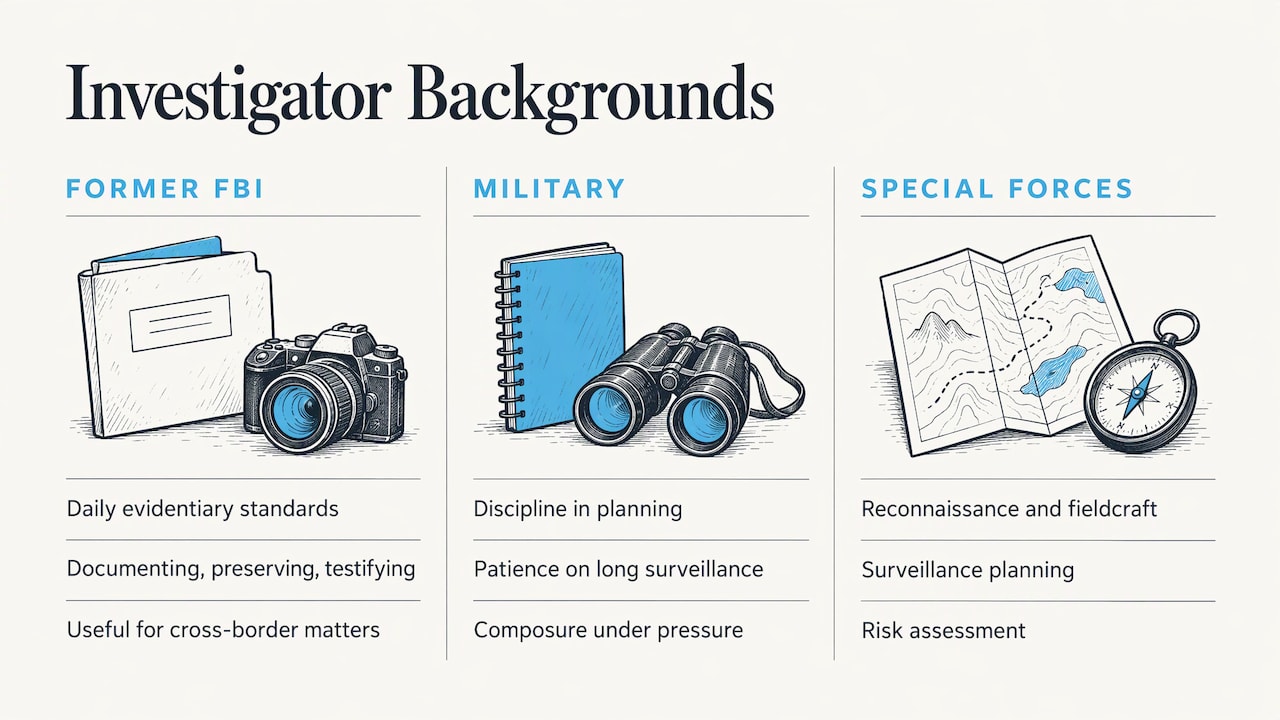
Former FBI staff. A former federal agent has worked to evidentiary standards daily: documenting, preserving and testifying. That experience is useful when you need a frank view on whether your material is likely to hold up, or when a matter crosses borders, such as a missing person or child abduction case. Read more about our former FBI agent expertise on missing persons and child kidnapping.
Former military personnel. Ex-military investigators bring discipline in planning, patience on long surveillance jobs and composure under pressure. Those traits show in the logs and footage they produce. If you want to hire ex-military help, say what outcome you need, whether that is evidence for court, locating a person or a safety assessment, so the right person is matched to the job.
Former special forces, including SAS. Readers sometimes ask specifically for advice from former SAS soldiers. Their strengths, such as reconnaissance, fieldcraft and risk assessment, translate well to surveillance planning. Tell us the background you are looking for, and we will explain honestly who on our team can advise on your situation. Whoever advises you, the standard is the same: lawful methods and evidence a court can use. We do not offer or support unlawful or violent action of any kind.
At Pi Melbourne, our private detectives include former FBI and military agents, ex-police and polygraph experts. That mix lets us advise on both the investigation and what a court will want to see.
Finding people anywhere in the world
Video evidence often depends on locating a person: a witness who recorded something, a debtor who has moved, a parent who has taken a child abroad. Locating people across countries involves different record systems, languages and legal limits, and an investigator’s international experience shortens the search considerably.
Our team handles missing person and child recovery matters, and we have written about a case where we found a missing person in the UK. Our child recovery service is built for urgent family situations. For financial matters, an asset search can trace what someone owns and where. Whatever is found should be documented the same way as video: sourced, dated and preserved so it can be used later.
Perspective
Over nearly two decades, we have seen strong cases weakened by weak handling. A client records something real, forwards it three times, trims it on a phone and then cannot explain where the original went. The footage was true, but the court was never given a reason to believe it.
That is why we start with the end in mind. Our investigators are former police, military and FBI-trained professionals, and polygraph specialists, and they plan every job around the questions opposing counsel will ask. We use advanced technology to produce court-ready photos and video, keep originals secure and log every step.
Our view is simple: evidence is only as good as the person who can stand behind it. A trained investigator who watched events unfold and recorded them properly is a witness a court can rely on. That is the value of hiring a professional before you need to prove something, not after.
P.i Melbourne
Plan your surveillance with us
If you need footage that will stand up in a legal matter, we tailor each investigation to your situation, whether it is a suspected cheating partner, a family law dispute, staff misconduct or fraud. Our published price for surveillance is $1,000 to $1,450, one-off, and you can see what affects it on our surveillance cost page. For other services, browse our private investigation services or contact us through Pi Melbourne.

We serve clients worldwide, and we will tell you plainly what a court is likely to need before any work begins.
FAQ
Is video admissible in court?
Usually, yes, if it is relevant and authenticated. Authentication means evidence that the video is what you claim it is, often through a witness who saw the events or who recorded or retrieved the footage. The judge may still exclude it if its value is substantially outweighed by unfair prejudice.
Can a video from my phone be used in court?
Yes, phone video can be admitted when you can explain who recorded it, when and where, and show the file has not been changed. Keep the original on the phone, back it up without editing, and note who has handled it. Your attorney will advise on the rules in your state.
Do I need the whole video played in court?
Not necessarily. Courts focus on the relevant portions, and you can usually present a short excerpt while keeping the full original available. Ask your attorney whether a transcript or timestamp index is needed in your court.
Can screenshots or messages be used as evidence?
Yes, they can be, but they face the same authentication questions: who made them, when, and whether they are complete and unaltered. Capture the full conversation with dates visible and keep the original device. Our guide to social media evidence explains how to preserve it.
Who can authenticate surveillance footage?
The investigator who filmed it is the most natural witness, because they can describe what they saw, the equipment used and how the files were stored. For unattended cameras, the person who installed or maintains the system or retrieved the footage can fill that role.
Sources
- New York State Courts, 9.14 Video Recording
- Bureau of Justice Assistance, Video Evidence primer for prosecutors
- SWGDE, Practical Considerations for Submission and Presentation of Multimedia Evidence in Court
- SWGDE, Best Practices for Maintaining the Integrity of Digital Images and Digital Video
- Supreme Court of Maryland, Mooney v. State
- American Bar Association, Circumstantial Authentication of Video Evidence
- WITNESS, Archive Guide: Video as Evidence
- Canadian Bar Association, Video Evidence