An insurance fraud investigation is a structured effort to test whether a claim, a policy application or a payment is genuine. It collects documents, statements, data and sometimes surveillance, then weighs all of it against what the claimant says happened. In the US, insurers’ own special investigations units handle most of this work. Law enforcement and state fraud bureaus take over when a case looks criminal. Private investigators fill the gaps for insurers, employers, attorneys and individuals who need facts that hold up.
This guide explains how investigators actually work, which signs matter and which don’t, how to report a suspicion, and where outside help makes sense.
TL;DR
- Fraud comes in two forms: hard fraud (staged or deliberately caused losses) and soft fraud (padding a real claim or lying on an application). Soft fraud is more common.
- No single red flag proves anything. Investigators look for patterns: inconsistent statements, repeated claims in a short window, and paperwork that doesn’t match the story.
- Report suspicions to your insurer, your state fraud bureau or the National Insurance Crime Bureau (NICB), which accepts anonymous tips.
- Good investigations are fair. They weigh facts that favor the claimant and respect privacy law.
- If you are a business owner, attorney or family member who needs documented, court-ready evidence, a specialist private investigator can gather it lawfully.
Table of Contents
- Why insurance fraud investigation matters
- Hard fraud and soft fraud
- Signs of insurance fraud: the red flags that matter
- How insurance fraud is investigated
- How to report suspected insurance fraud in the US
- Who does what: insurers, agencies and private investigators
- Perspective: what we see in fraud-related work
- When it makes sense to hire a private investigator
- How Pi Melbourne can help
- What to do if you suspect fraud right now
- FAQ
- Sources
Why insurance fraud investigation matters
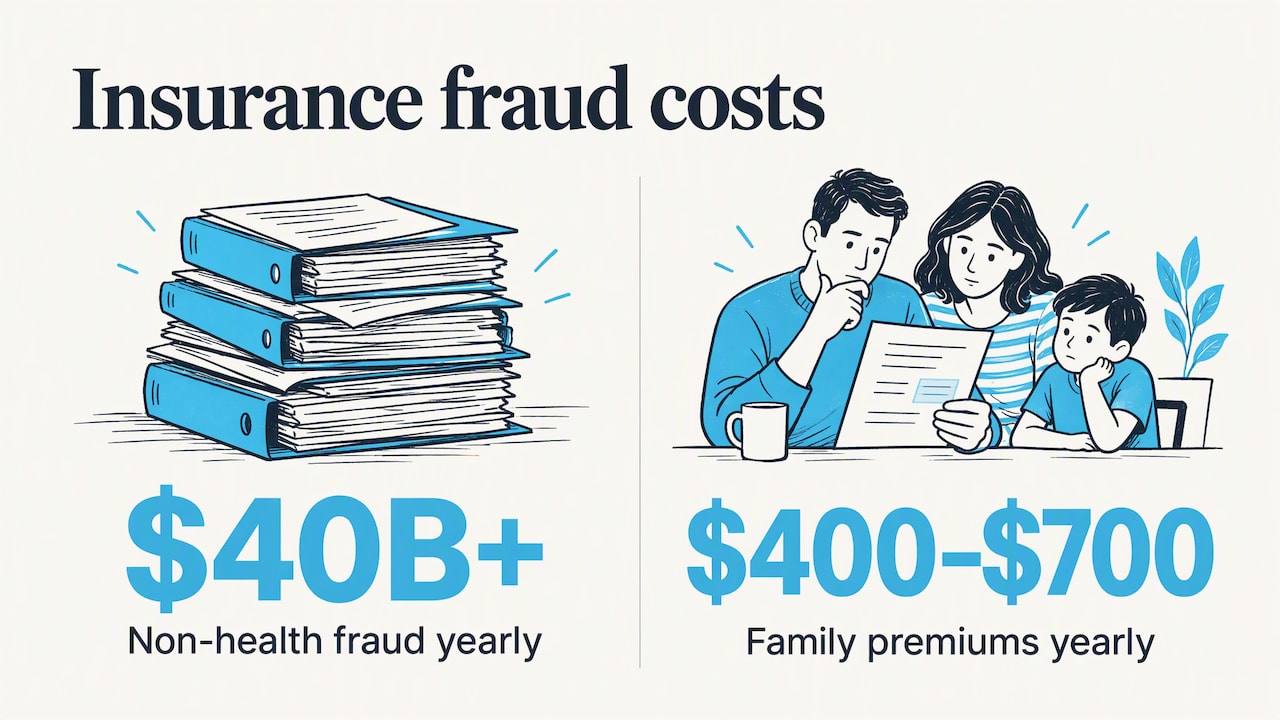
The scale is large. The FBI estimates that non-health insurance fraud costs more than $40 billion a year, which adds roughly $400 to $700 to the premiums an average American family pays annually. Those costs land on honest policyholders, not on insurers alone.
That is why a suspicious claim isn’t only a private dispute between one person and one company. When fraud is paid out, everyone else covers it.
The flip side matters just as much. Most claims are honest, and an investigation that treats every claimant as a suspect harms real people at the worst moment of their lives. The best investigators keep both facts in mind.
Hard fraud and soft fraud
The NAIC separates insurance fraud into two categories. Knowing which one you face changes how an investigation is run.
| Type | What it looks like | Typical examples |
|---|---|---|
| Hard fraud | A loss is invented, staged or deliberately caused to collect money | Arson, staged auto accidents, faked theft, a fabricated death |
| Soft fraud | A real loss or policy is exaggerated or misrepresented | Padding a repair bill, adding items that were never lost, lying about mileage or health on an application |
Soft fraud is usually a crime of opportunity, which is why it is more common. Hard fraud is rarer but more organized, and it is where investigators see rings: crooked repair shops, “medical mills” and recruiters who stage collisions.
A third category worth knowing is fraud by professionals in the claims chain. Agents who pocket premiums without passing them to the underwriter are one example the FBI describes in its insurance fraud guidance. Contractors who exploit disaster victims are another.
Signs of insurance fraud: the red flags that matter
Red flags are reasons to look closer, not verdicts. A regulator’s guidance on fraud risk, such as the Monetary Authority of Singapore’s insurance fraud guidelines, lists indicators that apply well beyond one country. Combined with US consumer-protection material, they sort into a few groups.
Red flags in the claimant’s story
- Inconsistent statements. Dates, locations or sequence of events change between the first report, the recorded statement and the police report.
- Unusually fast settlement appetite. A claimant who will accept an inexplicably low payout just to close the matter quickly can be hiding something.
- Too many claims in a short period. Several claims in a few months, especially across different insurers, deserve a second look.
- Recent coverage trouble. A policyholder who was declined by other insurers, or who bought or raised coverage shortly before the loss, is a classic prompt for questions.
Red flags in the paperwork
- Receipts, invoices or medical bills that don’t match the damage described.
- Documents that look altered, or that come in with identical formatting from supposedly unrelated vendors.
- Missing or late police reports for losses that normally generate one, such as theft.
- Repair or treatment costs far above local norms.
Red flags in the intermediaries
After storms and floods, the fraud often comes from outsiders rather than the policyholder. The NICB has warned about high-pressure door-to-door sales, upfront payment demands and blank spaces in contracts after severe weather.
Assignment of Benefits (AOB) forms are a related trap. A policyholder who signs one can unknowingly hand a vendor the right to file claims, inflate costs and collect directly from the insurer. The NICB has flagged AOB abuse as a driver of fraud in auto glass claims. Massachusetts also publishes a consumer guide to identifying fraud sources, including fake insurance companies.
Why a single flag proves nothing
People contradict themselves after a car crash because they are shaken. Low settlements get accepted by exhausted people. Several claims in a row can reflect a bad year, not a scheme. An investigator’s job is to see whether the flags cluster and whether the documents back the story. That is the difference between suspicion and evidence.
How insurance fraud is investigated
Step 1: Triage
Most claims go through automated screening. Modern detection combines supervised models, which learn from known fraud patterns, with unsupervised models, which pick out anomalies. Research on both approaches shows each has strengths. A review in the data science literature concludes these tools work best alongside human judgment rather than in place of it. The score only tells a person where to look.
Step 2: Referral to a special investigations unit
Suspicious files go to a special investigations unit (SIU). These teams are often staffed by people with law enforcement or forensic accounting backgrounds, and they work under procedures that stress evidence preservation, thorough documentation and compliance with privacy law, as the Florida Department of Financial Services anti-fraud best practices describe.
Large insurers also work with outside partners. GEICO describes its SIU as working alongside the NICB and public law enforcement to disrupt schemes such as staged accidents and medical mills.
Step 3: Evidence gathering
A typical file collects:
- Police reports, fire reports and photographs of the scene.
- Recorded statements and interviews with witnesses.
- Medical records and repair estimates compared with what was actually done.
- Public records, claims history and financial indicators.
- Where lawful and proportionate, surveillance and photo or video documentation.
The common thread is documentation. Every item needs a source, a date and a clear chain of custody. Evidence that cannot be explained to a judge or an adjuster is worth little.
Step 4: Analysis and decision
The investigator compares the claim to the evidence. Three outcomes are possible: the claim is valid and is paid, it is partly valid and is adjusted, or it is denied and may be referred for prosecution. Fraud bureaus and prosecutors take it from there.
Fair play is part of the standard
Professional guidelines say insurance investigations aren’t meant to be adversarial. The Finnish insurance industry’s good practice guidelines say investigators must consider circumstances that favor the claimant. They must also avoid delaying claim processing or using methods so intrusive that they violate privacy. Those rules come from Finland, but the principle of proportionality is sound anywhere. If you ever hire an investigator, ask how they apply it.
How to report suspected insurance fraud in the US
You have three routes, and you can use more than one.
- Your insurer. Insurers encourage consumers to report suspicious activity directly to the company’s fraud unit or to the relevant state fraud bureau, as GEICO’s SIU page explains.
- Your state fraud bureau. The FBI notes that most states sponsor a fraud bureau, and you may even be eligible for a reward in some cases. Maryland, for instance, lets you report to its Insurance Fraud Division without giving your name.
- The NICB. The NICB is a non-profit that works with more than 1,400 insurers and law enforcement agencies. Tips can be reported anonymously through the hotline at 1-800-835-6422.
Write down what you saw, with dates, names and amounts, before you call. Report facts, not conclusions. “The contractor asked me to sign a blank form” is more useful than “he is a fraudster.”
Who does what: insurers, agencies and private investigators
| Who | Role | Best for |
|---|---|---|
| Insurer SIU | Investigates claims against its own policies | Claims the insurer is paying |
| State fraud bureau | Receives reports, investigates, refers to prosecutors | Tips about local schemes |
| NICB | Data analytics and intelligence shared across insurers | Organized rings, vehicle and disaster fraud |
| FBI | Federal jurisdiction over large financial crimes, including non-health insurance fraud | Interstate or large-scale schemes |
| Private investigator | Works for a client: insurer, employer, attorney, family or individual | Targeted fact-finding and evidence for a specific dispute |
A private investigator doesn’t replace the public system. A PI can’t arrest anyone or compel testimony. What a PI can do is focus on one question, gather lawful evidence and document it carefully for whoever needs it.
Perspective: what we see in fraud-related work
We are Pi Melbourne, a private investigation firm established in 2006. Our investigators include former police, ex-military and polygraph specialists. The insurance cases that end well share the same traits, whatever the country.
First, they start with a precise question. “Is this claimant honest?” is too vague. “Did the activity described in this injury claim actually happen on these dates?” can be answered, documented and tested.
Second, the evidence has to survive scrutiny. A clear photo or video with a date, a location and an unbroken record of how it was captured is far stronger than a pile of hearsay. We design every job so that the material could be shown to a lawyer, an adjuster or a court.
Third, fraud rarely lives in only one place. Insurance deception often overlaps with other problems we investigate: employees padding claims, corporate misconduct, hidden assets in a family law dispute. Looking at the whole picture often shows more than the claim file does.
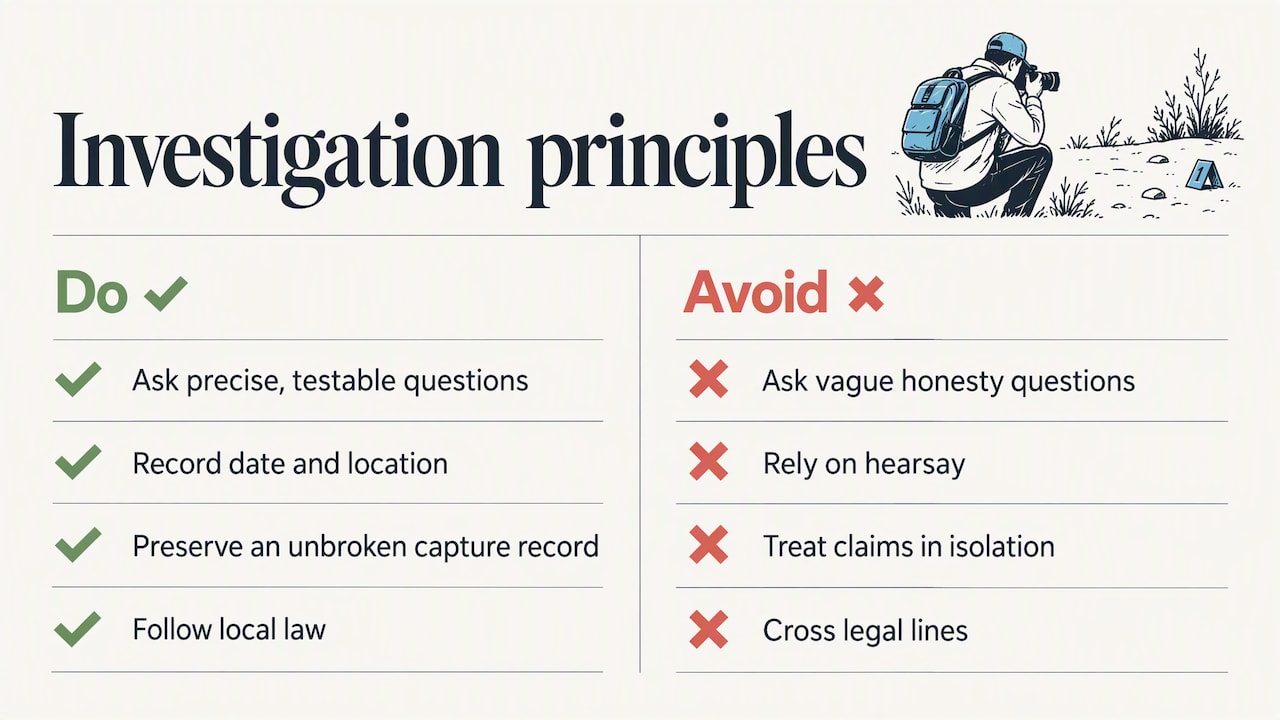
Fourth, restraint is a feature. Surveillance that crosses legal lines doesn’t just risk the investigator. It can contaminate an otherwise sound case. Local law decides what is allowed, so we scope each engagement to the rules of the place where the work happens.
Our approach is to tailor each investigation to the client’s circumstances rather than run a template. A small business owner worried about staff claims needs something different from a family worried about an elderly relative who is being targeted by a scammer.
— Global
When it makes sense to hire a private investigator
You are not required to hire one, and many suspicions are resolved by simply reporting to the insurer. A private investigator earns their fee in situations like these:
- You are a business owner and suspect an employee is misusing workers’ compensation, disability leave or company insurance benefits.
- You are in a legal dispute and your attorney needs documented facts, for example to challenge an exaggerated injury claim.
- You are a family member concerned that a relative is being exploited through a fake policy, a pressure-selling contractor or a related scam.
- A fraud is mixed with something else, such as hidden assets in a divorce or a partner who is lying about finances.
Before hiring anyone, check these points:
- Licensing. Most US states license private investigators, so ask for the license number and verify it with the state.
- Written scope. The engagement should state the question being answered, the methods and the deliverables.
- Legal limits. A trustworthy investigator will tell you what they will not do, such as obtaining private records by pretext or trespassing.
- Evidence handling. Ask how photos, video and notes are recorded and stored.
- Honest expectations. Anyone who promises a particular result before starting is selling, not investigating.
How Pi Melbourne can help
We handle surveillance, fraud detection, corporate misconduct investigations, asset investigations and evidence gathering for legal proceedings. We deliver court-ready photos and video using advanced technology, and our team includes experienced ex-law enforcement, ex-military and polygraph specialists. If you have a situation involving suspected fraud and need facts you can rely on, you can contact Pi Melbourne to discuss your case. Conversations are discreet.
What to do if you suspect fraud right now
If you think a claim, a contractor or an agent is not genuine, a calm sequence works best:
- Stop signing. Don’t sign an AOB, a contract with blank fields or a release until you’ve read it and, if needed, had an attorney review it.
- Preserve everything. Keep emails, texts, estimates, photos and receipts. Don’t delete anything, even if it seems embarrassing.
- Write a timeline. Dates, names, what was said and promised.
- Report it. Use your insurer, your state fraud bureau or the NICB.
- Don’t confront. Accusing someone directly can lead to destroyed evidence or retaliation. Let the investigation proceed.
- Get qualified advice from an attorney if money or legal exposure is large, and from a licensed investigator if you need independent evidence.
FAQ
What are the most common signs of insurance fraud?
Inconsistent statements, several claims filed in a short time, recent coverage changes before a loss, and a claimant who accepts a very low settlement quickly are the usual prompts. Documents that don’t match the damage described are another. None of these proves fraud alone, and investigators look for several together.
How do insurance companies detect fraud?
They screen claims with data models that spot known fraud patterns and unusual outliers, then pass flagged files to a special investigations unit. Human investigators review documents, interview people and compare the story to the evidence. Automated scores are a starting point, not a conclusion.
How can I report suspected insurance fraud?
Contact your insurer’s fraud unit, your state’s insurance fraud bureau or the NICB hotline at 1-800-835-6422. The NICB and some state bureaus accept anonymous tips. Include dates, names and amounts, and stick to what you observed.
What is the difference between hard and soft insurance fraud?
Hard fraud is a deliberately staged or caused loss, such as arson or a fake accident. Soft fraud is exaggerating a genuine claim or misstating facts on an application. Soft fraud is more common, but both raise costs for honest policyholders.
Can a private investigator look into an insurance fraud suspicion?
Yes, within the law. A licensed investigator can gather lawful evidence such as documented surveillance and public records for an insurer, employer, attorney or individual. They cannot make arrests, so confirmed fraud still has to be reported to the insurer, a fraud bureau or law enforcement.
Sources
- FBI: Insurance Fraud
- NAIC: Insurance Fraud
- Monetary Authority of Singapore: Insurance fraud risk guidelines, January 2024
- Insurance Business: NICB warns about fraud schemes in severe weather-prone states
- PR Newswire: Arizona Leads the Nation in Auto Glass Claims
- Mass.gov: Identifying and Reporting Insurance Fraud
- Journal of Risk and Insurance: Detecting insurance fraud using supervised and unsupervised machine learning
- Springer: Data Science for Insurance Fraud Detection, a review
- Florida CFO: Anti-fraud best practices 2024
- GEICO: Special Investigations Unit
- Finnish Financial Services: Good practice guidelines for insurance investigation
- Maryland Insurance Administration: Consumer guide to insurance fraud