
An asset recovery investigation is the work of finding out where money or property went, proving who really controls it, and building evidence strong enough for a court to freeze it and return it to its rightful owner. A private investigator handles the first two parts: tracing and proving. Lawyers, courts and, in criminal cases, public authorities handle the rest. Knowing where one stops and the other starts is the difference between a recovery that works and an expensive file of loose ends.
This guide walks through the stages, the evidence that matters, where private investigators fit, and what to expect on timing.
TL;DR
- Recovery runs in four stages: tracing, freezing, confiscation, and disposal or return. An investigator mainly works on the first and feeds evidence into the others.
- The hard part is usually proving who owns an asset hidden behind a trust or shell company, not finding the asset itself.
- Speed matters. Funds move fast, and courts act on evidence, not suspicion.
- Expect a long road. The World Bank’s StAR program says cases can take up to six years from investigation to return.
- Hire an investigator before you file or alongside your lawyer, so evidence is gathered in a form a court will accept.
Table of Contents
- What an asset recovery investigation actually covers
- The four stages of the asset recovery process
- Why proving ownership is the real challenge
- Build an evidence matrix early
- Where private investigators fit, and where they don’t
- Cross-border cases and formal cooperation
- Crypto and online fraud
- How long does it take?
- A practical sequence for your case
- Our perspective
- Related situations we investigate
- Start with an asset search that holds up
- FAQ
- Sources
What an asset recovery investigation actually covers
People use the phrase for several different situations, and the right approach depends on which one you are in.
- Fraud and theft victims. Money was taken through a scam, embezzlement or a dishonest partner, and you want to know where it went.
- Judgment creditors. A court has ruled that someone owes you money, but they say they have nothing. The investigation looks for property, accounts, vehicles, business interests and income they have not disclosed.
- Divorce and family disputes. One spouse suspects the other of moving or undervaluing assets during a separation.
- Business disputes. A former director, employee or supplier diverted funds or property, and the company needs to trace and secure them.
- Crypto and online fraud. Funds left through wallets and exchanges, often across several countries.
Governments use the same term for confiscating the proceeds of crime. The FATF defines asset recovery broadly, well beyond corruption cases. Private clients borrow the same logic, with civil courts instead of prosecutors.
The four stages of the asset recovery process
Eurojust, the European Union’s criminal justice cooperation agency, describes four central stages: tracing, freezing, confiscation, and disposal. The vocabulary comes from criminal cases, but the sequence fits civil recovery as well.
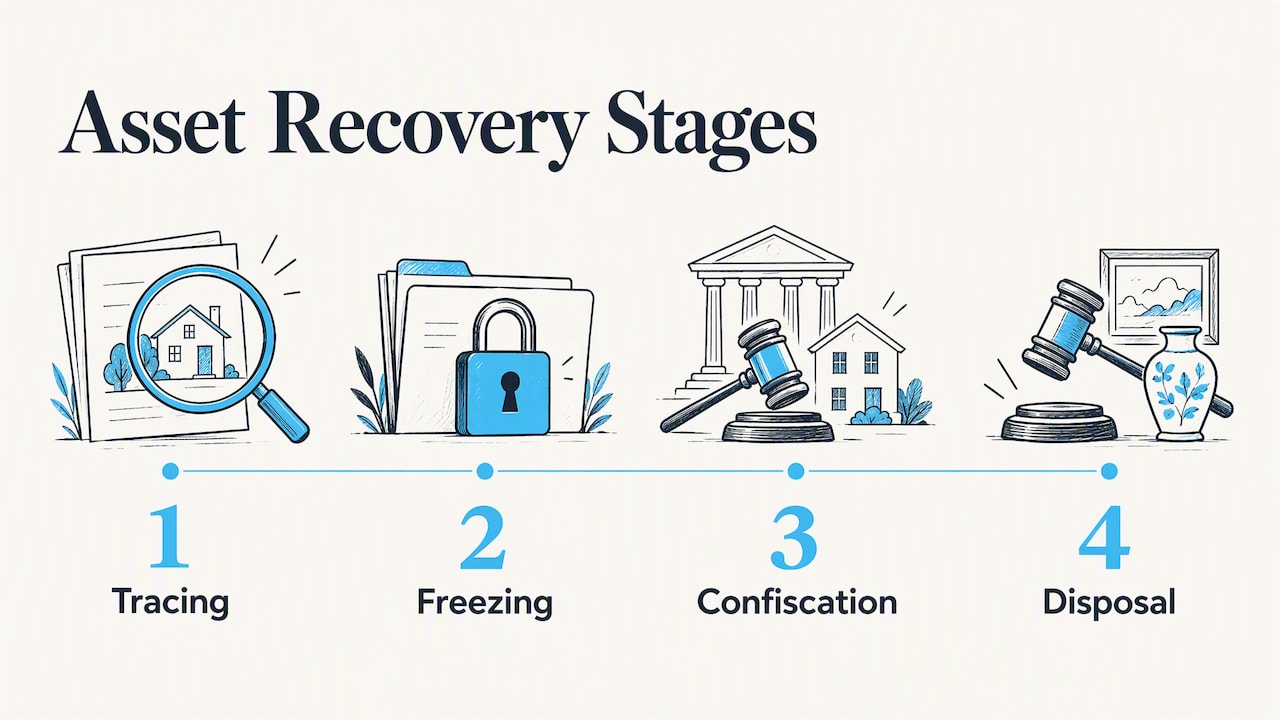
1. Tracing
Tracing means identifying what exists, where it is and who stands behind it. This is the investigative core. It combines public records, corporate registries, property and vehicle records, court filings, open-source research and, where lawful, field inquiries.
2. Freezing
Freezing preserves the asset through a temporary legal restraint so it cannot be sold, moved or spent while the case proceeds. Only a court or competent authority can order it. Your investigator’s report is what persuades them that a freeze is justified.
3. Confiscation or judgment enforcement
In a criminal matter the court permanently deprives the offender of the assets. In a civil matter the equivalent is a judgment followed by enforcement against identified property. Either way, the assets you can name and document are the assets you can reach.
4. Disposal and return
The assets are sold or transferred and the proceeds go to the victim or, in public cases, the state. Costs and competing claims are settled here, which is why stage one needs to be precise.
Why proving ownership is the real challenge
Finding an account or a property is rarely the bottleneck. Proving that it belongs to the person who owes you is. According to analysis from World Bank StAR on beneficial ownership, those hiding assets often put them in trusts or shell companies fronted by a third party, so success depends on piercing that layer to the person who benefits.
In practice that looks like this:
- A house is held by a company whose only director is a relative.
- A vehicle is leased through a business the debtor quietly controls.
- Funds pass through three accounts in different names within days.
- Income is paid to a spouse or associate rather than to the debtor.
Each link needs evidence: who signed, who paid, who benefits, who actually uses the asset. Courts rarely accept a guess that “it’s really his.” They accept a documented chain.
Build an evidence matrix early
StAR’s guidance on financial investigations stresses an investigative plan, subject profiles, charts of financial flows and an evidence matrix. An evidence matrix is simply a table that lines up each element you must prove against the documents and witnesses that prove it.
A simple version for a civil fraud case:
| Element to prove | Evidence | Status |
|---|---|---|
| Funds left your account | Bank statements, transfer receipts | Have |
| Recipient is controlled by the defendant | Registry filings, signatory records, emails | Partial |
| Funds were used to buy a specific asset | Purchase documents, payment trail | Missing |
| Asset is still held | Current title or registration records | Needs check |
The gaps in the third column tell you where to spend the investigator’s hours. Cases tend to stall because nobody mapped the money against what the court needs to see until late in the process, which is why it pays to do it at the start.
Where private investigators fit, and where they don’t
Be clear about roles before you spend anything.
What an investigator can do:
- Search property, vehicle, corporate and court records, and map connections between people and entities.
- Establish a person’s lifestyle, business activity and likely income, which often contradicts claims of having nothing.
- Locate a debtor or witness who has disappeared.
- Carry out lawful surveillance to document where a person works, lives and which assets they use.
- Compile findings into a report your lawyer can use, with evidence recorded so it holds up.
What an investigator cannot do:
- Seize, freeze or collect anything. Only courts and authorized officers can.
- Access private bank records without legal process. Be wary of anyone who promises account balances “off the books”; evidence obtained unlawfully can sink your case and expose you to liability.
- Guarantee recovery. Nobody can, and anyone who does is selling something else.
The sober backdrop is the scale of the problem. INTERPOL’s material on its Silver Notice says that criminals keep roughly 99% of their illegal gains. That figure is global and about organized crime, not your dispute, but it explains why early, systematic work matters.
Cross-border cases and formal cooperation
Money crosses borders easily. Court orders do not. StAR’s guide for recovery in France makes the point that informal contacts between agencies are useful for intelligence but a formal Mutual Legal Assistance request is what secures assets legally, and it needs a detailed outline of the case with supporting evidence.
Two tools are worth knowing about, even though neither is available to a private client directly:
- INTERPOL Silver Notice. A newer notice that lets member countries ask for help to locate, identify and monitor assets worldwide. It is requested by national police bodies, so it is relevant if your case becomes a criminal complaint.
- StAR. The Stolen Asset Recovery Initiative is a partnership between the World Bank Group and UNODC. It is not a law enforcement agency and does not take on individual cases. It advises national authorities.
For a private client, the practical lesson is to line up evidence in a form that any foreign lawyer or authority can use, and to involve local counsel in each country where assets sit.
Crypto and online fraud
Fraud has moved online, and recovery has followed. The FATF now treats asset recovery as a priority against all profit-driven crime, including cyber-enabled fraud and crimes involving virtual assets. In the United States, coverage of the FBI’s 2025 Internet Crime Report says cryptocurrency fraud complaints totaled more than $11 billion in losses, up 22 percent from 2024.
If you were a victim, a few steps help right away:
- Stop sending money. Recovery “services” that demand upfront fees are a common second scam.
- Preserve everything. Keep wallet addresses, transaction hashes, chat logs, emails, screenshots and bank records.
- Report it. In the US that means a complaint with the FBI’s Internet Crime Complaint Center and your bank or exchange, which sometimes can act quickly.
- Get the trail mapped. An investigator can follow the movement of funds to the exchange or entity where they can be named in a legal request.
Blockchain records are public, but identity is not. Linking a wallet to a real person usually takes a combination of transaction analysis and traditional inquiries, and an exchange will only release customer details to a court or authority.
How long does it take?
Longer than most people hope. StAR’s FAQ says practitioners should prepare for a timeline of up to six years from the start of an investigation to confiscation and return, mainly because of legal hurdles. Simpler domestic civil cases against a debtor with identifiable property can move much faster, but the shape is the same: tracing first, then court action, then enforcement.
What shortens the timeline is the same every time:
- Evidence collected at the start, not after the money has moved on.
- A lawyer engaged early, so the investigator knows what the court needs.
- A clear target: named assets rather than a general sense that “he has money somewhere.”
A practical sequence for your case
- Write down what you know. Names, dates, amounts, account details, addresses, companies. Collect contracts, invoices, and communications.
- See a lawyer in the relevant jurisdiction. They can tell you what remedies are available and what evidence counts.
- Brief an investigator with a defined goal. For example: identify real property and vehicles held by the debtor or entities he controls, and show the link.
- Review interim findings. Decide with counsel whether to apply for a freezing or preservation order while the assets are still there.
- Keep the chain of evidence clean. Dated, sourced and recorded properly, so a report can be tendered or relied on.
- Move to enforcement. Counsel takes the findings into court. The investigator may continue to monitor for new assets or movements.
Our perspective
Most clients reach us late. The money has gone through two or three hands, the debtor has had months to rearrange things, and the client has already tried to chase it themselves. We tell them the same thing every time: tracing is a method, not a trick.
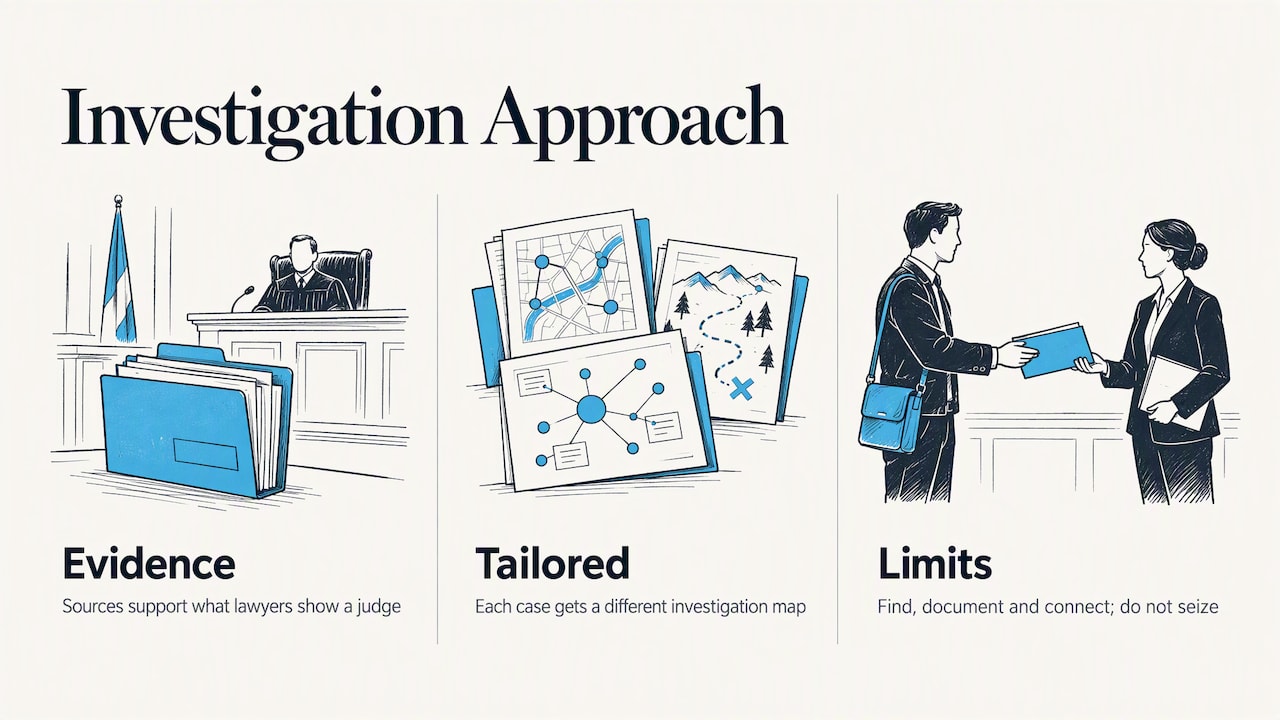
We work from the court’s point of view. Our investigators come from policing, the military and polygraph work, and that background shapes how we handle evidence. What matters is not what we personally believe about where the money went but what we can show, with sources, that a lawyer can put in front of a judge. That is also why we tailor each investigation to the client’s scenario rather than run a template: a hidden-income case, a fraud by a former partner and a business theft each need a different map.
We are also direct about limits. We do not seize or freeze anything, and we do not obtain private financial records by unlawful means. We find, document and connect, then hand over a file your legal team can act on.
— Global
Related situations we investigate
Asset questions rarely come alone. They usually sit inside something else:
- Money drained by a staff member: see our practical guide to employee theft investigations and the basics of corporate investigations.
- Claims built on false pretenses: our overview of insurance fraud investigation.
- A person who has vanished along with the money: our work on missing persons cases, including one in the UK.
- Disputes between separating partners: our family law support.
Start with an asset search that holds up
If you need to know what someone owns, controls or has moved, our asset search investigation service is built for exactly that. It starts with your objective, traces what can be traced, and documents it so it can be used in legal proceedings. We do not publish a price for it, because the scope depends on how many entities, jurisdictions and assets are involved. To discuss your situation in confidence, contact Pi Melbourne and tell us what you know so far.
FAQ
What is the difference between asset tracing and asset recovery?
Tracing is the investigative step of finding assets and proving who controls them. Recovery is the whole process, which also includes freezing the assets, obtaining a judgment or confiscation order, and returning value to the owner. Tracing is the part a private investigator does; the rest is done through courts.
Can a private investigator recover my money directly?
No. Investigators gather and document evidence, and only a court or authorized officer can freeze, seize or collect assets. A good investigator makes recovery possible by giving your lawyer a clear, lawful, well-sourced picture of what exists and who owns it.
What is the Stolen Asset Recovery Initiative (StAR)?
StAR is a partnership between the World Bank Group and the UN Office on Drugs and Crime. It does not investigate or prosecute cases. It gives technical assistance, training and policy advice to national authorities, and it runs a public database, the Asset Recovery Watch, that tracks efforts to recover proceeds of corruption.
How much of the stolen money do victims usually get back?
There is no reliable single figure for private cases, and anyone quoting one should be questioned. At the global level, INTERPOL cites that criminals keep around 99% of illegal gains, which shows why acting early and documenting thoroughly are so important. Outcomes depend on how quickly the money is traced, whether assets remain, and what the court allows.
Sources
- Eurojust: Asset recovery
- StAR: About StAR
- StAR: Frequently asked questions
- StAR: Financial investigations
- StAR: More transparency against corrupt gaming of the system
- StAR: Guide for asset recovery in France
- INTERPOL: Innovation, Silver Notice
- FATF: Asset Recovery Guidance and Best Practices
- FATF: Annual report 2023-2024
- ASIS Security Management: Half of 2025 U.S. fraud losses linked to cryptocurrency scams