
An asset search investigation is a structured effort to locate, verify and document what a person or business owns, and it is the right next step when you hold a judgment, face probate, or suspect concealment. Start by gathering your court orders, contracts and any known account or property details, then bring in a qualified investigator before the other side moves anything.
TL;DR:
- Before work begins, give the investigator court orders, contracts, known account or property details, and request a written scope and fee estimate.
- Property titles, corporate filings, liens, and vehicle registries often leave public traces, but bank balances and brokerage holdings usually require legal process or cooperation.
- Ask counsel before surveillance or other sensitive methods, and require source records and chain of custody documentation so investigators can explain how evidence was obtained.
- For offshore leads, coordinate with foreign specialists and counsel, preserve records without alerting the target, and time any freeze to avoid tipping them off.
- A basic public property search may be a starting point, but seek legal advice before investigating concealed assets, foreign holdings, or legally sensitive matters yourself.
Table of Contents
- When should you order an asset investigation?
- How does an asset search work, step by step?
- Which assets can investigators find?
- What are the legal and privacy limits?
- What happens when assets cross borders?
- How do investigators turn intelligence into court-ready evidence?
- When is a professional worth it over a DIY search?
- Ready to trace assets with court-ready evidence?
- FAQ
- Sources
When should you order an asset investigation?
Order one when you cannot afford to guess. Common triggers:
- You hold a judgment and the debtor claims to have nothing.
- A divorce or probate matter involves wealth that does not match the paperwork.
- You suspect fraud, or the counterparty lives well beyond their declared income.
- The other side is evasive, or ownership keeps shifting to relatives and new companies.
A search may help identify property records, corporate filings and liens. Bank balances and brokerage holdings may be difficult to confirm; ask a lawyer what process applies. Before you call, collect court orders, signed contracts, full names and dates of birth, and any account numbers, addresses or vehicle details you already have.
How does an asset search work, step by step?
Good investigators follow a phased workflow, similar to the identify, compile, analyze and validate sequence described in asset investigation training material.
- Scope and intake: define the targets, timeframe, objectives and legal limits, including how far to extend searches to relatives and related entities.
- Public-record discovery: search for property titles, corporate filings, liens, UCC records and bankruptcy filings.
- Financial leads: review securities filings, tax liens and corporate records for possible leads about accounts or transfers.
- Fieldwork: consider surveillance, interviews and third-party records, after confirming with counsel which methods are lawful.
- Analysis: compare spending with known income using source-and-application-of-funds methods.
- Reporting: document findings and recommend possible follow-up, subject to legal advice.
Pro Tip: Ask your investigator for a written scope before work begins. A tight scope keeps costs predictable and keeps the findings usable.
Which assets can investigators find?
Expect uneven visibility across asset types:
- Real property: title and registry records make this the most reliably discoverable category.
- Business interests: corporate filings and beneficial ownership traces show who stands behind a company.
- Bank and brokerage accounts: public traces are thin, and confirmation typically needs legal process or cooperation.
- Vehicles and registered property: registries usually reveal the titled owner.
- Cryptocurrency: on-chain tracing can follow transfers, but custodial accounts stay opaque without a court order.
- Concealment tactics: nominee owners, proxies and shell companies are common, and spotting them is a core investigative skill.
What are the legal and privacy limits?
Legality shapes everything an investigator does:
- Under the Right to Financial Privacy Act, 12 U.S.C. § 3405 requires notice and a limited chance to challenge before certain government subpoenas for customer financial records are honored.
- SAR supporting documentation follows different disclosure rules from that notice procedure.
- Before using surveillance or other investigative tactics, ask counsel which privacy rules apply and whether the approach could affect the case.
- Careful evidence preservation and chain-of-custody documentation may help support the use of findings in court.
These rules describe the US framework. If your matter sits elsewhere, ask counsel which statutes govern.
What happens when assets cross borders?
Foreign assets slow everything down. Evidence collected abroad may raise legal and coordination issues; the UNODC manual discusses coordination when securing or seizing assets.
- Information shared between financial intelligence units may help guide an inquiry; ask counsel how it can be used in court.
- Consider how and when to preserve records, taking care not to alert the target; the UNODC manual discusses this risk.
- Time any freeze carefully, because acting too soon can tip off the target.
- Escalate to foreign authorities or specialists once leads point offshore.
How do investigators turn intelligence into court-ready evidence?
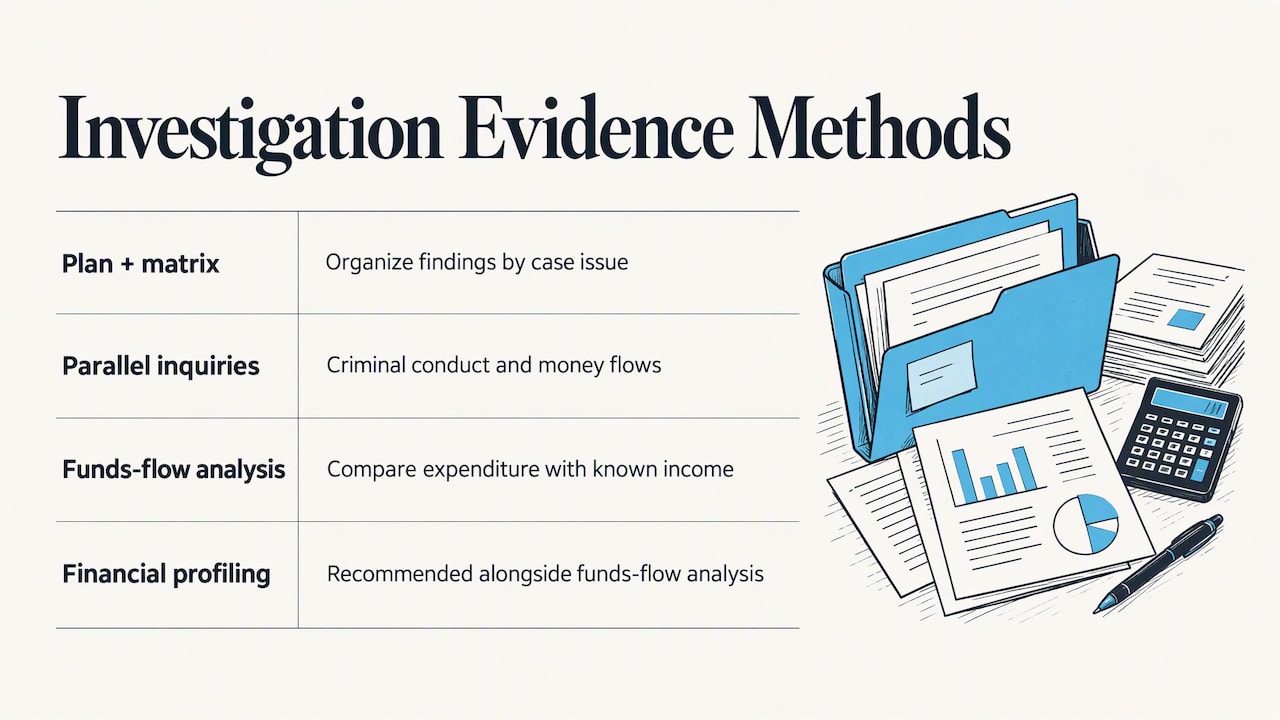
Whether findings can be used in court depends on the circumstances and applicable rules. An investigation plan and evidence matrix may help organize findings and show how each item relates to the issues in the case. Funds-flow analysis then compares expenditures with known income to expose unexplained wealth, a method the Basel Institute practitioner’s guide recommends alongside financial profiling. The Basel Institute highlights the FATF recommendation to investigate criminal conduct and related money flows in parallel. Credentials, documented methods and a clear report can help explain the work and its findings.
Pro Tip: Before hiring, ask how the investigator documents sources and chain of custody. Vague answers are a warning sign.
When is a professional worth it over a DIY search?
Some people choose to begin with public-record checks, such as looking for property-title information. Hidden, cross-border or legally sensitive cases are different: an uninformed step could alert the target or affect evidence, so seek legal advice before proceeding. Never use unlawful tactics, and consult your lawyer before any legal step.
— Global
Ready to trace assets with court-ready evidence?
Our team offers investigative services for matters involving legal proceedings. Ask us about the team’s experience and how findings are documented. Before you reach out, prepare:
- Your court orders, contracts and any known account or property details
- A clear statement of your goal: recovery, probate, or proof of concealment
- Names, addresses and dates of any relevant transactions
Request a confidential consult and we will scope your matter with you.
This article is general information, not a substitute for advice from a qualified financial advisor. Consult a qualified financial professional about your own circumstances before acting on anything here.
FAQ
How long does an asset search investigation take?
Timelines depend on scope, jurisdictions and how many assets are involved. Simple property and corporate checks move quickly, while accounts, offshore holdings and legal process take longer. Your investigator should give an estimate once the scope is fixed.
How much does an asset search cost?
Cost depends on scope, complexity and whether fieldwork or cross-border work is needed. Most professionals quote against a defined scope, so a narrower brief means a more predictable fee. Ask for a written estimate before work begins.
Can an investigator see my target’s bank accounts?
Not directly in most cases. Public records rarely expose balances, so confirming accounts usually requires legal process such as a subpoena. Investigators can identify leads and help your lawyer pursue them.
Is an asset investigation legal?
It depends on the sources and methods used and the laws that apply in your jurisdiction. Ask a lawyer before proceeding. Unlawful access to private records can harm your case. Your lawyer can confirm what applies in your jurisdiction.
Sources
No single source tells the whole story, so investigators triangulate:
- 12 USC 3405: Administrative subpena and summons
- A PRACTITIONER’S GUIDE
- Manual on International Cooperation for the Purposes of Confiscation of Proceeds of Crime
Why it matters: the Basel Institute notes that the lack of centralized account databases is a real operational challenge, which can make cross-checking sources useful when assessing leads.